No, it is not always damage-free, but markedly more often than most people believe. A door that was only slammed shut we almost always open in minutes without damage. A locked door with a modern security cylinder, on the other hand, can make drilling the cylinder necessary. The difference is not skill alone, it is the mechanics behind it.
I have also written insurance reports for 16 years. I care less about what looks impressive and more about what actually holds in the end and what was actually necessary. That rubs off. On every opening I look at the door first, then the bolt, then at the drill last.
The most important question first: slammed or locked
That is the dividing line where everything is decided. A slammed door only sits in the latch. The latch is the bevelled tongue that snaps into the strike plate when you pull the door shut. It keeps the door closed, nothing more. A door like that is, in the vast majority of cases, open in two to five minutes, with a plastic card, a spring-steel latch slip, or the classic wire from above. No damage, no new lock.
Locked means someone turned the key and threw the deadbolt. Often twice. Now a solid steel bolt sits in the strike plate, and that cannot be pushed aside. This is where it gets involved, and this is where the cylinder decides whether it goes without damage.
Say so on the phone. Really. The sentence "I only pulled it shut" versus "I locked it" shifts the effort by a factor of ten. Anyone who does not ask about that on the phone is either working sloppily or does not want to know the difference at all.
What else it depends on
Three more things weigh in:
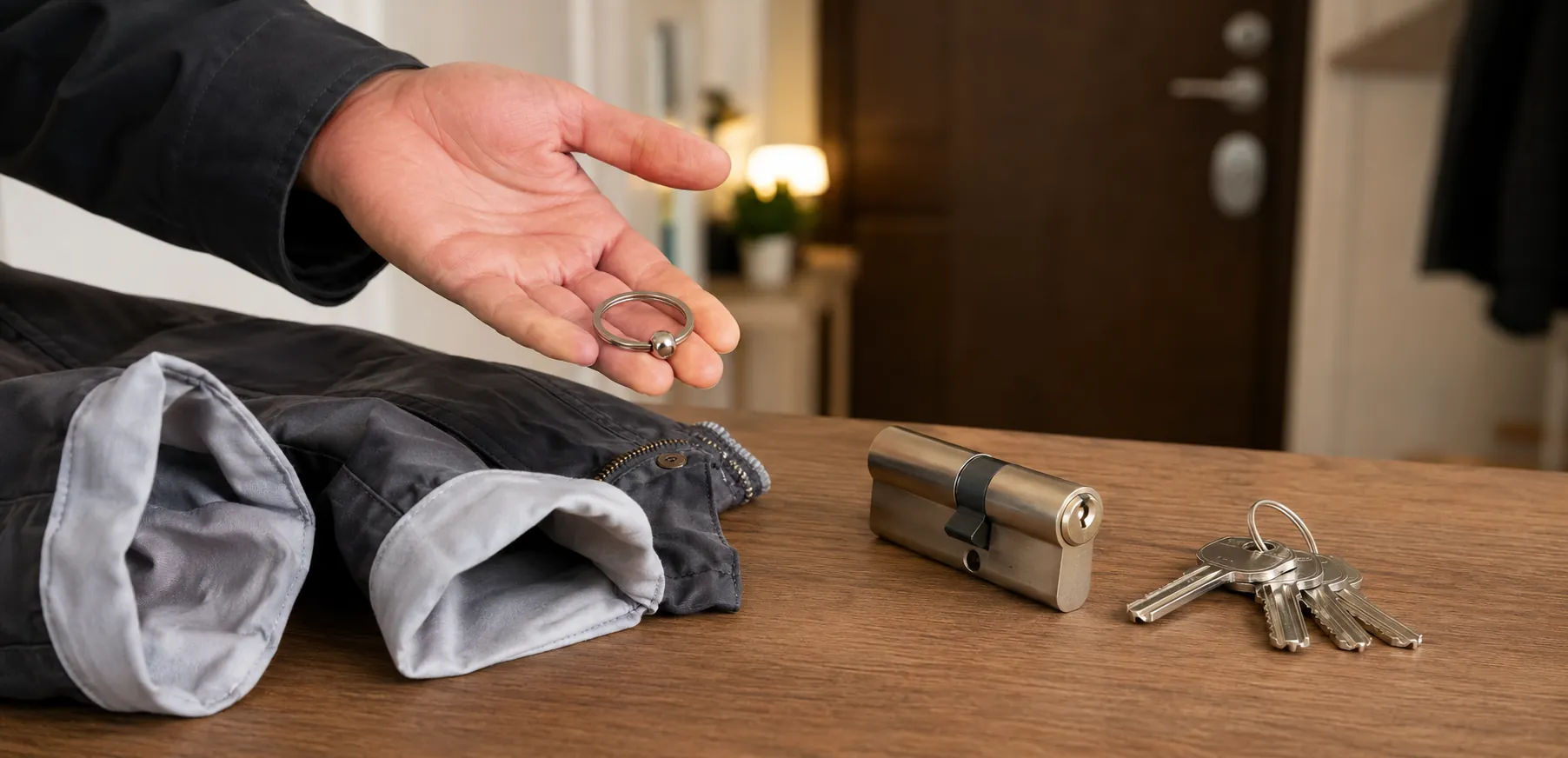
- The cylinder. A plain standard cylinder can often be picked or opened with special tools. A good security cylinder to DIN EN 1303 with drill and pull protection, from ABUS, BKS, Winkhaus or EVVA, is built precisely so that this does not happen in minutes. What protects you also slows the technician down.
- Is a key in the inside? Then it blocks the channel from within. Some tools still grip, but often you have to go a different way, and sometimes drilling is all that is left.
- The state of the door. A sagging, warped door, a jammed bolt, a worn strike plate. That kind of thing binds the mechanics, and then even a basically harmless door opens hard.
In short: the better your door is protected against burglary, the more likely a legitimate opening leaves marks. That is not a contradiction. That is the whole point. A cylinder that gives way to the burglar in two minutes gives way to me in two minutes too, and then it is worthless.
When drilling is needed, and that is completely fine
Drilling is not botched work in itself. It is the last resort when non-destructive will not work. And there are cases where there simply is no other way:
- A high-grade, thrown security cylinder with drill protection and a pull-protected core.
- A key snapped deep in the core that can no longer be gripped.
- A jammed or bent bolt that blocks mechanically.
- A door with a key on the inside, when no pull technique grips any more.
Then the cylinder is drilled in a controlled way, swapped, done. What matters is what gets destroyed in the process. With clean work only the cylinder is finished afterwards. Door, lock, fitting and strike plate stay intact. Anyone who destroys the whole lock or the fitting while drilling has either bad tools or no idea.
What a cylinder swap then costs is modest. Here are the honest figures from Frankfurt:
| Service | realistic price |
|---|---|
| Standard cylinder (part) | 15 to 40 euros |
| Security cylinder DIN EN 1303 (part) | 60 to 150 euros |
| open a slammed door, daytime | 80 to 150 euros |
| the same at night, weekend, holiday | 150 to 250 euros |
| drilling plus new standard cylinder, fitted | usually 120 to 220 euros |
If someone writes 540 euros for a slammed door on a Sunday morning, something is wrong. More on that in a moment. The full price range with night and weekend surcharges is on our pricing page.
Locked out and in a hurry?
Price quoted up front, vetted partner business, ~22 minutes on site.
The real problem: drilling when it is not needed
Here is where it gets annoying, and here is where the actual fraud sits. Drilling a door that was only slammed shut is almost always a sign that someone either cannot do it or wants to bill faster. The fresh cylinder they then sell is their business, not your need.
Last year a case from Ostend crossed my desk as a report for the contents insurer. A slammed, unlocked flat door. The invoice listed a drilled cylinder plus a new lock, 540 euros. The latch could have been pushed back in three minutes. I looked at the door, the old cylinder was still in the rubbish in the stairwell. Drill marks centred, clean, deliberate. Someone there knew what they were doing and did it anyway. The insurer did not reimburse the markup, the customer was left with the difference. Those are exactly the cases I mean.
Another case, two months ago in Bockenheim. An older lady, evening, key left in the inside, door pulled shut. The first provider on the phone named no price, came, drilled at once. She broke it off out of suspicion and called us. We gripped the key from the inside with a pull technique and opened the door without a single scratch. Cost: a normal door opening, no new cylinder. The difference was not the lock. The difference was the intent.
How to spot needless drilling
- The door was only slammed, and the drill comes out at once anyway.
- No attempt at all is made to open non-destructively first.
- There was no price range up front, no callout fee, nothing in writing.
- They advertise a free 0800 number, but nobody on the phone names a price.
- Cash only, ideally right away, ideally without a receipt.
How to see through all of that early is spelled out in detail in the guide on spotting dodgy providers. When three of those points come together, hang up.
And if I want to upgrade my burglary protection
Many people ask me after an opening like that whether they should now upgrade. Often yes, but in measure. A security cylinder with an emergency-and-danger function costs 60 to 150 euros as a part and makes sure you are never locked out again when a key is in the inside. A protective fitting to DIN 18257 ES1 or ES2 protects the cylinder from being torn off. Anyone who wants more looks at a whole door to DIN EN 1627 in resistance class RC2 or RC3.
What really pays off and what only looks expensive, we advise honestly on the topic of burglary protection. Not every door needs RC3. But every flat door benefits from a proper cylinder and a protective fitting. The Federal Criminal Police Office has shown for years in the Police Crime Statistics that a large share of home burglaries stalls at the attempt stage because the mechanics hold out too long. Those exact minutes are what you buy with a good fitting.
What to do concretely in an emergency
Short and practical, so you do not overpay:
- Check whether the door is really locked or only slammed. Press the handle, jiggle it lightly.
- Say exactly what the situation is on the phone. Slammed or locked, is a key in the inside, which district.
- Have them name a price range before anyone sets off. Callout plus opening, roughly.
- Insist that non-destructive is tried first.
- Have them explain, before drilling, why it is necessary, and ideally show you.
In an emergency our emergency service helps and tells you up front what to expect. If you would rather clear up questions beforehand, you can do that through contact.
Short, because it is the core: damage-free opening is the norm, drilling the justified exception. Get suspicious not when drilling happens, but when it happens with no reason and no attempt. You recognise an honest opening by the fact that, in the end, only what had to be destroyed is destroyed, and not one cent more.