Here is the honest answer up front: with a jammed safe you call the manufacturer first, not the nearest locksmith. If the safe is still under warranty or an emergency opening via a factory code is possible, you save a hundred euros or more. Only when the manufacturer cannot help does the on-site specialist come in. And that specialist does not drill first. That is the single most important rule there is.
I have advised on locking technology for twelve years, and safes land on my desk more often than people think. Usually not because something is broken. But because someone is in a panic and calls the wrong person straight away.
Why does a safe jam at all?
In nine of ten cases I see, it is not a defect but a flat battery in the electronic lock. Swap the batteries for fresh brand-name cells and the problem often clears in a minute. Cheap no-name batteries from a drugstore bargain bin? Leave them. They give out too early under load, and that is exactly what happens when the boltwork is driven.
On many models there is an external emergency contact where you hold a 9-volt block battery. Burg-Waechter and Format do it this way. You press the battery onto the contacts, enter the code, and the bolt retracts. Try that before anyone unpacks a tool.
The second common cause: a bent or broken key in a double-bit lock. Do not yank at it, that only drives the broken piece deeper. Do not pour WD-40 into the lock either, over time it gums up the mechanism. Leave the bit inside and make the call.
And third, the forgotten code. A classic. That is exactly what the manufacturer has a proof-of-ownership procedure for.
The most common causes at a glance
- Flat battery in the electronic lock (by far number one)
- Broken or bent double-bit key
- Forgotten or mistyped code, keypad locks after several failed attempts
- Worn boltwork in old models that were never serviced
- Safe closed under load, door slightly canted when pushed shut
For the keypad lockout, the rule is: wait. Many electronic locks block for a few minutes after three or five wrong entries. That is not a defect, that is by design. Take your hands away, sit out the lockout time, then enter the correct code slowly and once.
Manufacturer first, and exactly why
Brands like Format, Burg-Waechter or Hartmann Tresore run an emergency service with factory codes. You prove the safe is yours with a receipt or serial number, and you often get an opening code or an authorised technician. That route is clean, documented and, if it matters, insurance-compliant.
That last point is decisive, and almost nobody talks about it. If your safe holds valuables covered by your home contents insurance, an improper opening can cause trouble. Let someone drill at random and you risk the proof. The factory route documents cleanly that you are the owner and everything was in order.
You usually find the serial number on the inside of the door, on the back, or in the purchase papers. Note it down, ideally today, photograph it and keep the photo somewhere safe outside the safe. Sounds trivial. In an emergency it saves you half a day.
Last month I had a case in Westend. A customer in a panic, family jewellery inside, code gone. We did not drill. One call to the manufacturer, serial number passed on, and the factory code arrived the next morning. My on-site cost: 90 euros for the visit and supervision instead of 400 euros for drilling. That is the difference. And the jewellery was sitting inside, untouched.
When the locksmith is the right call
There are situations where there is no way around the on-site specialist. No receipt, an old safe without a serial number, a manufacturer out of business or gone entirely, or a genuine emergency with documents you need right now. Passport gone, appointment tomorrow morning, nobody reaches the factory service. Then an experienced technician opens it.
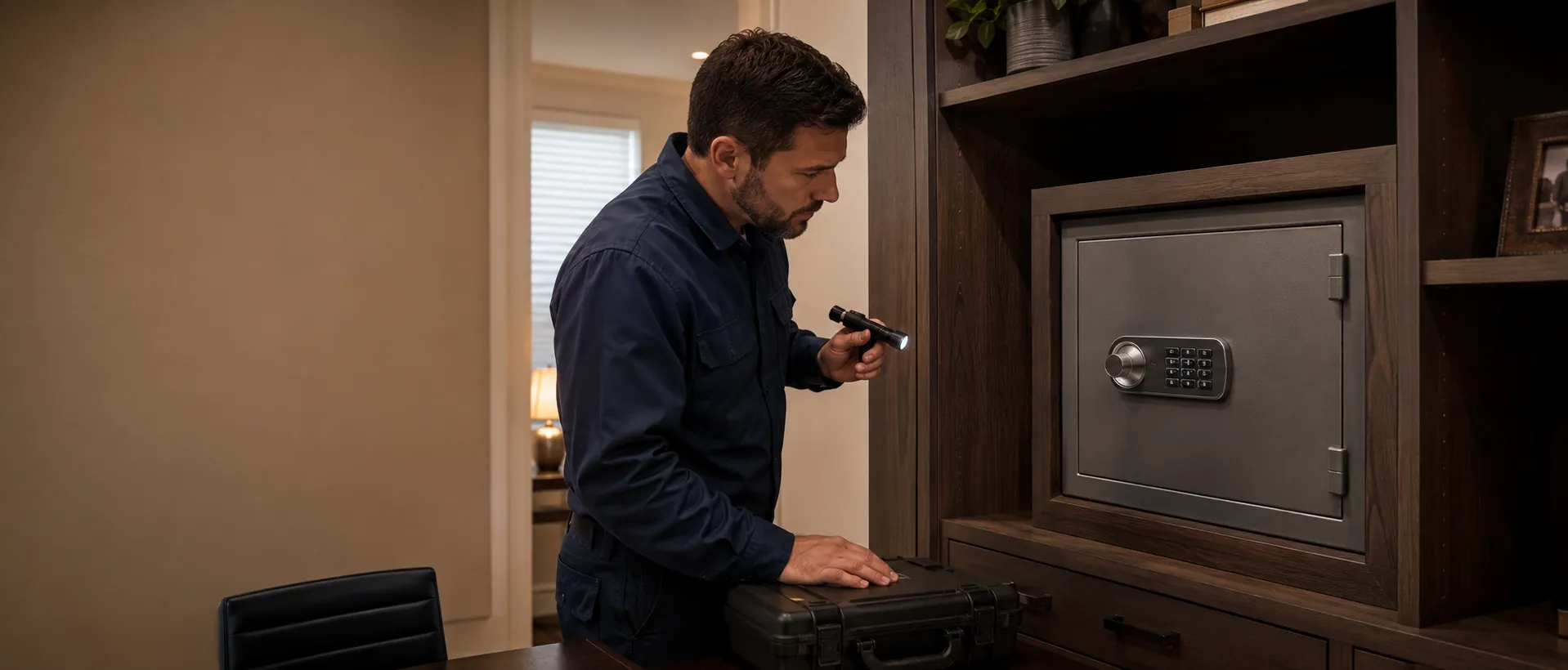
First by manipulation, meaning without damage. That works on more locks than most people believe. A good safe technician knows the weak points of the common boltworks and gets them open without destruction. Only when that fails does core drilling come in as the last stage. Targeted, at a defined spot, with the lock repaired afterwards.
Drilling is always the last stage, never the first move. If a firm starts talking about drilling on the phone before it even knows the brand, hang up.
A second story from practice
The week before last, a call from Bornheim. An older gentleman, an inherited security cabinet from his father, no code, no papers, the manufacturer gone since the nineties. Here the factory route was dead. We opened the cabinet by manipulation, without a single hole. It took two hours, it was patient work, it cost 220 euros. The man had braced for the worst, for an angle grinder and noise. Instead the door opened quietly. That is exactly what we are here for.
Locked out and in a hurry?
Price quoted up front, vetted partner business, ~22 minutes on site.
What a safe opening costs in Frankfurt
Let us talk money, without the waffle. The price depends heavily on whether it can be opened by manipulation or has to be drilled, and on the security grade under EN 1143-1.
| Service | Realistic range |
|---|---|
| Battery swap / emergency power, on-site advice | 70 to 120 EUR |
| Manipulative opening, no damage | 120 to 250 EUR |
| Core drilling with lock repair | 300 to 500 EUR |
| High-grade security cabinet, higher class | from 450 EUR upwards |
These figures are realistic for a plain safe opening in Frankfurt. With a heavy security cabinet of grade III or higher it can get markedly more expensive, because the wall thickness and the boltwork are built differently. That is not a rip-off, that is material effort.
Always have the range named up front, on the phone, before anyone sets off. Exactly as with any reputable door opening. Anyone who will not give a price frame does not come. You will find rough guidance on fair rates on our price overview as well.
One more thing about night work. A safe rarely runs away from you. Unlike a slammed flat door that leaves you standing outside, with a jammed safe you can wait until the next morning in almost every case. Save yourself the night surcharge if nothing is on fire. Call during the day, calm and prepared.
How to recognise a reputable firm
A firm that wants to drill straight away without asking about brand and lock is the wrong one. Anyone who really understands safes asks first about manufacturer, lock type and security grade before they even talk about a method.
Watch for these points:
- A clear price frame on the phone, no excuses
- Questions about brand, model, lock type and serial number
- Manipulation before drilling, not the other way round
- No bare 0800 number with no address behind it
- An invoice with itemised work, no cash payment under pressure
How to spot dodgy providers in general, with all the tricks of the trade, is laid out in detail in our guide on recognising rip-offs. Read that once in peace before the emergency hits. That is the best preparation there is.
Quick questions, quick answers
Can I drill the safe open myself? Leave it. You destroy the boltwork in the wrong place, often damage the contents and ruin any insurance proof. A targeted core drilling belongs in trained hands.
My code no longer works even though it is correct. Now what? First swap the battery, then sit out the lockout time, then enter it slowly and exactly once. If that does not help, it is a case for the factory service or the technician.
Does insurance cover the opening? For a pure lock defect, often not automatically. Check your policy. What matters is clean documentation of the opening, otherwise it gets sticky.
How do I protect myself against next time? Write the code down and store it safely, photograph the serial number, change the batteries once a year, ideally at the same appointment as your smoke detector.
The most important thing in one sentence
Stay calm, manufacturer first, and let nobody drill who does not have to. When it comes to that and the safe genuinely has to be opened on site, you will find everything on a proper safe opening with us, and in a real emergency you reach us through the emergency service. A jammed safe is almost never a drama. Most of the time it is a battery and a phone call.