Straight to it, because in business the numbers decide. You do not secure an office or shop in Frankfurt's banking district with an expensive safe, but with a well-planned locking system, clean access control, and cylinders whose keys cannot be copied at the hardware store. That is exactly where most commercial customers I advise in the Innenstadt fall short.
In 22 years I have learned one thing. The biggest risk in an office is not the night-time break-in but the key that stayed with a former employee. Safes are easy to sell. A properly documented locking system that nobody slips past is the real work.
What actually matters in a commercial setting
In a private home it is about one front door. In a business it is about responsibility towards staff, customers, the insurer, and sometimes files that fall under confidentiality. Three things decide whether a property is secure.
- Who gets in where, and who decides that.
- What the door can withstand mechanically before someone is inside.
- How fast you can remove a lost or withheld key from the system.
Point three is almost always underestimated. A shop window in the banking district is exposed, sure. But the most common damage I document is not smashed glass, it is an employee who still had a key to the store room after being dismissed. No camera catches that.
The locking system is half the battle
In an office with several rooms, a store and a server room, you do not want to hand out twenty keys. A locking system with a hierarchy solves this cleanly. The manager opens everything. The cleaners only the entrance. IT only the server room. That is not bureaucracy, it is hygiene.
The key point is a patent-protected system whose keys can only be reordered with a security card. Otherwise a key walks off after every dismissal, and in the worst case a copy is already sitting at the hardware store around the corner. Patent protection means the blank is protected and nobody gets a duplicate without your card. EVVA, Winkhaus or Kaba have built such systems for decades. How such a system is built and what it costs is in our overview of locking systems.
A master key is not always a master key
There is a difference between a real locking system and a stack of keyed-alike cylinders. In a proper system every door has its own individual key, with a hierarchy above it. If a single key is lost, you block exactly that one, not the whole building.
Last week in Bockenheim. A tax firm with six rooms had all doors keyed alike, so one key opened everything. A temp lost her key on the bus. With that, essentially every door was open, including the archive with client files. We converted the whole floor to a real system with a hierarchy. Cost around 1,900 euros for twelve cylinders including keys and a locking plan. Expensive? Compared to a reporting obligation over a data breach, it was a bargain.
Locked out and in a hurry?
Price quoted up front, vetted partner business, ~22 minutes on site.
Cylinder and fitting: do not save at the wrong end
For business I recommend high-class cylinders to DIN EN 1303, with anti-drill and pull protection, plus a solid protective fitting to DIN 18257, at least ES1, ES2 for exposed entrances. Brands like Winkhaus, BKS or Kaba are standard in commercial use. A good security cylinder costs 60 to 150 euros as a part, the protective fitting roughly the same again. That is nothing compared to the contents of an office. Save here, and you pay many times over at the first break-in.
One thing many business owners do not know. A protective fitting with core-pull protection is often more important than the cylinder itself. The most common attack on an office entrance door is not picking, that is cinema. It is pulling the cylinder with a screw and pliers in under thirty seconds. A fitting that covers and protects the cylinder takes the ground out of that attack.
Two months ago, a law office near the Alte Oper. Glass door, pretty, but a standard cylinder with no protection. One attempt had already left marks, the cylinder was centre-punched. We switched to an ABUS security cylinder with pull protection, a cross bar and a small access control, around 640 euros for the entrance door, fitting included. Quiet ever since, and the insurer was satisfied. More on the mechanical basics is in burglary protection.
Glass and shop doors are their own subject
The prettiest glass front is useless if the bolt only reaches one centimetre. A multi-point lock that engages top and bottom into the frame holds far longer than a single bolt. For shop windows, throw-resistant glazing pays off on top, especially in busy spots around the Zeil and the Innenstadt, where almost nobody passes at night.
For shop doors with profile frames I look at the door as a whole. An RC2 fitting to DIN EN 1627 on a warped door with a worn frame is money thrown away. The frame first, then the lock. In that order.
Access control: only as much as you need
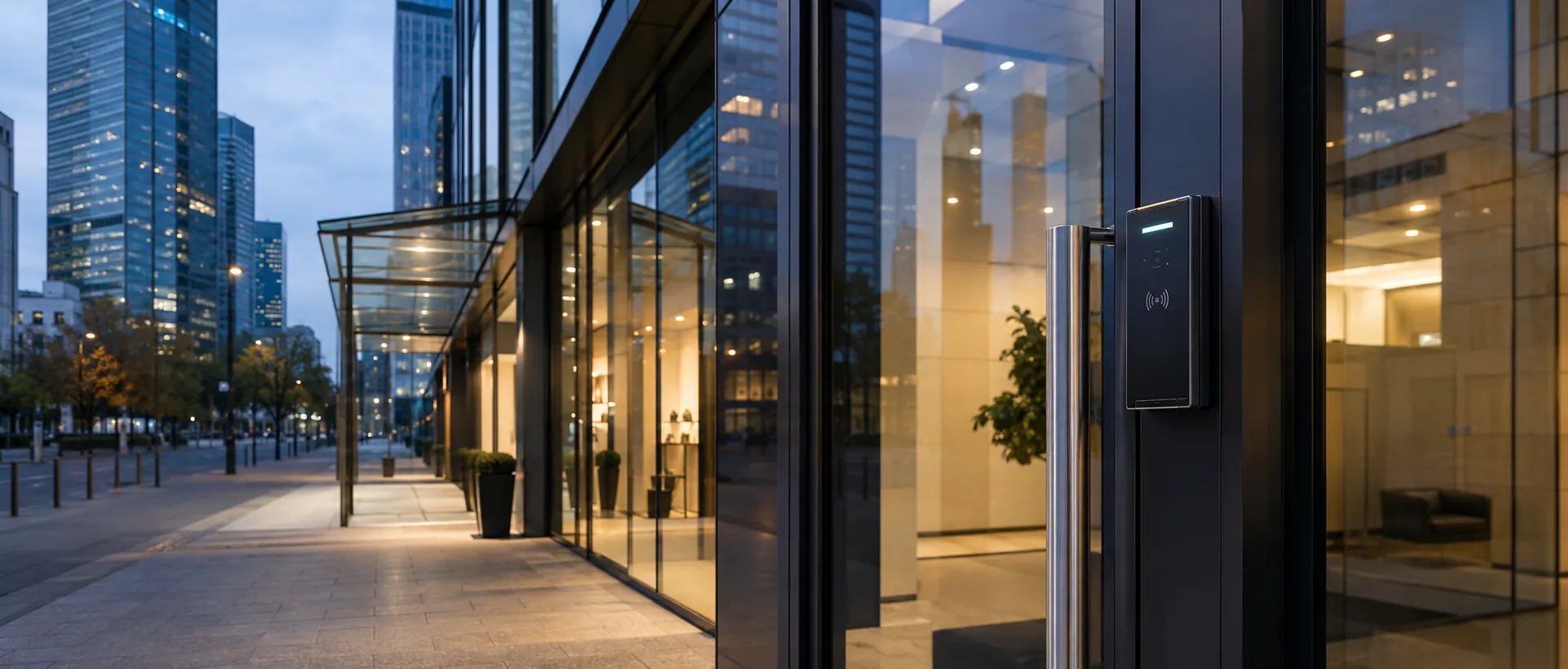
Electronic access control makes sense in the banking district because you can block a key without swapping the cylinder. An employee leaves, you block the transponder, done. That solves exactly the problem I named above as the biggest risk. But do not overdo it. A small office needs no full biometric kit with a face scanner.
My sober advice on choosing:
- Up to five employees, a good mechanical system with a security card is often enough. Key gone, new cylinder, done.
- From ten employees or high turnover, electronic access control with transponders pays off. Block instead of swap.
- Biometrics only where real value or sensitive data sits. Server room, vault room, store with expensive goods.
- Stay away from cheap WiFi locks from the online shop for a commercial entrance door. If the network drops, you are standing outside.
What the insurer wants to see
Insurers often prescribe concrete requirements for business. At higher sums insured they demand tested burglary protection, documented to standard, sometimes an alarm system to VdS. Read your policy before you invest, otherwise you buy past the requirement. If you want to talk requirements with the insurer, the consumer advice centre and the guide on home insurance and locks are a good basis.
A detail from practice. In a claim the insurer usually wants to see that the door was locked, not just pulled shut. Teach your staff to lock up in the evening. A glass door merely pulled shut is open in under a minute, locked it costs far more time and noise.
Quick answers to common questions
Does a small office even need a locking system? As soon as you have more than two doors with different access rights, yes. Otherwise you hand out keys you never collect again.
What does the initial setup cost roughly? A simple system for a small practice or firm often runs 1,500 to 2,500 euros including fitting. A single well-secured entrance door with cylinder, fitting and cross bar runs around 500 to 800 euros.
Smart lock or mechanical for the entrance? For the outer business door, mechanical remains the base. Electronics go on top, not instead of the mechanics. A cylinder that resists pulling cannot be replaced by an app.
Who pays if an employee loses the master key? In business this is often settled by contract, and the loss can be substantial if the whole system has to be recoded. That is exactly why I argue for individual keys with a hierarchy instead of a master key everyone carries.
How often should I review who holds which key? At least once a year, and immediately after anyone leaves. Keep a simple key list with names and dates. It costs you ten minutes and saves you a full recoding when something goes missing and nobody can say who had what.
Bottom line. You secure a business with structure, not with fear. A clean locking system, good cylinders and controlled keys beat any expensive gadget. Get advice on site instead of buying an off-the-shelf package. I look at the door, ask who needs to be where and when, and build you a locking plan that fits your operation. Get in touch through our contact, and if it is urgent, through the emergency service.