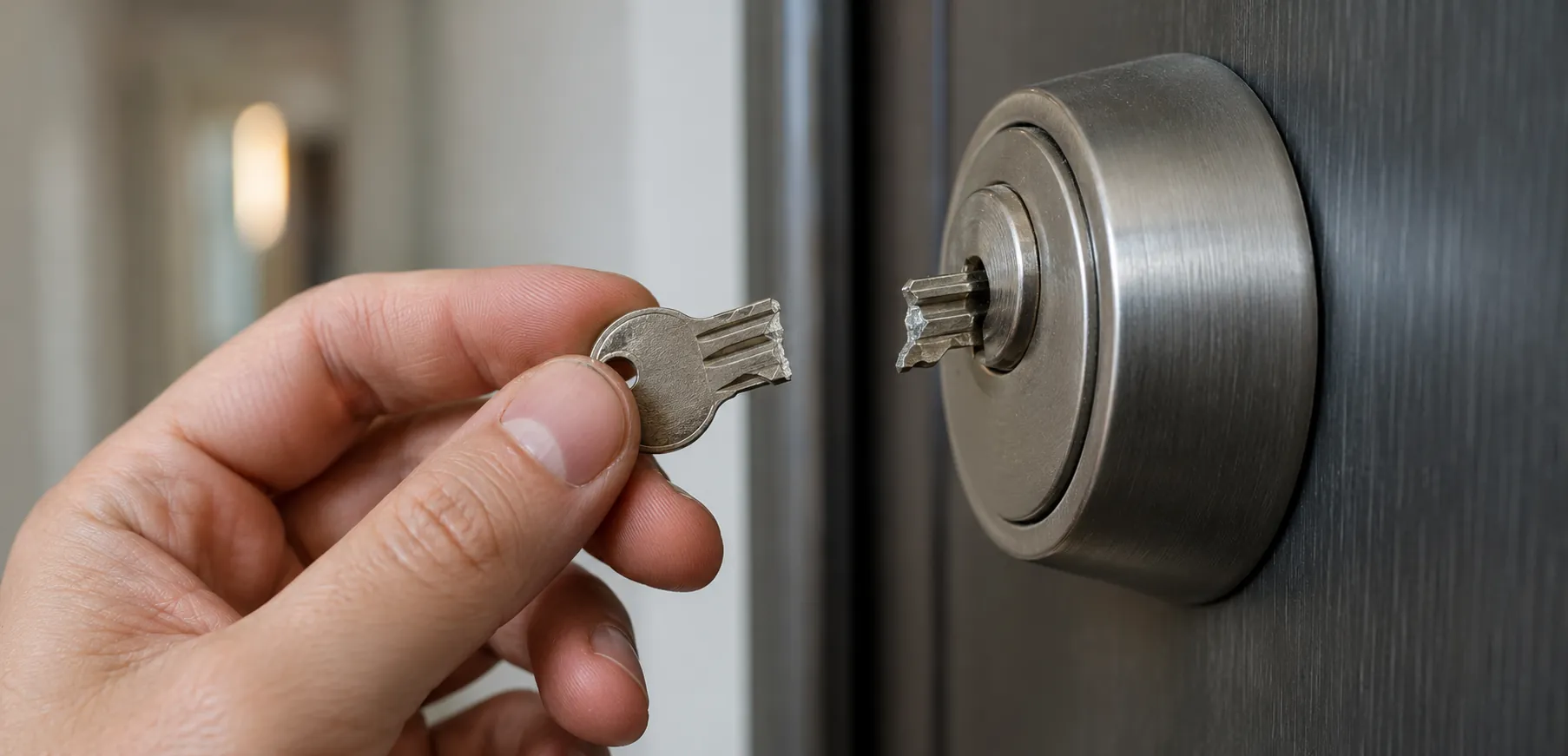
If your key has snapped inside the cylinder, rule one: stop turning and do not push the second key in after it. In most cases the broken piece can be pulled without wrecking the cylinder, and during the day that costs you 80 to 130 euros rather than a full lock swap. Stay calm. Smear nothing into it. Those are the two things that decide whether this stays cheap or gets expensive.
I am a locking-systems technician, eleven years now, and I have done this hundreds of times. Sometimes in five minutes, sometimes in an hour. What matters is the state the fragment is in and where exactly it sits. That is exactly what I am going to walk you through, step by step.
The first 60 seconds: what to do and what to leave alone
Before you grab any tool, take a breath. Most of the damage I see does not come from the break itself, but from the panic in the three minutes that follow.
Do this:
- Leave the fragment sitting where it is. Do not tap it, do not push it in.
- Look closely: is a stub sticking out, is it flush, or has it slid in deeper?
- Check whether the cylinder is still in the rest position, the position where you would normally withdraw the key.
Leave this alone:
- Pushing the second key in after it to force the stub out. That just jams both.
- Pouring oil, WD40, penetrating oil or grease in. More on that shortly, it is the most expensive mistake of all.
- Forcing it round in the hope that it will somehow open.
Why the cylinder position matters so much
A profile cylinder has several little pins inside, the wafers. When the key sits in the rest position, those pins lie flat at the shear line. In any other position they press against the bit at an angle, and that is exactly when the fragment jams rock solid. If the broken stub peeks out a little, gently turn it back to the straight position before you pull. That alone saves a surprising number of cylinders.
Is a stub still sticking out?
Then you have a real chance of freeing it yourself, and I genuinely encourage you to try. Grip the piece with thin needle-nose pliers or a sturdy pair of tweezers. Pull straight out, evenly, without wiggling. No jerking. A single drop of graphite or silicone spray may touch the edge, no more.
The direction of pull is what counts. You pull along the axis of the keyway, not up or down. Pull at an angle and the bit tilts and shears again, and then you are stuck with a much shorter piece.
If the piece moves a millimetre and then catches again, do not force it round. Reset, check the cylinder position, and pull calmly once more. For me that is exactly the moment the fragment comes out in nine cases out of ten.
Is it flush or sitting deeper?
Now it gets tricky, and this is where self-help parts ways with professional work. There are these small key extractors, thin flexible saw blades with a barbed tip. You slide one alongside the bit, hook into one of the key cuts, and pull both out together.
In trained hands it is a wonderful tool. In untrained ones the things tilt, snap off, or push the piece in deeper. I carry a whole set in different gauges, and even I sometimes need three attempts.
My honest advice: if you do not have an extractor at home, do not go buy one at midnight. And the bent hook from a paperclip is no substitute, it just snaps off too. A door opening by someone who does this daily is almost always cheaper than a ruined brand cylinder from ABUS, Winkhaus or BKS. What such a callout realistically costs is laid out transparently on our pricing page.
The little hot-glue trick
There is one method that sometimes works, and I only mention it because it is far more harmless than superglue. You put a tiny drop of hot glue on the end of a matchstick or thin stick, press it briefly against the fragment, let it set for two minutes and pull. Hot glue comes off cleanly, superglue never does. Even so: only if the stub is cleanly accessible. If the piece sits deep and at an angle, leave this one too.
The mistakes I see most often
The classics, in exactly the order they land on my bench. Every single one turns a five-minute job into a cylinder swap.
- Superglue, to stick the key stub to the fragment. Almost never works and reliably glues the whole cylinder solid. Hands off.
- Forcing it round until the bit shears off too. A simple problem turns into a drilling job.
- Wires, hairpins, straightened paperclips. They snap off too, and then there are two pieces stuck in there instead of one.
- Holding a vacuum cleaner to the keyway. Sounds clever, but it just pulls at a piece that is firmly wedged, and nothing happens.
- Cutting or drilling into it because a video showed it that way. That ruins the surrounding lock as well.
Last week in Gallus
Let me tell you a case from last week, because it is almost a textbook example. A tenant in Gallus snaps the key in his flat door in the evening. In desperation he tips half a can of penetrating oil into the cylinder, hoping everything will then slide.
The next morning he called me. Overnight the oil had bound the dust inside the cylinder into a thick paste, and the bit would not move at all. Without the oil I would have pulled the piece in five minutes. Instead a new security cylinder was due, around 95 euros plus fitting. The oil saved him nothing and cost him everything.
And last month in Bornheim
Different case, different ending. An older lady in Bornheim, key snapped in the evening, the stub stood two millimetres out. She called me before she tried anything. Exactly right. I was there in twenty minutes, turned the cylinder to the straight position, gripped the piece with tweezers and pulled. Twelve minutes, done, cylinder intact. During the day it would have been a standard callout. Because it was evening, it came to around 140 euros with the trip, still clearly cheaper than a new cylinder plus labour.
Locked out and in a hurry?
Price quoted up front, vetted partner business, ~22 minutes on site.
When the cylinder really has to come out
Sometimes nothing helps. If the key broke right at the point where the wafers sit, or material has wedged itself in sideways, there is no way around a replacement. That is no drama, and it is no rip-off either, as long as someone tells you up front and names the price.
Here are the ballpark figures you should expect:
| Item | Realistic price |
|---|---|
| Pulling the fragment, daytime | 80 to 130 euros |
| Pulling the fragment, evening/weekend | 140 to 220 euros |
| Standard cylinder as a part | 15 to 40 euros |
| Security cylinder to DIN EN 1303 | 60 to 150 euros |
| Fitting the cylinder, labour | usually included in the callout price |
What actually makes sense during a lock replacement and what to watch for in the security class, we have written up separately. My position: if the cylinder has to come out anyway, do not take the cheapest hardware-store cylinder, but one with drill protection and an emergency function, so it can be unlocked from inside even when a key is in the outside.
Why keys break in the first place
A key rarely breaks out of a clear sky. Usually it had been tired for a long time, and the break is just the finale. The typical causes turn up again and again:
- A worn-out cylinder. The key catches, you turn with more force, and at some point the metal gives.
- The crooked spare that has dangled on the ring for years, fatiguing a little more with every turn.
- Cheap copies cut from soft material. A properly milled key in nickel silver holds, a cast bargain blank does not.
- Dry, dirty locking mechanics. Without care, every turn becomes a strain.
When a key breaks with no warning, have a clean copy cut while you are at it and throw the crooked spare away. Maintain the cylinder once or twice a year with the right product. Why a key spins freely in the lock and what that has to do with wear is in the linked piece.
Common questions, answered briefly
Can I just keep using the cylinder with the fragment in it? No. As long as the piece is stuck in there, neither you nor a key can reach the wafers. It has to come out.
Will insurance cover it? For plain wear, usually not. If the key broke during an attempted break-in, your contents insurance may step in. How high the risk in Frankfurt even is can be read from the police crime statistics of the BKA, which show the trend in residential burglary.
Tenant or landlord, who pays? Depends on the cause. Normal wear is often the landlord's matter, a bent private spare key rather not. When in doubt, a look at tenancy law or a call to us helps.
Is it worth owning an extractor at home? Only if you are willing to practise calmly. For the one-off emergency at midnight, the phone call is the better investment.
My bottom line
Stay calm, smear nothing into it, and when in doubt have the fragment pulled rather than sacrifice the whole cylinder. A snapped key is almost never the end of the world it seems to be in the moment. If the stub still peeks out, try the tweezers with a steady hand. If it sits deep, or you are unsure, call before you make it worse. We come out on emergency in the evening and at the weekend too, and most of the time we drive off again with the cylinder intact. Any questions beforehand we are happy to clear up via contact.