When your key spins freely and the bolt does not move, almost always the cam or the driver inside the cylinder has snapped. Drilling for this is rarely needed. In the vast majority of cases the cylinder has to come out and a new one go in, and that is routine, not a drama. Take a breath. Then we work through it in order.
I actually specialise in smart locks, but that is exactly why I see this fault all the time. People upgrade their door with a motorised lock or a retrofit drive and forget the cylinder underneath. By then it is ten years old, cheap, and one day it breaks. Smart or not, the mechanics underneath have to be right.
What is really broken inside
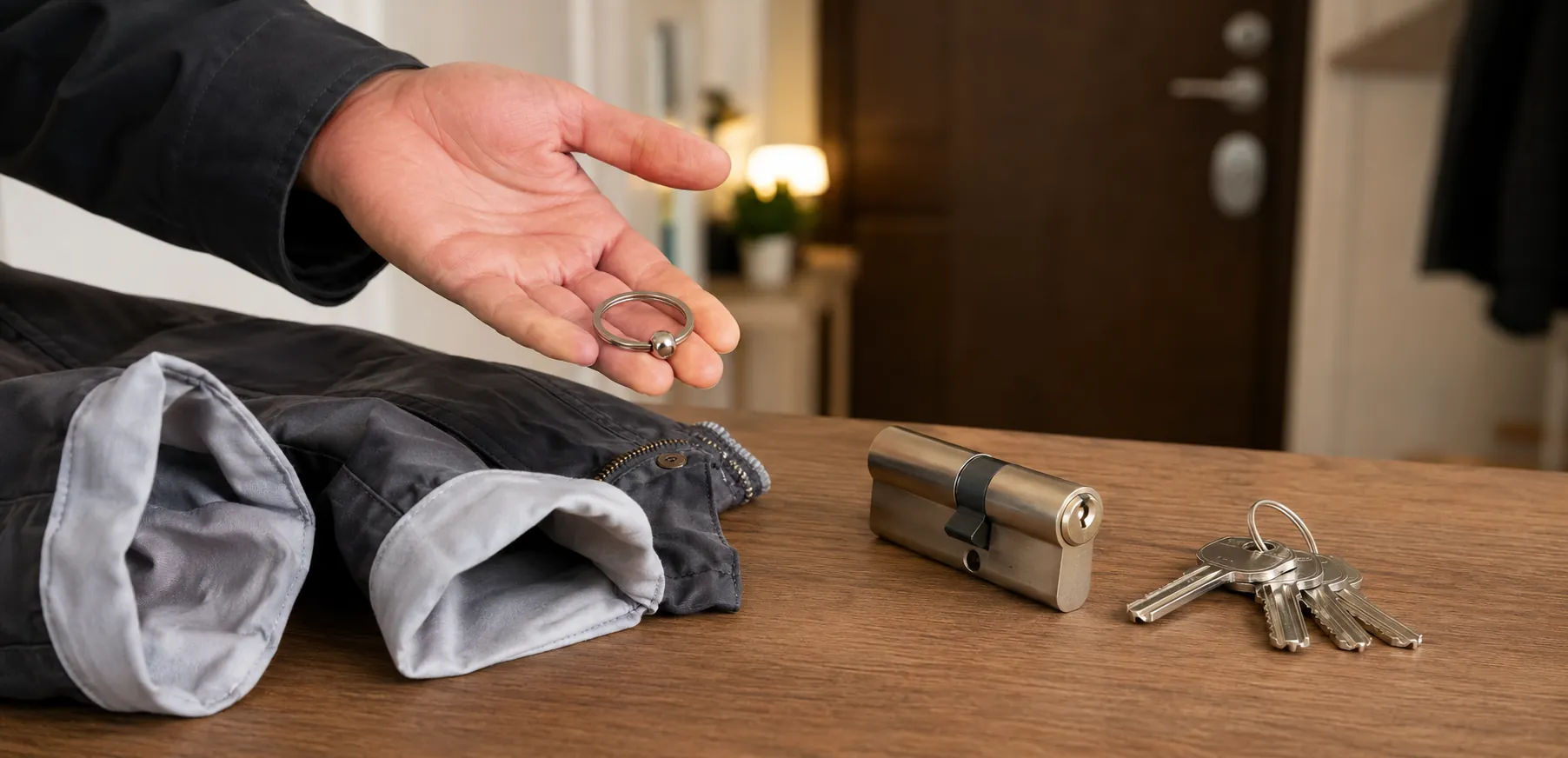
A profile cylinder has a small lug at the end, the cam. When you turn, it pushes the bolt. This exact part, or the coupling behind it, breaks over time. Especially with eight-euro hardware-store cylinders. Or after years of forcing the door shut with a jiggle and brute strength.
You often feel it coming weeks earlier. The key gets stiff. You have to wiggle a bit, pull a bit. Then one morning it spins free and nothing happens anymore. This is not a sudden death, it is wear with plenty of warning.
There are three typical causes, and they cost different amounts:
- Cam snapped off. The lug is gone, the key turns, but nothing catches. The cylinder has to come out.
- Coupling in the cylinder failed. With an emergency function there is a coupling inside. If it breaks, it also turns empty. Again: new cylinder.
- Worn key. A cheap blank copied many times no longer catches the pins cleanly. Here a fresh, properly cut key is often enough.
The quick self-test with the spare key
Before you call anyone: do you have a spare key? Try it. If that one turns cleanly and the bolt moves, the key was the problem, not the cylinder. Then you do not need an emergency call-out, just a proper spare cut at a specialist shop. That quickly saves you a hundred euros.
If the spare also spins free, it is the cylinder. Clear case, no more guessing.
Door open or locked out? That decides everything
Now the most important point most guides leave out. Are you standing inside with the door open, or are you locked out? That makes a huge difference to the price.
Door open means plannable. You book a calm appointment, during the day, at the normal rate. Nobody has to come out at three in the morning. Locked out means emergency, and the price climbs with the clock and with the day of the week.
Last week a customer in Gallus. Her key spun free at seven in the morning, the child due at nursery, her own shift waiting. Luckily the door was open. We came at midday, fitted a new ABUS cylinder, done. 35 euros for the cylinder, just under 80 euros labour during the day. Had she been stuck outside, it would have cost noticeably more, and she would have spent half the morning in the stairwell.
Quite different two days later in Bornheim. A young man, Sunday evening, key snapped off in the lock because the cam was already cracked. Door shut, him outside, no spare with a neighbour. That is the case where the weekend and evening surcharge kicks in. We opened it without drilling, because the broken stub could be pulled, and then swapped the cylinder. Still: Sunday is Sunday.
What does it cost, honestly reckoned
Here is the range you can count on. No bait prices, just what is genuinely fair in Frankfurt.
| Item | Realistic price |
|---|---|
| Standard cylinder (part) | 15 to 40 euros |
| Security cylinder with drill protection (part) | 60 to 150 euros |
| Door opening during the day, simple | approx. 80 to 150 euros |
| Surcharge at night, weekend, holiday | up to approx. 150 to 250 euros total |
| Cylinder swap labour, during the day | usually in the low two-figure range |
During the day and with the door open this is a cheap appointment. The exact figures are on our pricing page, and when it comes to the actual swap, read the guide on lock replacement. If you want to know what fair night and weekend surcharges look like, see our piece on night and weekend rates.
A word on phone quotes. If someone refuses to name a price on the phone, has an 0800 number and puts you through to a call centre somewhere, hang up. If someone wants to drill an open door, even more so. You do not drill an open door. Full stop. How to spot these outfits is in the guide on recognising rip-offs.
Locked out and in a hurry?
Price quoted up front, vetted partner business, ~22 minutes on site.
Which cylinder you should switch to
If the cylinder has to come out anyway, do not put the eight-euro block back in. That is money thrown away. Watch three things.
First, the length. A cylinder has to sit flush inside and out. If it sticks out more than three millimetres on the outside, that is an invitation for a break-in, that is where the pliers grab. We measure that on site, it is part of the job.
Second, the security grade. Look for a sensible rating to DIN EN 1303, and on the fitting side a protective escutcheon to DIN 18257, at least ES1. Brands I trust: ABUS, BKS, Winkhaus, EVVA. With no-name bargain-bin cylinders I am out, something breaks again in two years.
Third, drill and pull protection. A security cylinder with hardened pins and anti-drill protection costs a little more, but lasts for years and makes a real difference for burglary protection. More on that in the burglary protection section.
And if I want to switch to smart?
This is my field, so honestly: an electronic lock does not solve your problem automatically. Many retrofit systems sit on the existing cylinder or replace it with an electronic one. If the mechanical base is junk, no app comfort helps. Sort the mechanics first, then electrify. If you want to run several doors on one system, a proper locking system makes more sense than ten separate smart locks.
How to prevent the next break
A drop of maintenance oil or graphite once or twice a year extends the lifespan enormously. Not WD-40. It gums up and makes it worse after a few months. Dedicated lock oil or graphite powder, that is all you need.
Second tip: do not force the door shut when the key is sticking. Every wiggle eats at the cam. When it gets stiff, that is your early warning. React then, not only when it spins free.
Third tip: cheap blanks are a bad idea. A key copied for three euros at the corner rarely sits exactly and wears the cylinder and itself faster. Have keys cut at a specialist.
Frequently asked questions
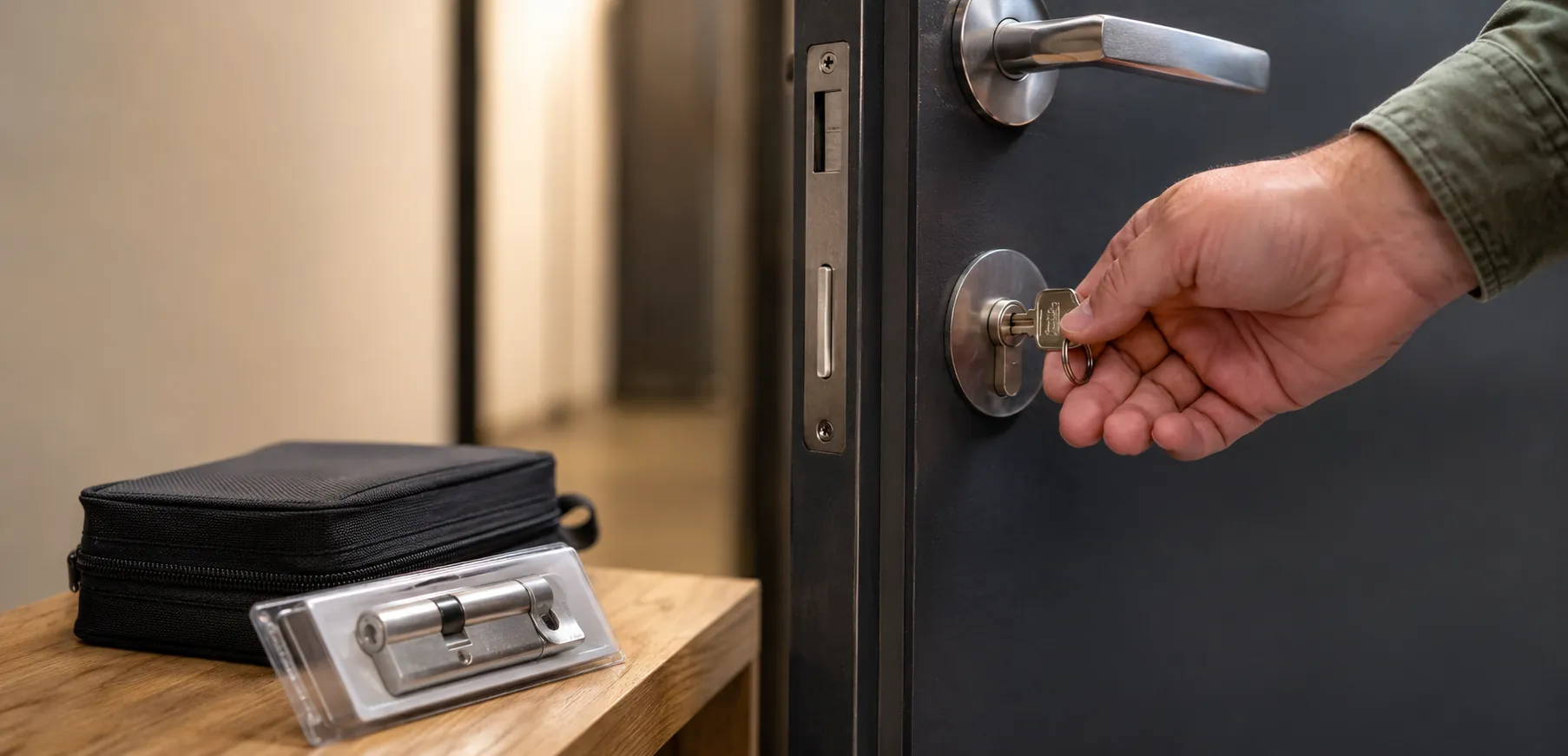
Can I swap the cylinder myself? If the door is open and you know the correct length, yes. Take out the forend screw on the door edge, turn the key slightly, pull the cylinder out. Sounds simple, but it often fails on the length and on a sticky bolt. If you are unsure, have it done.
Why does the key spin free sometimes and grip other times? With a cracked coupling the fault appears only sporadically at first. Sometimes it works, sometimes not. That is the moment to act, before it breaks completely and you are stuck outside.
Do I have to change all the locks after a break? No. Only the affected cylinder. Unless you have a locking system and want to keep the keying uniform. Then a conversation about the whole system is worth it.
In short
- Key spins free: usually cam or coupling broken, cylinder has to come out.
- Test the spare key first. If it turns cleanly, it was only the key.
- An open door is not an emergency. Book a daytime slot, it is cheap.
- An open door is not drilled. Anyone who wants to is the wrong person.
- When buying new, watch the length, DIN EN 1303 and a brand like ABUS or BKS.
If you are locked out and cannot get back in at all, reach our emergency service around the clock. If you are unsure which cylinder fits your door, just write to us via the contact form, ideally with a photo of the door edge. Then we tell you in advance what is what. Stay calm, test the spare key, and do not let anyone drill when the door is standing open.