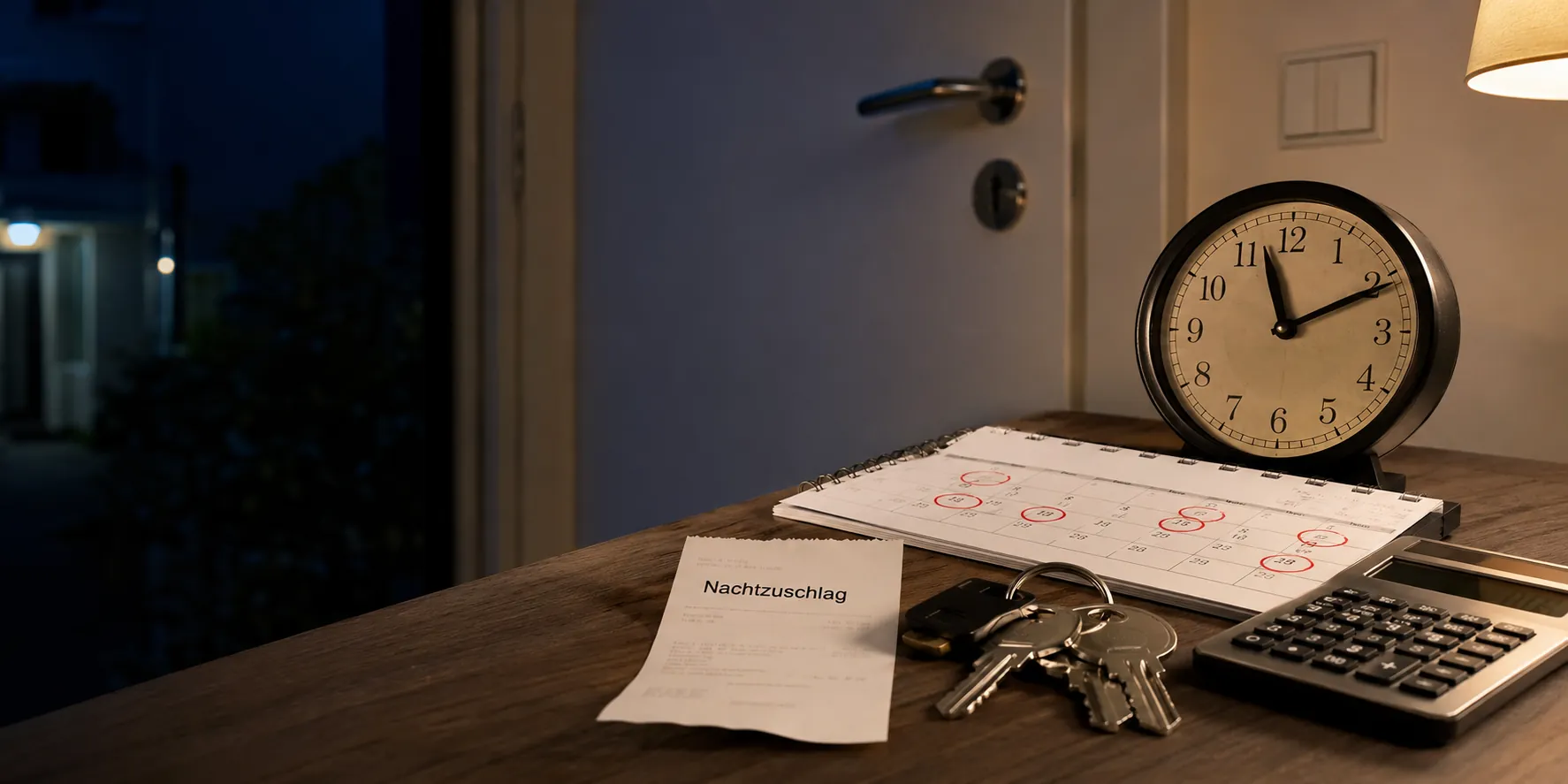
Up front, clear and short. A surcharge for nights, weekends or public holidays is allowed and completely normal. But it must be named beforehand, and it must bear a sensible relation to the work. A surcharge that only appears on the invoice is, in case of doubt, not validly agreed. And no, a simple door opening does not turn into 600 euros at three in the morning either.
I have been fitting and servicing locking systems for eleven years, and I work late shifts myself. So I know from both sides what a night call-out costs and what it is worth. That is exactly why it annoys me when someone uses the surcharge as a lever to cash in on your emergency. Let us talk plainly.
How high can the surcharge really be
Realistically it is 30 to 100 percent on top of the daytime price, depending on the hour. No more. So a 100-euro daytime door becomes 150 to 200 euros at night, maybe 220 on a holiday. Anyone who quotes you triple or quadruple is not billing the effort, they are billing your panic.
The staggering matters. A clean firm distinguishes at least four tiers, and that is exactly how you recognise it:
- Weekday daytime, roughly 7 am to 6 pm: base price, no surcharge.
- Weekday evening, 6 pm to 10 pm: small markup, often 20 to 30 percent.
- Deep night, 10 pm to 6 am: 50 to 100 percent.
- Sunday and public holiday: its own rate, usually at the upper end.
A Sunday at ten in the morning is not a deep weekend at three in the morning. That belongs in separate pricing. Anyone billing every call after 6 pm at double or triple the price is not working properly, full stop.
One more word on the call-out. That is its own line item and should stay one. In Frankfurt a call-out within the city is no expedition, I am in almost any district within twenty minutes of the workshop. 30 to 50 euros for the trip is fine. Anyone wanting 120 euros just for showing up has already hidden the first markup before even touching the lock. So ask for three numbers: travel, work, surcharge. If the answer is a single flat fee nobody will break down, something is off.
What you are actually paying the surcharge for
So this does not stay abstract. At three in the morning the technician is awake, the van is out, the fuel is running, and the next day the energy for the normal job is gone. That effort gets paid for, that is fair and I defend it too. What is not fair is the idea that the pure working time on the lock is suddenly more expensive at night. A cylinder swaps just as fast at three in the morning as at three in the afternoon. The surcharge pays for the hour, not for a different service.
What the law says
A contract forms on the phone the moment you hear the price or the price range and agree. That is exactly why the surcharge must be named beforehand. If it is not named, German law (section 632 BGB) applies the customary fee, meaning the locally normal fair rate, not the fantasy figure on the invoice.
That is the lever almost nobody knows. If no price was ever mentioned on the phone and on site you get handed a 480-euro invoice, you did not agree a price. You then owe the customary fee. And customary means the rates I gave above, not four times that.
Then there is consumer protection. A contract concluded on the phone or at the doorstep is a distance or off-premises contract. In principle you have a fourteen-day right of withdrawal. For an immediate emergency opening you must expressly and in writing waive that right, otherwise you can withdraw later. Many dodgy firms deliberately forget that notice, because it disciplines them. If you are unsure, the consumer advice centre gives reliable guidance and template letters.
Immorality, the heavy artillery
There is still a ceiling. If the price stands in a striking mismatch to the work, it can be immoral and therefore void. Courts have ruled several times that a usurious fee for a simple door opening can topple the contract on that point. 600 euros for a slammed door that opens in two minutes with a flexi card is exactly such a case. You do not have to accept it.
Two cases from the field
Last year, Good Friday, a couple from Ostend called me. Door deadbolted, key forgotten inside. On the phone I named the holiday surcharge included: 220 to 280 euros, depending on whether the door opens cleanly or the cylinder has to go. It came to 240 euros. No drama, because everything was on the table beforehand. That is exactly how it must go, holiday or not.
And the counter-case, last week in Bockenheim. A student, Sunday night, had already called someone before me who came via an 0800 number. No price on the phone, no company name on the van. The man drilled the cylinder of a merely slammed door, that is a door you get open with a card in thirty seconds, and put down a 540-euro cash bill. She did not have the money and called us. My advice was simple: pay nothing in cash, demand an invoice, object in writing. In the end she paid around 180 euros, more was never agreed and more was not appropriate either.
The difference between the two cases is not the hour. It is whether there was a conversation first.
Locked out and in a hurry?
Price quoted up front, vetted partner business, ~22 minutes on site.
How to spot a fair surcharge
Three points that always hold:
- The surcharge is named on the phone, not only on site at the open door.
- It is staggered and traceable, not a flat double for everything.
- You get an invoice with company name, address and the surcharge as its own line.
If one of those is missing, get suspicious. A serious firm tells you on the phone: daytime price is this much, at night this surcharge is added, final price roughly so. Anyone who waffles and says it will be seen on site wants to keep the door open, in every sense.
Drilling is almost never necessary
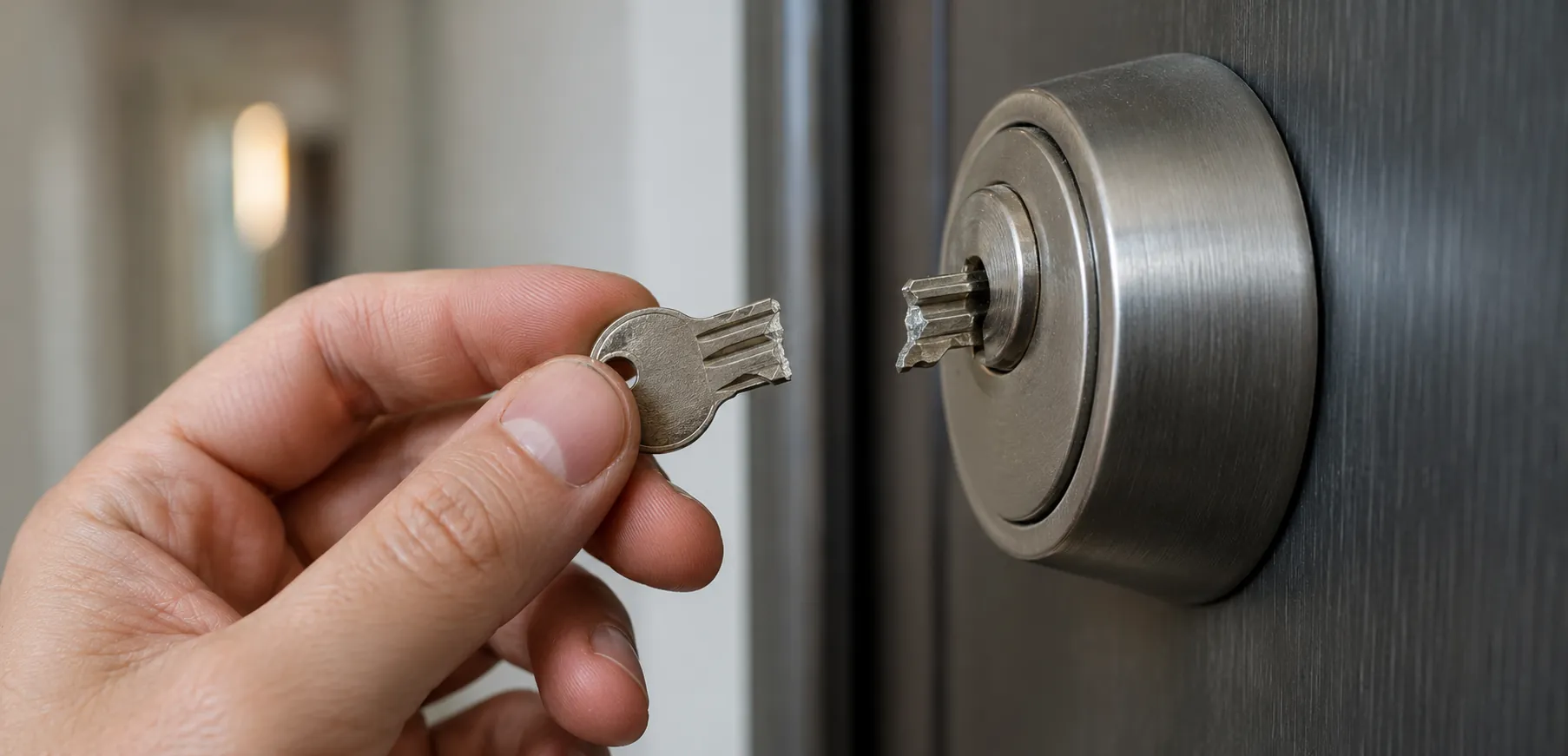
A technical point that ties directly to the surcharge. A merely slammed door, meaning not deadbolted, is not drilled. Full stop. It opens with a card, wedge or the right technique in minutes, without damage. Anyone drilling a slammed door creates damage you are then also supposed to pay for: new cylinder, new lock, sometimes the whole strike plate. That is how a 150-euro night becomes a 500-euro night. With a genuinely deadbolted door and a good cylinder, drilling can be necessary, but that is the exception, not the rule.
If a cylinder really is due: a standard cylinder costs 15 to 40 euros in material, a good security cylinder from ABUS, BKS or Winkhaus 60 to 150 euros. That is material, not surcharge. Have it itemised separately.
A small technical note from my daily work, because I mostly build locking systems. If a system cylinder has to be swapped at night, that is not the same as a garden-variety profile cylinder from the hardware store. With a locking system several doors hang on one setup, and the new cylinder has to match the system, otherwise the master key no longer turns. At night that often cannot be solved cleanly. My honest advice: at night only have the acute door opened, and swap the actual system cylinder on the next working day at the daytime price. That way you save the night surcharge exactly where it hurts most.
What to do at night, concretely
Short and practical, for the moment it happens:
- On the phone, ask for the final price, including travel and surcharge. No number, no job.
- Note the company name. A bare 0800 number with no name is a warning sign.
- Insist on an invoice, never just cash with no receipt.
- With a slammed door, insist on damage-free opening, not drilling.
And plan ahead where you can. A spare key with a neighbour in Nordend or Sachsenhausen saves you the entire night surcharge. A well-maintained locking system whose cylinder does not stick means you never lock yourself out at night in the first place. That is the cheapest emergency service, namely none.
Frequent questions
Is a night surcharge of 100 percent too much? No, in the deep night that is the upper edge of normal. At 200 or 300 percent I prick up my ears.
Do I have to pay the surcharge if it only appears on the invoice? If it was never named on the phone, the customary fee under section 632 BGB applies. You can dispute the excessive part.
Can a holiday be charged more than a Sunday? Yes, a separate holiday rate is customary and fine, as long as it is named beforehand and traceable.
What if I already paid in cash? Demand an invoice, object in writing, file a report if needed. Money paid can be reclaimed if the price was immoral.
More on the tricks of the bad apples is in our guide on spotting rip-offs, and the whole pricing logic including daytime rates is in our guide on 2026 locksmith prices. In a real emergency our emergency service is reachable around the clock, the current rates including all surcharges are transparent on the pricing page, and if you want to prevent the whole thing, we are glad to advise you on the right locking system. More expensive at night, yes. Ripped off, no.