
The most important truth up front: where you retrofit for security in Mannheim depends less on your district than on the year your building was put up. A Jugendstil old building in the Oststadt has different weak spots than a post-war block in the Waldhof, and anyone treating both the same either throws money away or leaves open exactly the gap they climb in through. The good news: most burglars in this city are not pros with special tools, they are opportunists who try for under three minutes and then give up. That is precisely what we play to when we retrofit.
I am Lena, a locking-systems technician, and I have been securing flats and houses in and around Mannheim for over ten years. Let me put my position on the table straight away: the most expensive alarm system is worth little if the front door opens with one kick. Mechanics first, electronics after. That is how we go about it, ordered by building era, because that is the most honest route.
Why the building era decides the weak spot
The police crime prevention service has said it for years, and I see it at every door: around a third of all break-in attempts get stuck at the attempt, because the security hardware holds. That is not a trifle, that is the whole lever. Force the offender to work loud and long, and you lose your property less often. Background figures on the national trend are at the BKA, concrete retrofit recommendations bundled at the police K-EINBRUCH initiative.
And that is exactly where Jugendstil and post-war part ways. The old building often has solid fabric, but ancient fittings and doors built for beauty, not for resistance. The post-war block of the fifties and sixties has thin door leaves, the simplest cylinders and windows with fittings you lever out with a screwdriver. Two worlds, two recipes.
Jugendstil old building: beautiful, solid, open in the wrong places
The Oststadt is my favourite example. These houses around the water tower and the Augusta-Anlage are a dream, high ceilings, stucco, heavy double-leaf doors. And in security terms often a sieve. The problem is not the walls, it is the details.
Let us look at the typical weak spots:
- The flat door itself. Often an old leaf with a warded lock or a simple cylinder with no drill protection. The cylinder sometimes protrudes past the escutcheon, ideal for pulling with pliers.
- Double-leaf doors. The fixed leaf is often only secured with a simple bolt top and bottom, which levers open with a little pressure.
- Basement and souterrain doors. In many Oststadt houses a door leads from the yard or light well into the cellar, old, rotten, unwatched. The preferred route.
- Windows on the raised ground floor. The old window fittings have no mushroom-cap pins. A crowbar on the frame, and the window is open in seconds.
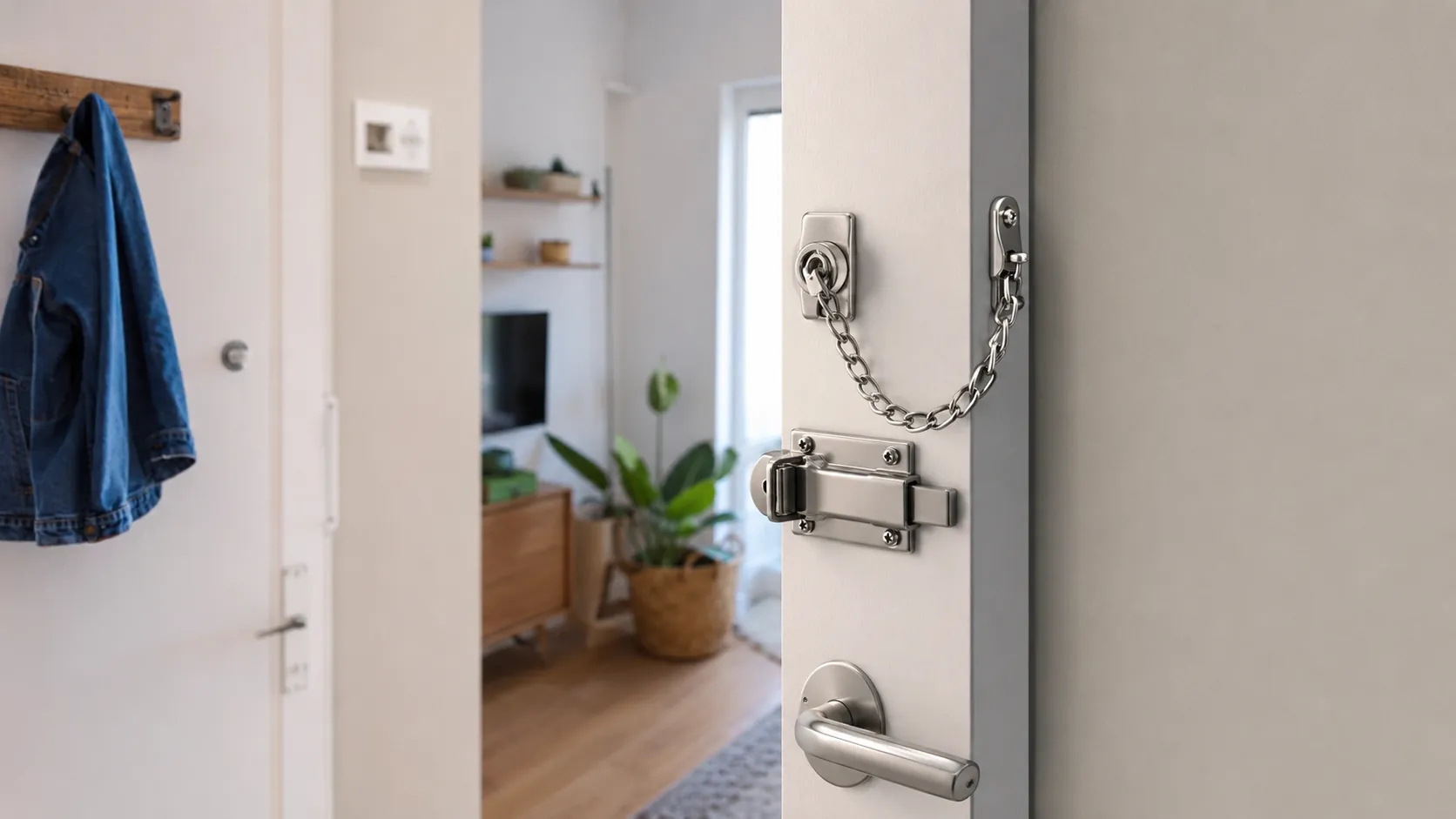
My recipe for the old building goes gently, because listed-building rules, or at least the character, often stand in the way. You do not have to rip out the lovely old door. A good cylinder with drill and pull protection to standard, plus a solid protective escutcheon with core-pull protection, and the front door is a different animal. As a package that realistically costs 150 to 350 euros fitted, depending on cylinder grade. For the double-leaf door I fit a surface-mounted additional lock or a rod bolt that ties both leaves together firmly. And for the old windows there are lockable retrofit catches you screw on without wrecking the frame.
Last month in the Oststadt
A case that still nags at me. A couple in a Jugendstil house near the Augusta-Anlage, ground floor. They had put money into a camera, but the cellar door to the yard was built in 1912 and closed with a bolt a child could push open. That is exactly where someone got in, in daylight, while the camera dutifully filmed the front entrance. Afterwards we secured the cellar door with a cross bar lock that bolts the door across its full width, and retrofitted the raised ground-floor windows. Peace ever since. The lesson: secure the route the offender takes, not the one you imagine.
Post-war building: thin doors, simple hardware, plenty of leverage
Now the entirely different case. The estates in the Waldhof and parts of the Neckarstadt-Ost are shaped by the reconstruction of the fifties and sixties. Built pragmatically, fast, cheap. These flats are solid to live in, but the original doors and windows are yesterday's news in security terms.
The weak spots look different here:
- Thin, light door leaves. Some can be pushed in outright. An additional lock alone does little if the leaf gives.
- Simple mortise locks with no multi-point locking. One point holds the door, and that is quickly overcome with a lever.
- Windows and balcony doors with roller cams. The old fittings give the crowbar no resistance. Levered open in seconds.
- Cellar compartments with wire mesh and a padlock. Practically an invitation.
Here the bold cut often pays. If the door leaf is any good, I fit a multi-point lock that closes at three to five points, plus a security cylinder with an emergency function so it can be unlocked from inside even when a key is in the outside. If the leaf is past it, a full lock replacement or a new tested door is the more honest investment. For the windows: retrofittable mushroom-cap catches and lockable handles, or new windows in resistance class RC2 outright. Anyone wanting one uniform key for a whole apartment building, say for the front door, cellar and flat, should think about a locking system, it tames the eternal flood of keys.
And once in the Waldhof
A tenant in the Waldhof, living alone, had two levering attempts on the ground-floor balcony door within a year. The second time the scratch marks were deep. We fitted the balcony door with a mushroom-cap retrofit and a lockable handle and mounted an additional lock with a locking bar. Cost for the balcony door around 250 euros. On the third attempt, which the neighbour watched, the offender gave up after less than a minute. That is the whole trick: not impregnable, but too loud and too slow.
Locked out and in a hurry?
Price quoted up front, vetted partner business, ~22 minutes on site.
What really works, in the right order
Because I am asked constantly, here is my honest ranking of what gives the most per euro:
| Measure | Realistic price | Effect |
|---|---|---|
| Security cylinder with drill and pull protection | 40 to 150 euros | high, the basis for everything |
| Protective escutcheon with core-pull protection | 60 to 200 euros | high on the flat door |
| Cross bar lock (cellar, yard door) | 150 to 400 euros | very high on weak doors |
| Window mushroom-cap retrofit per window | 80 to 200 euros | high on the ground floor |
| Additional lock with locking bar | 100 to 250 euros | good on thin door leaves |
| New door or windows in RC2 | from 800 euros upward | very high, but expensive |
My clear advice: start low, at the house and on the ground floor, that is where they climb in, not on the third floor. And keep your hands off pure show. A sticker saying "alarm protected" with no system behind it impresses no one who knows what they are looking for. By the way, the KfW subsidises mechanical burglary protection with a grant, worth it above all in owner-occupied property. Details and further guides we collect in our guide.
The most common mistakes I see in Mannheim
Three things that keep going wrong, right across the districts from the Schwetzingerstadt to the Lindenhof:
- Securing only the flat door and forgetting windows and balcony. On the ground floor hardly anyone comes through the reinforced door, they come through the tilted window.
- Buying a cheap hardware-store cylinder. A cylinder with no drill protection for twelve euros is money thrown away. The difference to a good one comes to a few euros a month spread out.
- The tilted window. A tilted window often counts, for insurance purposes, as an open window. If someone comes through, your contents insurance may cut the payout. This is not legal advice, just a note from practice, but check your policy.
What makes sense for your specific door and building year in terms of burglary protection, we best look at on site. Every house in this city is a little different, and the estimate is free with us.
Common questions on burglary protection
Is retrofitting worth it at all in a rented old building? Yes, but talk to the landlord. Surface-mounted additional catches can often be fitted with little residue. Many landlords chip in, because the property benefits.
Does an alarm system replace mechanics? No. An alarm reports, it does not hold. Someone already inside grabs and is gone in two minutes, before anyone reacts. Mechanics first, that is non-negotiable with me.
What is the single most important measure? On the flat door a good cylinder with pull protection plus a protective escutcheon. On the ground floor the window and balcony-door catch. That is the foundation, everything else comes after.
Is there state money towards it? The KfW subsidises mechanical burglary protection with a grant for owner-occupied homes. The conditions change, so check the current position directly with the KfW before you commission work.
How fast can you come if there has already been a break-in? With a fresh break-in and a forced door we are on emergency around the clock, secure the door provisionally and swap the fittings. The permanent retrofit we then plan at leisure.
My bottom line
Security in Mannheim means understanding your own house. The Jugendstil old building of the Oststadt needs clever detail solutions that keep the charm and close the weak points. The post-war block in the Waldhof needs robust hardware, often on the door and the window at once. Neither has to cost the earth if you go about it in the right order and start where they actually climb in. If you want to know what makes sense in your district and for your building year, look at our overview for Mannheim or clear up open points in the FAQ. And if you are unsure, better to drop by one time too early than one time too late.