Short version: the risk of a residential burglary in Germany is real, but it comes down surprisingly easily. Not with expensive electronics, but with mechanically reinforced doors and windows. According to the police crime statistics, almost every second break-in stays an attempt, because the intruder gives up after two or three minutes and moves on. Everything is decided in that window. Know your weak points, and you deny the burglar the very minutes he needs.
I have been advising households and small businesses on burglary protection for fourteen years, and let me be blunt from the start: most of the fear sold in this field is overblown, and most of the technology sold with it is unnecessary. What actually holds looks boring and costs less than most people think.
How high is the risk really? The numbers without the alarm bells
The most reliable source is the police crime statistics (Polizeiliche Kriminalstatistik, PKS), which the Federal Criminal Police Office publishes every spring. In the most recently reported years it counted around 77,000 cases of residential burglary nationwide, so clearly up again after a low during the pandemic. The average loss per case runs into several thousand euros, and that is only the material part. The psychological cost, the uneasy feeling in your own home afterwards, appears in no statistic.
But two figures from the same statistics are the ones that really matter, because they give reason for hope. First: attempts make up almost half of all cases. That means in nearly every second registered burglary the intruder failed at the secured door or window and never got in. Second: the clearance rate, at roughly one in six, is low. So do not rely on the police alone when it comes to your home. Prevention beats detection, every single day.
Regionally the picture varies a lot. City states and densely populated areas such as the Ruhr region, Bremen or Hamburg traditionally sit above average, while large rural states like Bavaria report lower rates. Hesse and the greater Frankfurt area sit in the middle, with the familiar hot spots wherever ground-floor flats, quiet rear plots and quick escape routes come together. And one more pattern that surprises many people: burglars prefer the dark season, from October to February, and by no means only at night. Many break-ins happen in the late afternoon, when nobody is home and it gets dark early.
How burglars really work, and why that is good news
Forget the images from television. The elegant pro who opens a lock silently with two picks is the exception, not the rule. The overwhelming majority of break-ins is opportunistic crime with brute force. The typical way in leads through a tilted or poorly secured window, a patio or balcony door, and the tool is usually a plain screwdriver. The lever goes between the sash and the frame, one hard shove, and an unsecured window springs open in seconds.
That sounds threatening, but it is exactly the reason for confidence. Anyone working with a screwdriver is working against time and against resistance. If the first prying point holds, a second attempt follows, and at the latest when nothing gives after two or three minutes, the intruder breaks off. No burglar wants to make noise and be seen. So your task is not to build an impregnable fortress. Your task is to be more expensive in time and risk than the house next door.
The real weak points on your front door
On flat and house doors I keep seeing the same three points of attack.
The first is prying the door leaf, the same principle as with a window. If the door sits badly in the frame or the fitting is weak, it gets levered open on the lock side. The second is what we call cylinder pulling: if the lock cylinder protrudes even a few millimetres beyond the fitting, the intruder grips it with pliers and tears it out, core and all. After that the door is open in seconds. The third and rarer route is drilling out the cylinder. There is a clear, affordable answer to all three, and none of them is "rip the whole door out".
One thinking error I correct almost daily: an expensive brand-name cylinder alone does not make a secure door. The best cylinder is useless if the door leaf can be levered out of the frame or the cylinder sits exposed and proud. Security is always the interplay of cylinder, fitting, strike plate and hinges. Swap only one component and you have often spent money and gained little. Which measures on the door make sense, and in which order, is set out in detail in our overview on burglary protection.
What actually protects: the ranking I recommend
Sorted by effect per euro, not by sales margin.
- Windows and patio doors first. This is where most break-ins happen, so invest here first. Mushroom-cam locking pins, lockable window handles and screw-on add-on locks turn prying into a test of patience. Retrofit kits cost roughly 80 to 150 euros per element depending on the window; from the factory it is better to order fittings to resistance class RC2 straight away.
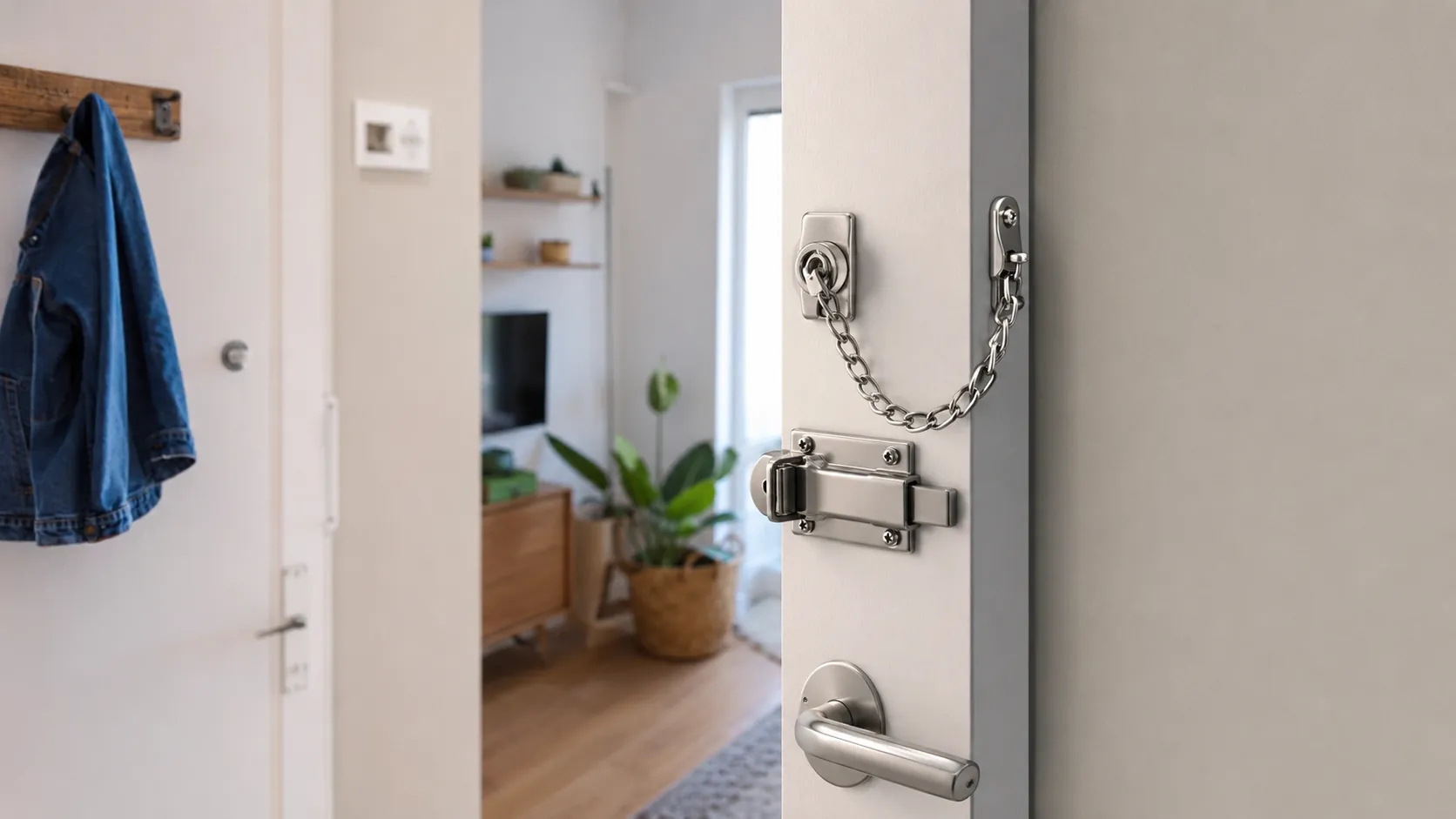
- Upgrade the door mechanically. A security fitting with a cylinder cover takes the ground out from under cylinder pulling. Add a security cylinder with pull protection and an emergency function, so it can be unlocked from the inside even when a key is in the outside, plus a solidly bolted security strike plate. If a lock replacement is due anyway, for example after losing a key or moving into a new flat, that is the cheapest moment to switch to this combination. A security fitting and cylinder together usually run 140 to 350 euros plus fitting.
- A cross bar lock for exposed doors. On ground-floor flat doors, cellar doors or basement flats, a cross bar or armoured bar reaching across the whole leaf secures the door in the frame on both sides. It is the single most effective measure against prying, costs roughly 250 to 550 euros fitted, and looks robust, which alone deters.
- Behaviour costs nothing and works. Always double-lock the door, do not just let it fall shut, because a merely pulled-to door levers open almost as easily as a window. Simulate presence with timer switches for the lights. Have the letterbox emptied while you are on holiday. And please post your trip only after you get back, not before.
- Alarms and smart tech last of all. An alarm reports, but it stops nobody physically. A smart door lock is convenient, but it replaces no mechanical protection. My clear position after fourteen years: anyone who has 400 euros and puts it into a WiFi lock instead of mushroom-cam fittings and a cross bar has saved at the wrong end. Electronics are the cherry, not the cake.
As a benchmark for mechanical quality, resistance class RC2 to DIN EN 1627 has become established. It means a component withstands an opportunistic offender with simple tools for several minutes. For a normal flat, RC2 is the sensible target; private households rarely need anything above it. Incidentally, the police advise on all this free of charge and independently of any manufacturer, an offer far too few people use.
Locked out and in a hurry?
Price quoted up front, vetted partner business, ~22 minutes on site.
The state often chips in
Grants get overlooked. The well-known direct KfW subsidy for burglary protection alone has expired, but burglary-protection measures can still be co-financed through low-interest KfW loans for age-appropriate, barrier-reduced conversion, and individual states and municipalities run their own programmes. It pays to quickly check the current status at the KfW and at your own municipality before you place the order. Important: first the application or approval, then the order, otherwise the funding is gone.
Two cases from Frankfurt that show the difference
A case from Sachsenhausen has stayed with me, because it shows textbook-style what prevention achieves. A couple had, six months earlier, had their patio door retrofitted with mushroom-cam fittings and a lockable handle, for around 180 euros. In November someone tried to pry open exactly that door. The next morning they found deep lever marks in the frame, but the door was shut. The intruder had given up. The damaged profile cost 90 euros; the rest was covered, without argument, by the contents insurance, because the security had demonstrably held.
The counter-case played out in Nordend. A flat door, stable in itself, but the lock cylinder stood a good five millimetres beyond the old fitting. For an offender with a pipe wrench, an invitation. The cylinder was pulled in seconds, the flat cleared out. The door itself was undamaged; all that was missing was a security fitting for about 120 euros that covers the cylinder flush. Details like that decide it, not the price of the cylinder.
What a locksmith actually does here
A good locksmith does not only open doors; above all it stops others from opening them. In an on-site consultation we look at the real weak point, not the catalogue. We check whether the cylinder protrudes, how the leaf sits in the frame, whether the hinges are secured, and where the windows need retrofitting. Then comes a proposal in exactly the order set out above, with clear prices, no package selling. Common triggers are moving into a new flat, a lost key, or a break-in attempt already suffered. An overview of the services that come together here is on the page about our services.
One more word on trustworthiness, because the trade's reputation suffers: a proper business names a price range up front, arrives with ID, fits tested components, and pushes nothing on you that you do not need. Anyone who promises 39 euros on the phone and bills five times that on site is exactly the sort the consumer advice centres have been warning about for years.
Frequently asked questions
Is burglary protection worth it as a tenant too? Yes. Talk to the landlord; many measures can be fitted without leaving marks, and some owners chip in because the upgrade stays with them. Lockable window handles and add-on locks often need only consent, not a building permit.
Is good insurance not enough? Contents insurance replaces material goods, but not the sense of security and not the time a burglary costs. On top of that, many policies require reasonable securing, meaning locked doors and intact windows. Prevention and insurance complement each other; one does not replace the other.
What use is a camera or video doorbell? It documents and deters some, but stops nobody physically. Sensible as a supplement, no as sole protection.
When should I really replace the cylinder? After every move, after a lost key, and whenever the old cylinder protrudes or has no emergency function. How such a swap works is described under lock replacement.
Bottom line
Residential burglary is common enough in Germany to take seriously, and at the same time predictable enough that you can protect yourself effectively. The statistics are on your side: almost every second attempt already fails today against secured hardware, and with comparatively cheap, unobtrusive means. Start with the windows and the patio door, make sure the cylinder does not protrude, double-lock, and save the electronics for last. If you are unsure where your own weak point is, have someone who knows doors from both sides take a look. Usually it is two or three small tweaks that decide between "gets in" and "gives up after three minutes".