
The short answer first: yes, you can make your old Gründerzeit front door in Südstadt or Ehrenfeld secure, and no, in the vast majority of cases you do not have to throw out the beautiful leaf to do it. I have been doing this in Cologne for years, and I see the panic on people's faces when they think it is either heritage charm or security. That is a false choice. A solidly retrofitted period door costs you, depending on scope, roughly between 350 and 1,400 euros, and it holds off an opportunist far longer than the original 1904 condition ever could.
I advise people on burglary protection, and I stand in these Cologne houses almost daily. Ornate stucco facade, high ceilings, and on the ground floor a double leaf door in solid oak with a transom light. Beautiful. And, in security terms, often a dream for anyone who wants to get in. Why that is and what you concretely do about it is what we are going to look at now.
Why the old Cologne front door opens so easily
The problem is rarely the wood. Gründerzeit doors are massive, the leaf itself often takes more punishment than a modern lightweight door. The problem sits elsewhere.
First, the hardware. In many houses in Südstadt there is still a warded lock or an ancient mortise case where the bolt reaches barely a centimetre into the frame. Second, the frame itself. Over a hundred years of Cologne weather, damp off the Rhine, settling cracks, and the wood has gone soft on the closing side. Third, the hinges. On a door that opens outward, they can be levered off if they are not secured.
A practised intruder sometimes needs less than thirty seconds on a door like that. Not because he is a genius, but because the weak points are lying open. The good news: these exact three points can be tackled one by one and affordably.
The heritage protection myth
Many of my clients in Südstadt and around the Ehrenfeld ring believe they are not allowed to touch the door at all because of heritage protection. In most cases that is simply not true. Not every Gründerzeit house is listed, and even when it is, the protection often covers the facade and the external appearance, not the inside of the door leaf. An additional lock on the inside, a security cylinder, an invisible hinge-side bolt, that can very often be done without anything looking different from the street. When in doubt, ask the authority, but do not let yourself be discouraged in advance.
What actually helps, in the order I recommend
I am no fan of selling people the most expensive package. Start with what gives the biggest effect per euro.
- The cylinder. This is the cheapest and often the most effective measure. An old cylinder with no drill and pull protection is overcome in seconds. A good cylinder with drill protection and an emergency function costs between 60 and 150 euros as a part. Why the cylinder is so decisive and what to watch for when you have a cylinder replaced we have written up separately.
- A security fitting with core pull protection. This protects the cylinder itself so it cannot be yanked out. That combination of a good cylinder and a protective fitting is my standard advice for period doors.
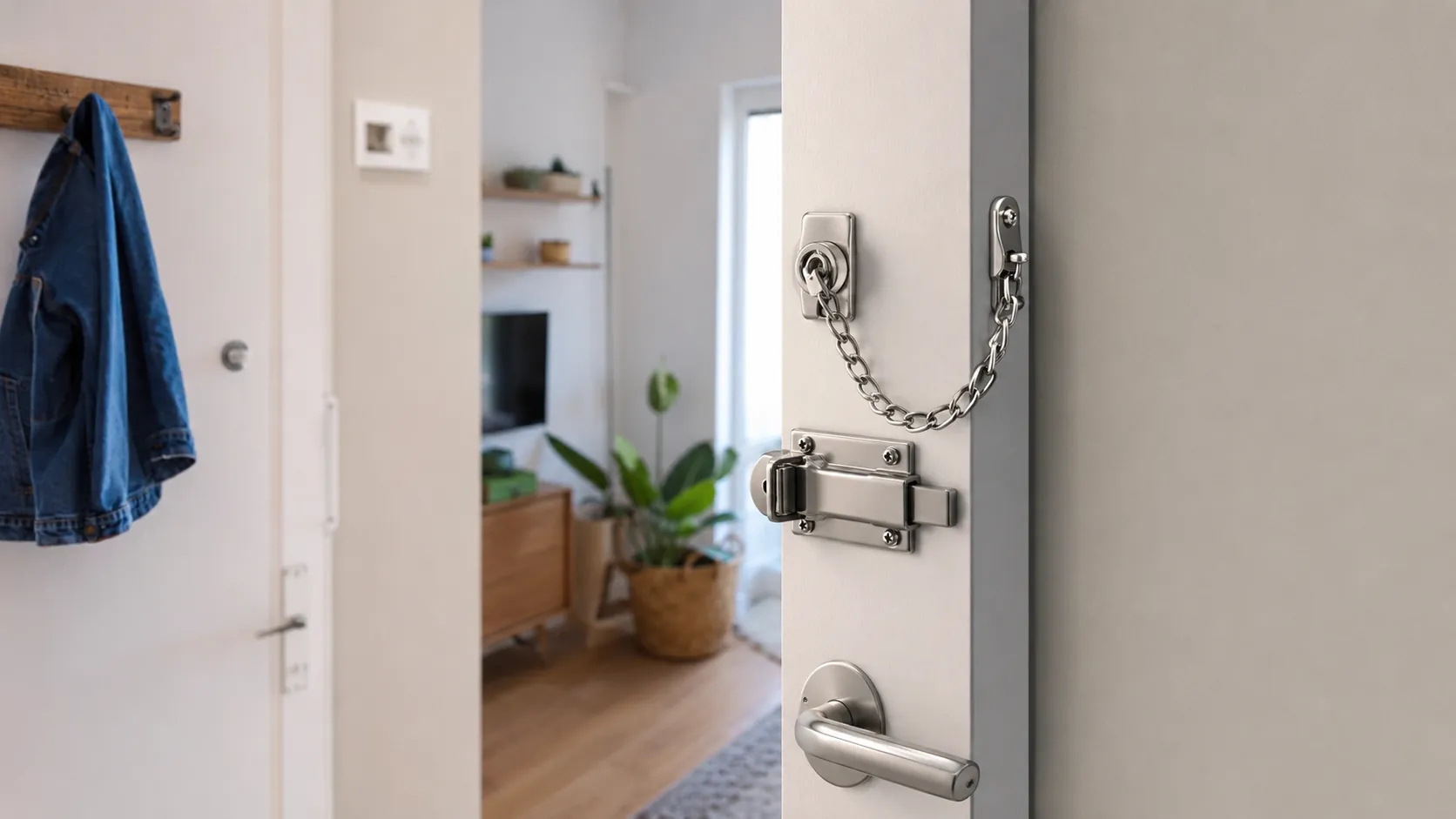
- An additional lock or crossbar lock on the inside. Here the bolt reaches wide into both sides of the frame. On double leaf Cologne front doors a crossbar lock is often the single most sensible measure of all, because it catches the entire width.
- Hinge-side security. Small bolts, usually invisible from outside, that stop the door being levered off on the hinge side. Cheap and, on outward-opening doors, almost mandatory.
If you want the full picture, meaning a genuine exchange of the whole lock including the case, then a lock replacement is the right route, especially if the old mortise case is jamming anyway. A good overview of every measure is on our burglary protection page.
Concrete prices to reckon with
I dislike giving fantasy prices, so here are realistic Cologne market ranges. No guarantee, but the order of magnitude holds.
| Measure | Realistic range incl. fitting |
|---|---|
| Security cylinder with drill protection | 90 to 220 euros |
| Protective fitting with core pull protection | 120 to 300 euros |
| Crossbar or armoured bar lock | 350 to 700 euros |
| Hinge-side security (per set) | 60 to 150 euros |
| Full retrofit of a period door | 700 to 1,400 euros |
The wide range comes from the state of the frame. If the wood on the closing side is healthy, it goes quickly. If it first has to be doubled up or backed with a steel plate, that costs time. Which is exactly why I always look at the door before I name a figure.
Last week in Südstadt
A case from last week, because it shows how unspectacular good security often is. A couple in Südstadt, an old building near Chlodwigplatz, a double oak door, beautiful, built around 1900. They were afraid that any security would destroy the character. We fitted a security cylinder with a matching protective fitting and set a crossbar lock on the inside at exactly the height where nobody sees anything from outside. From the street: unchanged. From inside: a door an opportunist fails on. Final cost around 890 euros. The man said his only regret was that he had waited twenty years.
And a counterexample from Ehrenfeld
To keep it honest: in Ehrenfeld I was at a tenant's who had bought a cheap add-on bolt online for 25 euros and screwed it into the soft frame wood herself with four short screws. The thing looked like security but was not. One firm kick and the screws would have torn out of the rotten wood. Security stands or falls with the anchoring. A fitting is only as good as the material it sits in and the screws that hold it. So: better one measure done right than three for show.
Locked out and in a hurry?
Price quoted up front, vetted partner business, ~22 minutes on site.
When several parties live in the building
That is the normal case in Cologne. Sülz, Ehrenfeld, Südstadt, everywhere multi-party houses with one shared front door and then the individual flat doors. Here it pays to look at the whole. If several cylinders are being swapped anyway, a locking system can make sense, where one key opens the front door and your own flat but not the neighbours'. That saves key chaos and can be cleanly documented in case a key is ever lost.
For the shared front door: talk to the owners' association or the property management before you start. On the flat door, by contrast, you as tenant or owner are usually much freer. What ends up being the landlord's matter and what is yours depends on the individual case. This is general information and not legal advice, when in doubt a quick look at the lease clears it up.
How high is the risk in Cologne anyway?
Honestly, I read statistics carefully, because figures are quickly misused to sell fear. What is certain: according to police crime statistics, residential burglary is nationwide among the offences with a low clearance rate, and the dark winter months are the classic season. In densely built old-building quarters with ground-floor flats and easily reached rear courtyards, the opportunity is simply there. You get reliable figures and good, manufacturer-neutral tips from the police at K-Einbruchschutz and from the consumer advice centre, which also warns against dubious doorstep deals. The nationwide trend in residential burglary is documented by the BKA.
My position after many years on Cologne stairwells: most burglaries are crimes of opportunity. The intruder tries, and if it does not work quickly, he moves on to the next, easier door. That is exactly where good burglary protection kicks in. You do not have to build a fortress. You just have to be more inconvenient than the house next door.
Common questions from my consultations
Does burglary protection ruin the old-building charm? No, if you do it right. Much of it sits on the inside or is invisible from the street. The lovely old handle and the transom stay, what changes is the inner workings.
Isn't a better cylinder enough on its own? A good cylinder is the basis and often the best first step. But if the bolt reaches only a centimetre or the hinges are unsecured, even the most expensive cylinder helps little. Security is always the chain of cylinder, fitting, lock and anchoring.
Can I do it myself? Many swap the cylinder themselves, that is fine. When it comes to anchoring crossbars in old, partly rotten frame wood, I see botched work far too often. If the screws do not hold, the whole measure is worthless.
Is the state subsidy worth it? For burglary protection there are grants depending on the current programme. This changes, so check the status directly with the KfW or get advice. If it fits, your own share drops noticeably.
What about the cellar door and the ground-floor windows? Good question, and often the blind spot. The finest front door helps little if the tilted ground-floor window stands open. Think of the ground floor as a whole.
My bottom line
A Gründerzeit front door in Cologne is not a security problem you have to throw away, but a solid base you cleverly supplement. Start with the cylinder, secure the fitting, add a crossbar and do not forget the hinge side. The whole thing costs less than most fear and saves the charm you love about your Cologne old building. If you are unsure where your door is weak, have someone who sees this daily take a look. You will find an overview of every service in the guide, regional contacts on the locksmith Cologne page, and if it is urgent, we are reachable via the emergency service in the evening and at the weekend too. Secure neighbourhoods are contagious, by the way, in Südstadt just as in Sülz, in Ehrenfeld and in Neustadt-Süd. We keep collecting further answers in our FAQ.