Short and honest first: if you live in an expensive old-build flat in Schwabing or Haidhausen, you usually do not need a ton-heavy armoured door for 3000 euros. In almost every case you get the biggest security gain from three things. A lock cylinder with anti-drill and anti-pull protection. A solid additional lock or crossbar. And secured hinges. In Munich that realistically costs you between 300 and 900 euros, depending on the door, and as a tenant it can almost always be fitted reversibly. Let us start there and I will sort the rest afterwards.
I am Sophie, I have advised private households and small businesses on burglary protection for fourteen years, and in Munich I see the same pattern every week: a beautiful period door, high ceilings, stucco, and behind it a lock from the sixties that a casual offender defeats in under a minute. The old building is the reason I am writing this. It is gorgeous. From a security point of view it is a special case, and that is exactly what gets overlooked.
Why Munich's old buildings behave differently
A new-build flat in Trudering comes today with a flat entrance door that has all-round locking and a decent frame. The old building in Schwabing-West or Au-Haidhausen does not. There I meet tall, often double-leaf doors, old box locks, sometimes still a warded key, and timber that has been moving for a hundred years. It looks magnificent. It rarely closes the way it should secure.
Three things make the difference. First, the bolt often sits in soft, old wood that will not stand up to a determined pry bar. Second, the cylinder is often a standard part with no pull protection at all, and pulling the cylinder is the fastest method I see in break-ins. Third, there are those lovely details, a transom window, frosted glass, carved panels, that can become a window into the flat if you do not think about them.
On top of that comes the factor nobody in Munich likes to talk about: there is value in these flats. A racing bike in the hallway, art on the wall, the expensive coat on the rack. A casual offender in the stairwell reads the address and does the maths. That is not scaremongering, it is simply the reality I bring from fourteen years of advising.
The three upgrades that really count
Before you let anyone sell you a complete new door, let us do the sum the other way round. What buys the most security per euro spent? I have sorted by that question for years, and in the old building the answer is almost always the same.
First: the cylinder
The lock cylinder is the weakest and at the same time the cheapest point. A good security cylinder with anti-drill, anti-pull core protection and an emergency function costs between 60 and 150 euros as a part. It has to sit flush with the fitting, not a millimetre proud, otherwise the pliers have something to grip. If you do nothing else, at least do this. Replacing the lock cylinder takes a quarter of an hour and is the most discreet change of all for a tenant.
My position on brands: I have fitted ABUS, Winkhaus and BKS for years and have had no trouble with any of them. What I do not recommend is the nameless hardware-store cylinder for nine euros. It will not survive thirty seconds against a drill.
Second: an additional lock or crossbar
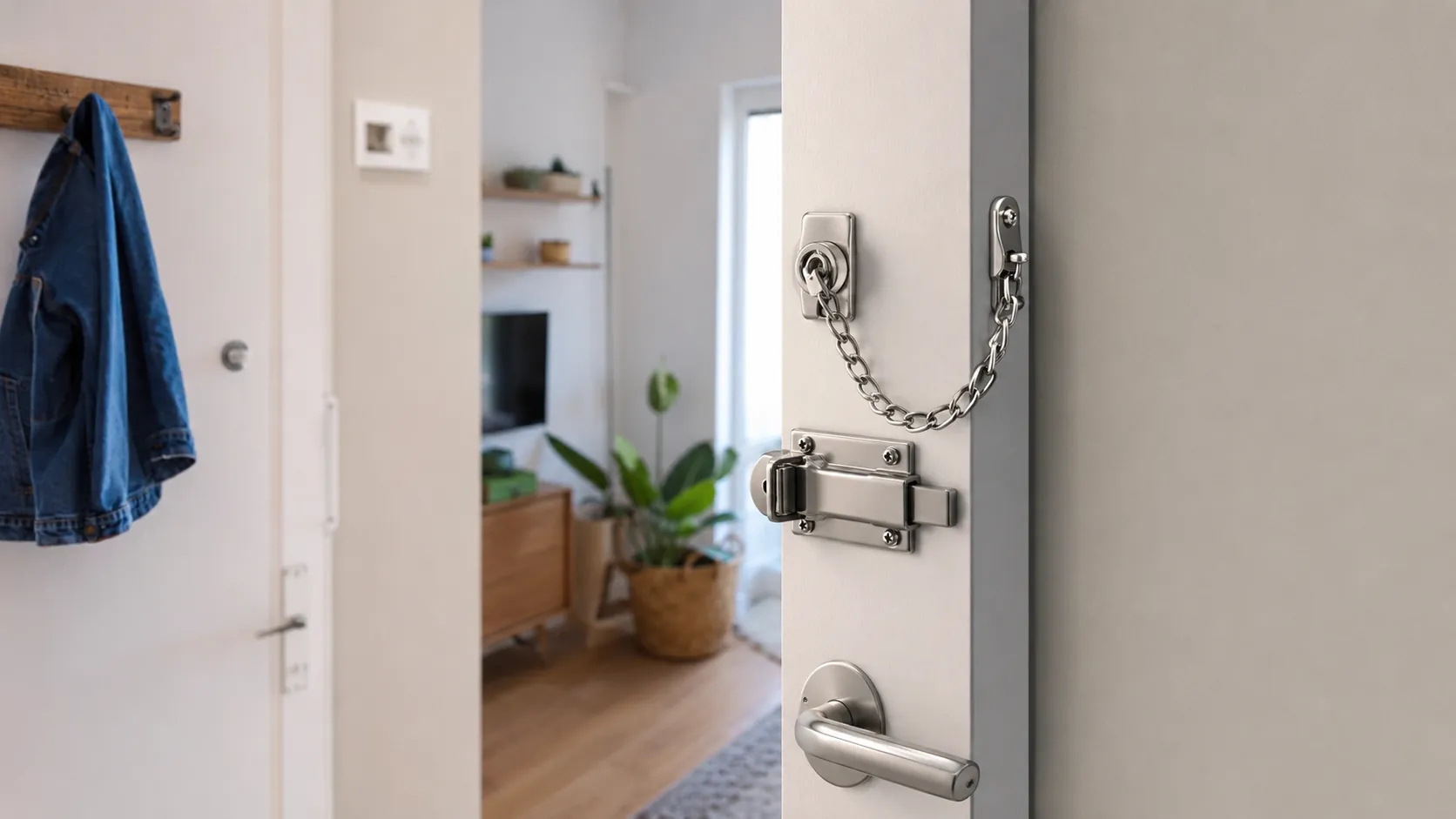
This is where the old building gets interesting. Because the old main lock often throws only a single bolt into soft wood, a second, independent closure is the real gain. A good box-type additional lock with a locking bar or, on very wide old doors, a crossbar lock spreads the force across the whole width of the door. Exactly where the levering happens. Reckon on 200 to 500 euros for material and fitting, closer to the top end for the wide double-leaf format.
If several parties in the building share the same problem, say in a renovated period house in Maxvorstadt, it is sometimes worth thinking about it together and planning a locking system for flat and front door at once. One key for everything, cleanly documented, and nobody carries five different warded keys on the ring any more.
Third: hinges and pry protection
When the door is levered, in the old building the hinges tend to break first. Hinge-side bolts, steel pins that engage into the frame on the hinge side, hold the door in the frame even when the hinges give. That is cheap material, big effect, and completely reversible in a rented flat. If your old main lock catches or is worn out anyway, combine that straight away with a lock replacement, and the door is at a sensible standard in one go.
What it costs in Munich
Munich is expensive, and that applies to trades too, so I would rather give you the ranges honestly than prettily. These are market prices from practice, not guarantees, and the old building almost always costs a little more than the new build because nothing is standardised.
| Measure | Realistic range in Munich |
|---|---|
| Security cylinder with pull protection, fitted | 120 to 260 euros |
| Box-type additional lock with locking bar | 200 to 380 euros |
| Crossbar lock for wide old door | 350 to 550 euros |
| Hinge-side security (pair) | 60 to 140 euros |
| On-site advice and door check | often free to 60 euros |
Anyone who does it all at once usually lands between 500 and 900 euros for a solidly upgraded old-build door. That is far less than a new security door, which in a listed context often will not be approved anyway, and it secures the point where break-ins actually happen.
Locked out and in a hurry?
Price quoted up front, vetted partner business, ~22 minutes on site.
Tenants in the old building: what you may and may not do
Now the question I get asked every week in Schwabing and Haidhausen. As a tenant, am I even allowed to change anything on the door? Short version: reversible measures yes, permanent interventions only with the landlord's consent. Swapping the cylinder, fitting a surface-mounted additional lock, adding hinge bolts, all of that can be removed again when you move out and is usually unproblematic. Keep the old cylinder and put it back when you leave.
It is a different matter when you drill deep into the frame or door leaf, or alter the historic fabric. Discuss that in writing with the property management beforehand. And when it comes to the cost question, who pays for the security, that is a negotiation, not an automatic entitlement. This is general information and not legal advice, but my practical tip: ask politely and specifically, many owners in Munich's old buildings contribute when the measure does not damage the door.
Last week in Haidhausen
An example from last week, because it is typical. A couple in the Franzosenviertel, a period building, a beautiful old flat door with two leaves. The passive leaf, the second, usually closed part of the door, was only secured with two small bolts top and bottom. From outside it could be pushed open with little effort. We set the passive leaf really firmly with an edge bolt, upgraded the active leaf with a new cylinder and a slim additional lock, secured the hinges. Not a single new hole in the visible area, everything reversible, the result a door you can no longer open in thirty seconds. Cost around 640 euros. The look stayed as it was, and that mattered to them.
Do not forget windows and cellar doors
A short but important point. In the old building many offenders do not come through the flat door at all, but via the ground-floor window, the light well or the poorly secured cellar door in the courtyard. In Neuhausen-Nymphenburg and Schwabing I see it constantly. Lockable window handles and mushroom-cam locking on easily reachable windows are just as important here as the door lock. Think of the flat as a whole, not just the one door.
If you are unsure where your own weak point is, the police advisory service at K-EINBRUCH gives neutral, manufacturer-independent recommendations, and the national picture of residential burglary is in the crime statistics of the BKA. I read both regularly myself, precisely because I do not invent scare figures.
Frequently asked questions
Is a complete security door worth it in the old building? Rarely. In a listed or ensemble context it often cannot be approved, and the existing door can usually be brought to a very good level. That is cheaper and preserves the look.
Is a better cylinder alone enough? As an immediate measure yes, as a complete solution no. The cylinder protects against pulling and drilling, but not against levering the whole door. Only cylinder plus additional closure plus hinge security give a rounded picture.
How long does the upgrade take? A normal old door is done in a morning. Two to four hours, depending on the additional lock and whether the door is double-leaf.
Do I have to ask my landlord? For reversible, surface-mounted measures usually not strictly, for interventions into the fabric yes. Asking never hurts and often opens the door to a cost contribution. This is general information, not legal advice.
My bottom line
Munich's old buildings deserve protection that suits them: discreet, reversible, in the right place. No material battle, but cylinder, additional closure and hinges, cleanly fitted. If you want to know where your door actually stands, have a door check done before something happens. You will find an overview of all services under services, answers to further questions in our FAQ, and if it has to be fast, for instance after an attempted break-in, we are reachable on emergency. More on your district and on scheduling is on the page for Munich.