
In short: yes, you can effectively retrofit a listed Art Nouveau front door in Wiesbaden's villa quarter against burglary without ruining the historic substance. The trick is not to replace the beautiful old door, but to reinforce it invisibly in three places: the cylinder, the strike plate and the hinges. Do it right and you lose no character while still making life hard for the opportunist burglar.
I am Anna Becker, a certified expert in locking technology, and over the past years I have assessed more carved oak doors in Wiesbaden than I can count. Between Nerotal, the Dichterviertel and the Rheingauviertel stands a building stock that half of Germany envies us for. And that very stock has a security problem hardly anyone talks about: the doors are gorgeous, solid and over a hundred years old, but their locks often date from a time when nobody stood at the door with a cordless drill and a YouTube tutorial.
Why the grand old door is the weakest link
A typical 1905 front door in Wiesbaden's Nordost is solid oak, has leaded glass, carved panels and weighs as much as a small fridge. You think: nobody gets through that. And that is true, nobody gets through the leaf. But nobody wants to.
Break-ins happen through the lock and through the hinges, not through solid wood. And there lies the problem. Almost every unrenovated period door still holds a warded lock or an early profile cylinder without any anti-drill protection. It can be defeated in under a minute with tools that fit in a jacket pocket. The carved panel around it does not interest the offender in the slightest.
The second point is the hinges. Historic doors often hang on screwed-on hinge leaves. If the door opens outward, which is common in period buildings, the hinge pins are exposed. A burglar simply lifts the door out if the hinge side is not secured. I have seen this several times in the Rheingauviertel: expensive door, valuable fittings, and the whole security hung on two bare steel pins.
What comes first: the cylinder
If you do only one thing, do this. The cylinder is the heart of it, and luckily it is the easiest thing to swap without carving into the door. A modern security cylinder fits into the same standardised recess as the old one, the leaf stays untouched.
What I look for when choosing a cylinder for a villa door:
- Anti-drill protection through hardened pins in the core.
- Pull protection, so the cylinder cannot be torn out with a screw. That is method number one on period doors.
- An emergency function, so it can be unlocked from inside even when a key is in the outside.
- Copy protection with a security card, especially in houses with several parties or changing tradespeople.
A good security cylinder to DIN EN 1303 costs between 60 and 150 euros as a part, high-grade systems with drill and pull protection more. Sounds like a lot for a piece of brass, but relative to the value of such a door it is laughably little. How a cylinder replacement actually works and what it costs, we have written up separately.
One thing matters, and here I am stubborn as an expert: the cylinder must not protrude on the outside. If it stands more than three millimetres beyond the fitting, it can be snapped off or pulled. In that case the door needs a protective fitting with a cylinder cover, and that exists in a brass finish that matches historic hardware.
The strike plate: the underrated hero
The best cylinder helps little if the bolt engages a thin plate held by two short screws in a rotten frame. On period doors in the Rheingauviertel and in Sonnenberg the frame is often the same old wood as the door, sometimes dried out, sometimes already broken out on the strike side and badly patched.
Here you fit a long security strike plate that reaches half a metre to a full metre with long screws deep into the masonry or the outer frame. This spreads the force of a prying attempt over a large area instead of concentrating it on two little screws. This measure is invisible once the door is closed, and when upgrading an existing door it is often more effective than the cylinder itself.
Do not forget the hinge side
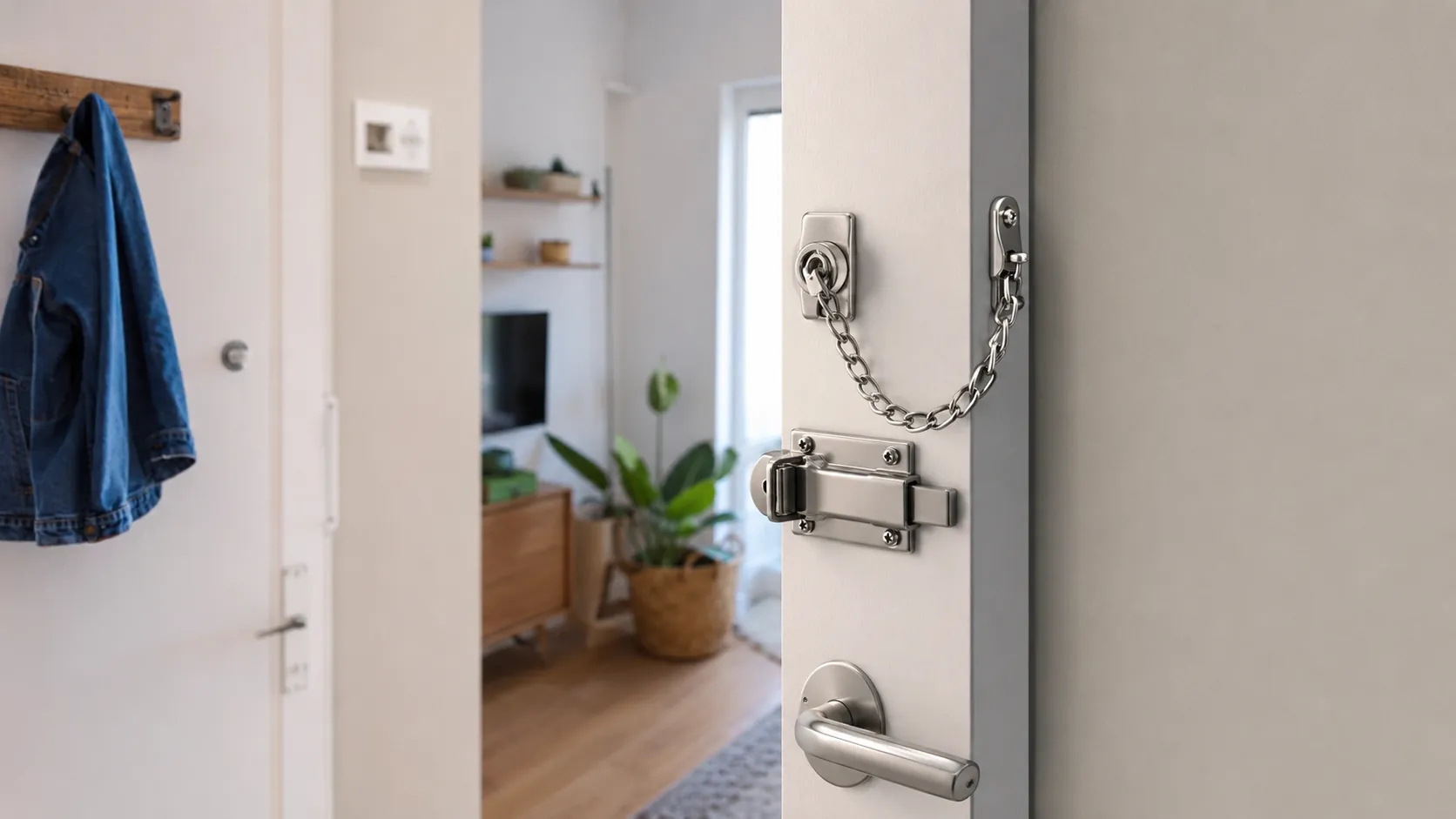
On outward-opening period doors I always secure the hinge side with dog bolts or hinge-side bolts. These are small steel pins that engage the frame as the door closes. Even if someone knocks out the hinge pins, the door stays hooked. Modest cost, big effect. On carved doors these parts can be set so that you cannot see them from the street.
Heritage protection has a say, but less than you think
Many villa owners in Wiesbaden hesitate because they fear heritage protection forbids any retrofit. In practice the opposite is often true. Security cylinders, long strike plates and hinge bolts are reversible and invisible from outside, and exactly such measures are regularly supported by the authorities. It only gets problematic when someone swaps fittings, drills into the ornamental plate or wants to replace the whole door.
My advice from practice: before larger measures, have a quick word with the city's lower heritage authority. One call saves trouble later, and most sensible measures are exempt from approval anyway because they do not touch the substance. General, independent guidance on mechanical security is published by the German police crime prevention, which I often draw on in my reports.
Locked out and in a hurry?
Price quoted up front, vetted partner business, ~22 minutes on site.
A case from the Dichterviertel
Last autumn a couple from the Dichterviertel in Nordost called me. They had an original 1908 Art Nouveau door, gorgeous, and the neighbour had been burgled. The two were about to swap the whole door for a modern security door out of panic. What a shame that would have been.
We did it differently. I swapped the old cylinder for a security cylinder with pull and drill protection, fitted a long strike plate and secured the hinge side. Plus a protective fitting in a matching brass finish that covers the cylinder. The door looks as before, no one sees the difference. The security gain is enormous, and the bill was a fraction of what a new door would have cost. I like to plan such packages as complete burglary protection, because the individual parts only work together.
What it all costs
Honest market ranges so you do not negotiate blind. Prices vary by door, condition and fitting, these are orders of magnitude, not guarantees:
| Measure | Realistic range |
|---|---|
| Swap security cylinder (part plus fitting) | 120 to 260 euros |
| Protective fitting with cylinder cover | 80 to 250 euros |
| Long security strike plate, fitted | 150 to 400 euros |
| Hinge-side bolt per pair | 60 to 160 euros |
| Full package period door, invisibly upgraded | 500 to 1200 euros |
For comparison: a new, heritage-appropriate replica front door quickly runs into five figures, and the old one is gone for good. The retrofit is almost always the smarter investment. If you are unsure what your door needs, it is worth looking at our full services overview or booking an on-site assessment.
What I expressly do not recommend
I am blunt here, because I too often have to repair the botch job afterwards. Do not buy cheap surface-mounted add-on locks from the hardware store held by four short chipboard screws. They look ghastly on an Art Nouveau door and barely withstand a lever. Also keep your hands off smart wireless cylinders as the sole security if the mechanical base is not right. Electronics do not replace pull protection.
And one more thing: a security package is only as good as its weakest element. There is no point putting 200 euros into the cylinder if a cellar window sits next to it that can be pried open with a screwdriver. Think about the whole ground floor, not just the grand door.
Frequently asked questions
Am I even allowed to change anything on a listed door? Reversible, invisible measures like cylinder, strike plate and hinge bolt are almost always accepted. Have a quick word with the lower heritage authority before visible changes. This is general information and not legal advice.
Do I really not have to replace the beautiful old door? In the vast majority of cases, no. A solid period door is an excellent base. Only what is mechanically defeated needs replacing, and that is the hardware, not the wood. If the lock body itself is stuck or the case is faulty, a targeted lock replacement is enough, the solid leaf stays.
How long does such a retrofit take? A pure cylinder swap is done in half an hour. A full package with strike plate and hinge bolts takes half a day to a full day depending on condition.
What if I lock myself out at night and the door is valuable? That is exactly when you should let nobody near it with a screwdriver. Call the emergency service that opens such doors without damage. We keep collecting further answers in our frequently asked questions.
My bottom line
The villas and Art Nouveau houses are the face of this city, from Nordost across the Rheingauviertel up to Sonnenberg. Their doors deserve protection, but not vandalism in the name of security. Swap the cylinder, reinforce the strike plate and hinges, and leave the beautiful old substance in peace. Anyone in Wiesbaden who needs advice on a specific door will find us through the page for the Wiesbaden locksmith. I look at every door individually, because none of these old ladies is quite like the next.