If the key will not turn in the morning and it is below freezing outside, it is almost always moisture frozen inside the cylinder. The fastest gentle fix: warm the key with a lighter for ten seconds, slide it carefully into the cylinder, wait a moment, repeat. After two or three goes it almost always turns again. No hot water, no force. That is the whole story, and yet every winter I see locks that get wrecked doing exactly this.
I have advised on burglary protection for 14 years, almost entirely in Frankfurt, and the cold weeks between December and February are the same old song every year. Iced-up cylinders. Snapped keys. And three or four families who ruined their own door with boiling water. None of this is rocket science.
Why does a lock freeze in the first place
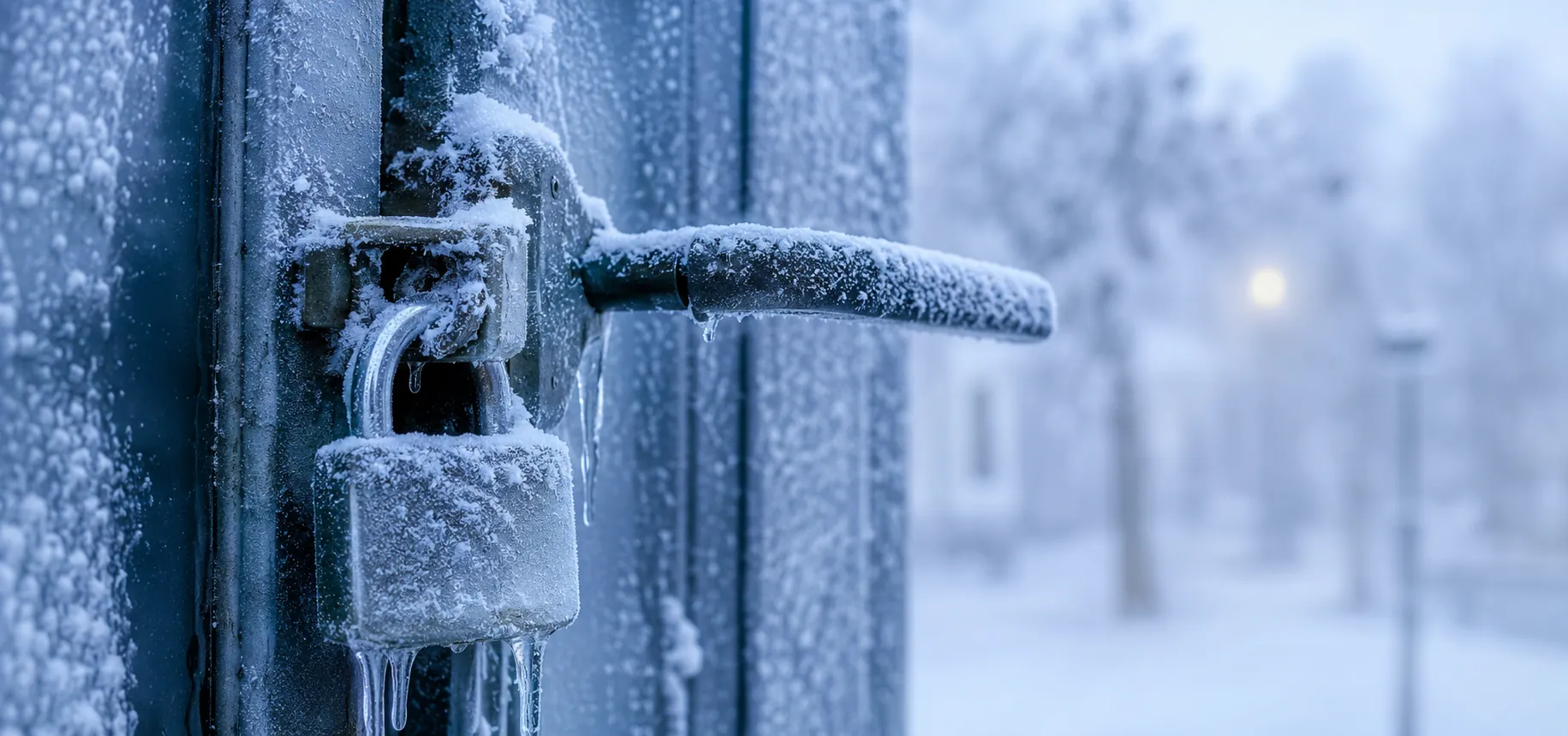
The cylinder is full of fine gaps inside where the pins sit. Condensation builds up there over autumn, sometimes rain that has run down across the door too. When the temperature drops below zero, that water freezes into tiny ice bridges between the pins. The key still fits in, but the pins can no longer move. It jams.
Worth knowing: it is not the key that freezes, and it is not the door leaf. It is the inside of the cylinder. That is why only the methods that bring heat exactly there will work.
The worst affected are outdoor cylinders without weather protection, cellar doors, garden gates and front doors on the weather side. In Sachsenhausen and Niederrad, where there are lots of old courtyard doors, people call in droves in January. New builds with a sealed door and an internal cylinder have the problem far less often.
What actually de-ices
Three things work reliably, and you probably have all three in the house already.
- Warm the key. Lighter, hairdryer or the radiator at a pinch. Heat to the key, not to the lock. The metal carries the heat exactly to where the ice sits. Key in, hold a few seconds, turn. Repeat until it gives.
- De-icer spray. Alcohol based, 3 to 6 euros at the hardware store. Spray, let it work briefly, turn. One thing: the spray belongs in the car and in your jacket pocket, never in the flat. Otherwise you end up standing in front of the very frozen door the spray is locked behind.
- Hand sanitiser. The alcohol in it lowers the freezing point. A little on the key, insert, wait thirty seconds. Works surprisingly well, and since the pandemic nearly everyone has some in a pocket anyway.
What comes next is the step most people forget, and it is the most important one: a drop of graphite or Teflon spray into the cylinder. That drives out the remaining moisture. Otherwise the same door freezes shut again at the next frost and you are stuck outside the following morning.
Hairdryer yes, but with sense
A hairdryer is the best method if you can reach a socket. Hold it ten centimetres from the cylinder, not straight onto the seal, and not onto plastic parts on the door leaf. Two minutes is usually enough. With plastic louvres or painted surfaces, be careful, or you get blisters in the paint.
The mistakes that ruin the cylinder
Now the part where I throw my hands up every winter. Please do not do this.
- Pouring boiling water over the lock. Sounds logical, but it is the worst thing you can do. It thaws for a minute, refreezes at once, and the new ice sits even deeper. Seals swell, on car windows the glass can crack. On a front door the cylinder suffers and you have doubled the problem.
- Forcing it round. The most common write-off. The bit shears off inside the cylinder, and a frost problem turns into a broken key, worst case a drilling job. A key gives way, a cylinder does not.
- WD40 or oil. Hands off. WD40 is a creeping oil, not a lubricant. It gums up over the months, attracts dust, and then the door jams in summer too. I have pulled out cylinders that were practically glued shut inside, just because someone had sprayed WD40 in there for years.
- Screwdriver or pliers on the key. Turn with pliers and you lever the key apart. Then half a key is in the cylinder and the rest is in your hand.
Last January I was called out to Niederrad to a family whose front door had not opened for two days. The son had poured hot water over it, it refroze overnight, and forcing the turn snapped the key in the ABUS cylinder. What would have been a two-minute warming job ended up costing a new security cylinder, around 110 euros plus the callout. Had he simply warmed the key, nothing would have happened.
A week later the same scene in Bornheim, only the other way round. An elderly lady had luckily tried nothing but a lighter. She had warmed the key three times, waited patiently, and the door opened. She had only phoned me to ask whether she had done something wrong. No. Exactly right. That is the difference between 5 euros and 110 euros.
Locked out and in a hurry?
Price quoted up front, vetted partner business, ~22 minutes on site.
Car or front door, is there a difference
Yes, a big one. On a car the door seal is usually the problem, not the cylinder, because modern cars often open by remote. Even so, the same rule applies: never hot water on a cold pane, the tension makes the glass crack. With a jammed remote, the mechanical emergency key inside the fob almost always helps, plus a little patience with the iced-up seal.
On a front door it is nearly always the cylinder. And that costs more to repair than a car window once it has to be drilled.
How to prevent it next winter
Prevention here is genuinely cheap, a few euros in autumn against a ruined cylinder in January.
- In autumn, put graphite or Teflon spray into the cylinder once. No oil, no WD40. It drives out moisture and keeps the pins moving. Once in October is usually enough for the whole winter.
- Keep a small de-icer in the car and in your jacket pocket. Three euros, and you have it with you when you need it. Not in the flat, that is the classic beginner mistake.
- A lock cap or a strip of tape over the outdoor cylinder when frost is forecast. Sounds simple, but it keeps off the rain that freezes overnight.
- Pull the door properly shut in the evening and lock it twice. A door merely latched with a gap draws in moisture, a fully locked one less so.
If you want to do it properly for good, combine that with the yearly lock maintenance as part of your burglary protection. A well-kept cylinder freezes less often, lasts years longer, and protects better on the side, because a smooth-running lock also opens faster in an emergency.
Is a weatherproof cylinder worth it
Yes, if your door is on the weather side and you have the same problem every winter. There are cylinders with a cover and weather protection from ABUS, Winkhaus or BKS that cost a good 60 to 150 euros depending on the security class. For an exposed garden gate in Niederrad or an old courtyard door in Sachsenhausen, that is money well spent. Look for a cylinder to DIN EN 1303, then you get something out of it for burglary protection too. What a replacement costs you can see transparently in our price overview.
Short and sharp, the FAQ
Can I thaw a frozen lock with my breath? On a thin cylinder sometimes, but your breath is moist and brings extra moisture into the lock that freezes again later. Better to warm the key.
Does antifreeze from the car help? Windscreen antifreeze with alcohol works much like de-icer spray. Coolant antifreeze does not, it is not meant for this and does not lubricate.
My key turns, but the lock does not react. Frost too? Possibly, but it could also be another fault. If the key spins in empty space, it is more likely the cam or the lock itself, not the ice.
Should I have the cylinder replaced as a precaution? Only if it is stiff or old anyway. A healthy cylinder needs care, not replacement.
In short: heat to the key, never hot water to the door, and never force the turn. If nothing works after several tries, or a key has already snapped, let a specialist handle it before a 5 euro spray turns into a new cylinder. In a real emergency, when you are standing outside a locked door at night, reach us through the emergency service or simply via the contact form.