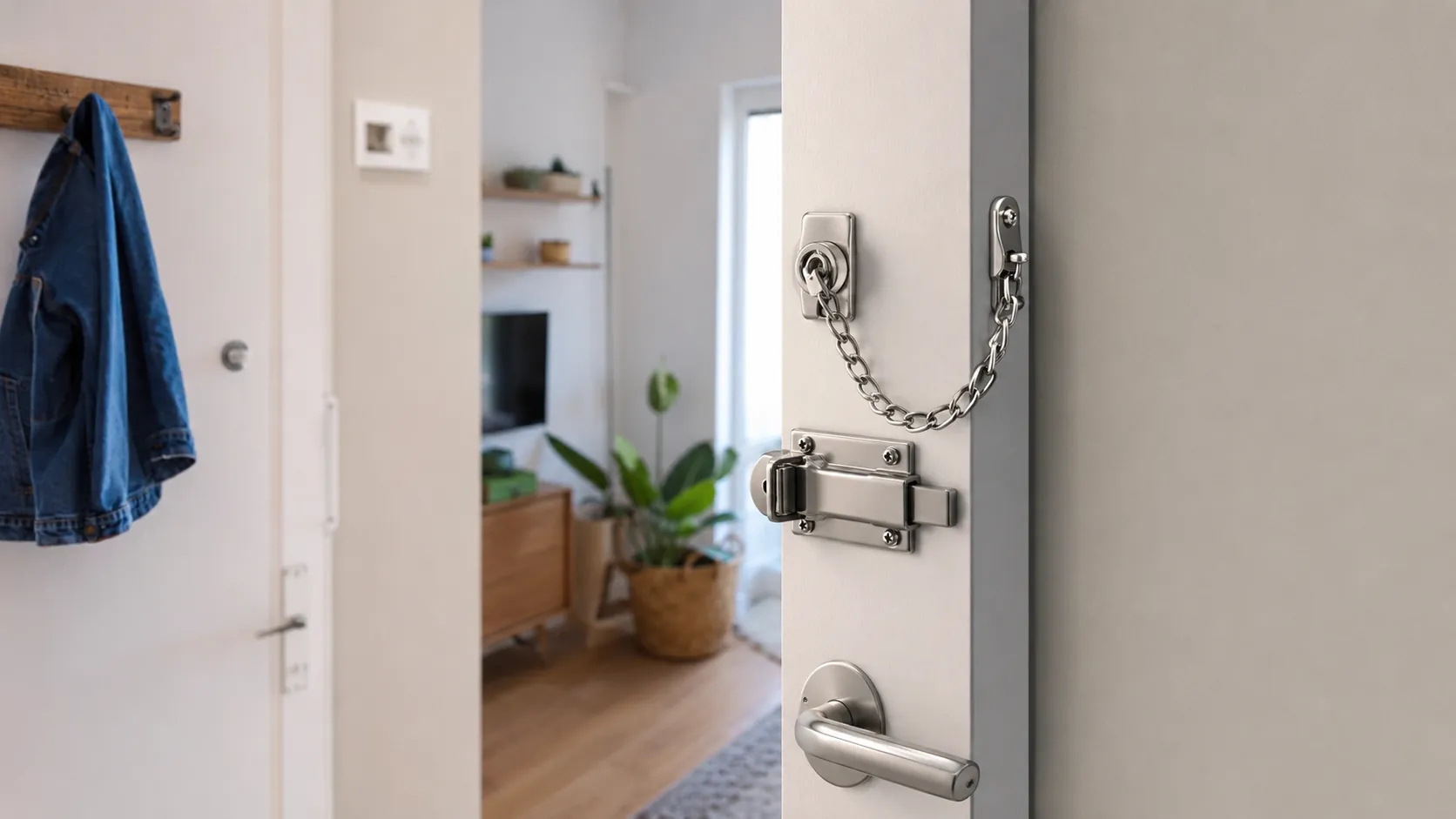

Short version: yes, a historic Art Nouveau door on the Mathildenhöhe can be secured effectively against burglary without harming its substance. The trick is not replacement, it is reinforcement. Surface-mounted hinge-side and box guards, a solid add-on lock and a modern cylinder behind the old escutcheon deliver most of the protection, and nearly all of it is reversible. That is exactly what heritage protection likes: measures you can remove again without a trace.
I am Anna, a locking-systems expert, and for years I have worked on old doors in the east of Darmstadt. The Mathildenhöhe has been a UNESCO World Heritage site since 2021, and you feel it on every handle. Anyone with an original door from 1905 does not want to swap it for a hardware-store steel slab. And they do not have to. But the romantic idea that such a door is safe by its age alone will cost you the break-in when it matters. Let us talk straight, step by step.
Why old doors are a special case
An Art Nouveau door is usually a frame-and-panel leaf in solid pine or oak, often with leaded or etched glass in the upper field. Beautiful. And that is exactly the problem. The lock is frequently still a mortise or box lock with a warded key, the strike plate is thin, and the hinges sit on the outside. A practised burglar needs less than half a minute for that. He levers at the lock or the hinge, the soft wood gives way, and the lovely panel is beside the point because he goes through the frame.
This is not scaremongering. According to police crime statistics, residential burglary nationwide remains among the offences with a low clearance rate, and the vast majority of offenders come in through the simplest weak point, not the most demanding one. On historic doors the simplest weak point is almost always the hinge side or the worn old lock. Understand that and you already have half the job in your head.
Heritage protection as a partner, not an enemy
Many believe that with a listed façade every retrofit is forbidden. That is not quite true. What counts is reversibility and the appearance from outside. Surface-mounted guards on the inside are invisible from the street. And even externally visible fittings can often be chosen in dark, aged brass or iron so they match the door. Important: this is general information from practice, not legal advice. For concrete requirements ask the lower heritage authority of the city of Darmstadt before you drill. A short call saves trouble.
The three problem zones on a historic door
I work through every old door in the same order. Lock, hinges, frame. In that order, because that is where the attacks happen.
First the lock. An old box lock with a warded key is charming but a joke in security terms. The good news: you can keep the box and still close with modern technology. Either a profile cylinder is fitted out of sight, or you add a high-quality auxiliary lock. If you swap the cylinder, insist on drill and pull protection and an emergency function. Which class is worth it we settle on site during a cylinder replacement. If the box is past saving, a proper lock replacement that respects the old look makes sense.
Second the hinges. Outward-opening doors with visible hinges are the classic point of entry. Hinge-side bolts that engage the frame when the door closes help here. On inward-opening doors the leverage point sits differently, but the principle holds: the hinge side must be locked, otherwise the best lock on the latch side does little.
Third the frame. The soft old timber is the sore spot. A massive strike plate, screwed deep and wide, spreads the levering forces. Where the frame is rotten it must be repaired before anything is screwed in. I have seen guards sitting in crumbling wood. That is decoration, not protection.
What I recommend in concrete terms
For a typical Art Nouveau flat door, say in one of the old buildings at the Woogsviertel or in the Johannesviertel, my standard package looks like this: a cross or box auxiliary lock on the inside, a modern cylinder in the existing lock, a hinge-side guard and a reinforced strike plate. It is all surface-mounted, all reversible, and it lifts the door from "open in thirty seconds" to a level where the opportunist gives up and moves on. That is all you want from mechanical security: that it holds long enough for the offender to lose interest.
If you want the whole picture of how mechanical burglary protection and retrofitting work together, you will find the details with us. The order matters: door first, then windows and cellar doors, because a chain is only as strong as its weakest link.
Last week in the Woogsviertel
An example from recently, because it is typical. An owner in the Woogsviertel, an original oak door from around 1908, etched glass, gorgeous. She feared any guard would ruin the door. We worked together with a joiner: the cylinder swapped out of sight, an auxiliary lock in aged brass matching the handle, and the hinge side secured. From the street you see no difference. From inside the door is another calibre. The cost sat in the mid three-figure range, and the original stayed fully intact. That is exactly how it should be.
And a counterexample I do not forget: a door in Bessungen where a previous owner, out of impatience, had driven a cheap box lock into the rotten wood with four coarse screws. At the first firm tug the whole lock tore out along with a chunk of wood. That is the difference between screwed on and properly anchored. If you retrofit in Bessungen or anywhere else in the old stock, have it done by someone who checks the wood first.
Locked out and in a hurry?
Price quoted up front, vetted partner business, ~22 minutes on site.
What does heritage-compliant retrofitting cost?
Honest market ranges, no guarantees, because every old door is different. Prices cover material plus proper fitting in the Darmstadt area.
| Measure | Realistic range |
|---|---|
| Profile cylinder with drill and pull protection | 60 to 150 euros |
| Cross auxiliary lock, surface-mounted | 120 to 280 euros |
| Hinge-side guard (pair) | 40 to 90 euros |
| Reinforced strike plate, screwed | 60 to 160 euros |
| Compact package historic door | 400 to 900 euros |
Sounds like money, but it is a fraction of what a break-in costs in damage and nerves, let alone the loss of irreplaceable things. If you are on a tight budget, start with the cylinder and the hinge side and add the auxiliary lock later. The hinge side always has priority, because that is where levering is quickest.
Common questions on historic doors
Am I even allowed to drill into a listed door? On the inside usually no problem, visible external measures you should coordinate with the heritage authority. That is practical experience, not legal advice. When in doubt, ask first.
Do I have to throw away my beautiful old lock? No. Very often the box stays and only gets modern technology inside. That is the rule, not the exception.
Does an alarm do more than mechanical security? Mechanics physically stop the offender, an alarm only reports. The police recommend mechanics first, then alerting technology. Start with the door.
Is a locking system worth it for a whole Art Nouveau house? If several parties and side doors are involved, yes. A locking system lets one key serve several doors without you carrying a whole bunch. We plan that individually.
And if I lock myself out in the evening? Then please no force on the old door. A gentle door opening is almost always possible without damage to the original. We come out on emergency outside business hours too.
My bottom line
Historic doors on the Mathildenhöhe and across the east of Darmstadt deserve protection that respects their beauty. It is possible, and better than most people think. Reversible, discreet, effective. Start at the hinge side and the lock, check the wood, and coordinate visible measures with heritage protection. If you are unsure, we will look at the door together. Concrete prevention tips are also available from the police at K-Einbruch and from the BKA, and if you want to go deeper our guide will help. Short answers to recurring questions we also collect in the FAQ. An old door is a piece of city history. You do not have to sacrifice it to live safely.