
Lost your key, and now the anxious question: who pays for the new cylinder, me as the tenant or the landlord? The short, honest answer is: as a rule, whoever caused the loss. If you mislaid your flat key in the spa park, you usually bear the cost of the new cylinder and the new keys. But, and this is the part hardly anyone knows, that does not apply without limit, and with an expensive master-key system in particular you can push back against excessive demands.
I am Nina Hartmann, and for years I have advised tenants in Wiesbaden, many of them from the densely let buildings around the Kurviertel, in the Westend and in Biebrich. The lost key is one of the most common disputes that land on my desk. And almost always the alarm is greater than the actual damage. First the important sentence: this is general information from advisory practice, not legal advice. In a real dispute, the tenants' association or a lawyer helps.
The core: fault decides, not the tenancy agreement alone
Forget the fear of the small print for a moment. Whether you pay does not depend on what is written somewhere in the contract, but on whether you are responsible for the loss. If you lost the key, that is on you, and then you generally bear the resulting cost. If the key snapped during entirely normal use, or the lock became old and weak, that is not fault but wear, and wear is the landlord's business.
Two situations that get confused all the time:
- You lose the key: your problem, your cost.
- The key snaps because the cylinder is worn out: wear, the landlord pays.
Sounds simple, and in principle it is. It only gets complicated when a single lost key allegedly requires replacing a whole master-key system. More on that shortly, because that is exactly where the biggest bills get written.
Single lock or master-key system? That is the 1000-euro question
The whole difference between a harmless and an expensive bill hangs on this one question. Settle it first.
With a completely normal single lock, as sits in many period flats in the Westend, the matter is cheap. You simply have the cylinder replaced, get new keys, done. A standard cylinder often costs only 15 to 40 euros as a part, a security cylinder more, and fitting is over in a quarter of an hour. Even if you pay it in full, it does not hurt.
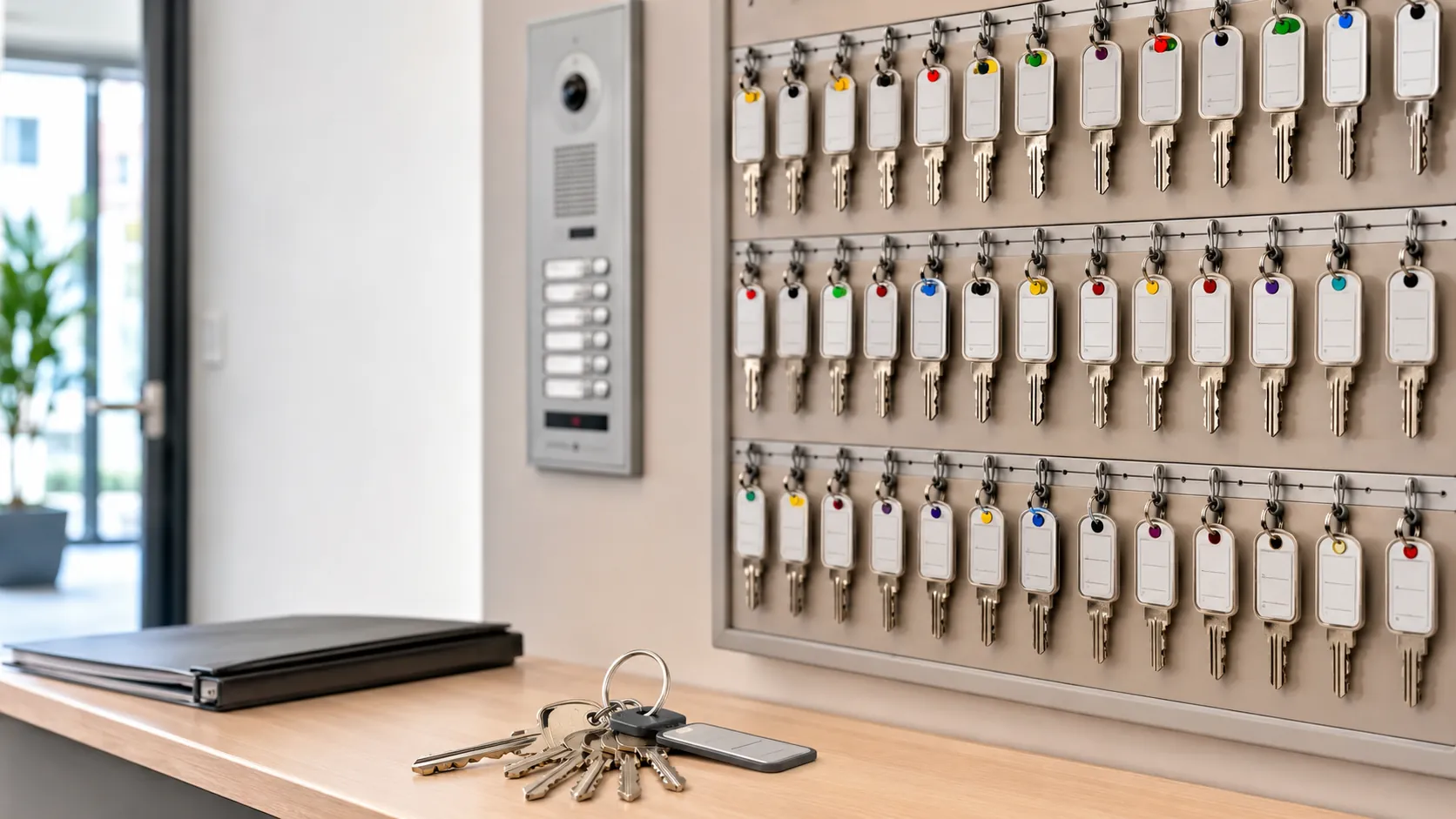
It is entirely different with a master-key system. That is a setup where one key locks several doors, say the front door, cellar, flat and laundry room. In larger housing complexes, as found in Biebrich and Bierstadt, such systems are the rule. If a single key is lost there, some landlords argue that now the entire system must be swapped, all cylinders, all keys of all tenants. And that can quickly run into four figures.
When you have to pay for the whole system, and when not
Now comes the point that can save you a lot of money, so read carefully here. Just because a key is gone does not mean you can automatically be billed for the complete new system. Several things have to come together.
First, there has to be a genuine risk of misuse at all. If the key demonstrably falls into the sea or into a drain no one fishes it out of, the risk is low. If, on the other hand, the key carries a tag with your address and went missing in the city centre, it looks different.
Second, and this is decisive, the landlord may only demand replacement of the whole system if he actually replaces it. A bare invoice for a system that stays in the lock is not something you have to pay. Courts have stressed this principle repeatedly in the past. I put it deliberately in general terms, without throwing a case number at you that might not fit your situation at all.
My advice when such a demand arrives: stay calm, ask in writing for a comprehensible breakdown, and demand proof that the system was really replaced. Very often the demand then shrinks on its own.
The insurance hardly anyone thinks of
Here tenants give away money year after year. A private liability insurance covers, in many tariffs, the loss of third-party keys, and that includes your landlord's flat or master-system key. Some policies even cover the cost of replacing an entire master-key system if the right clause is in there.
So before you pay out of your own pocket or panic: dig out your liability policy and look for the keyword key loss. If it is in there, report the claim before you sign or transfer anything. Independent, plain explanations of such clauses can be found at the German consumer advice centre, the Verbraucherzentrale, and anyone in an actual tenancy dispute is in good hands at the German Tenants' Association.
Locked out and in a hurry?
Price quoted up front, vetted partner business, ~22 minutes on site.
How to proceed concretely when the key is gone
Enough theory. If the key is missing tonight, take it in order:
- Search calmly first. Spa park, jacket, the cafe by the Kochbrunnen. Most keys turn up again.
- If you cannot get into the flat, you first need a door opening. A reputable service opens most flat doors without damage, nothing needs to break.
- Inform the landlord or property manager if it is a master-system key. That is proper, and better than concealing it.
- Only then decide whether anything needs swapping at all. For a simple flat key with no address tag, which you probably lost at home, the effort is often overblown.
- Check your liability insurance and report the claim there if applicable.
If a swap really is needed, have the lock replaced properly and get a decent set of keys made at the same time, so you are not left with one crooked spare. Anyone who just needs a second key for daily use often comes off cheaper with key cutting than with a complete swap.
What it costs, in honest ranges
So you can place an invoice. These are market figures from Wiesbaden, not fixed prices, and they vary by time of day and effort:
| Situation | Realistic range |
|---|---|
| Open flat door without damage, daytime | 80 to 130 euros |
| Opening in the evening, night or weekend | 140 to 220 euros |
| Swap standard cylinder, fitted | 90 to 180 euros |
| Swap security cylinder, fitted | 150 to 320 euros |
| Cut a single spare key | 8 to 40 euros |
| Renew a complete master-key system | four figures, heavily property-dependent |
You can see: between the harmless cylinder swap and the system replacement lie worlds. That is exactly why it pays to settle the single-lock-or-system question before any payment.
On moving out: the key trap
A classic from my advisory work, just last week again. A tenant from the Kurviertel moved out and could no longer find one of three front-door keys. The landlord wanted to withhold the deposit and charge for half the master-key system. We pressed: was the system swapped? No. Was there a concrete risk? The key had no marking at all, presumably vanished in the moving chaos. In the end there was a new key for small money, and the deposit came back almost in full.
The lesson: at move-in, count how many keys you receive and have the number confirmed in the handover protocol. At move-out you return exactly that number. If one is missing, clarify at once whether it is a system and whether a swap is really needed. Whoever documents the handover cleanly spares themselves almost all the trouble.
Frequently asked questions
I only lost one of several flat keys, does the cylinder still have to come out? With a simple single lock, that is your decision by sense of security. It is not mandatory as long as no stranger has access to the flat and the key cannot be traced to your address.
The landlord wants to swap the whole master-key system at my expense. Do I have to swallow that? Not unchecked. Demand a breakdown and proof that the system was actually replaced. Without a real swap and without concrete risk, the blanket demand is contestable. This is general info, in a serious case go to the tenants' association.
Does my insurance pay for the lost key? Often yes, if your private liability has a key clause. Check the policy and report the claim before you pay.
Who pays when the key simply snapped in the lock? That is usually wear and thus the landlord's business, not your fault. Do not confuse loss with breakage, those are two completely different pairs of shoes.
Where do I find reliable further information? We collect neutral guides in our guide section, and answer common individual questions in the FAQ. For a real dispute the tenants' association remains the best address.
My bottom line
A lost key is annoying, but rarely a financial drama. Remember two things: first, clarify at once whether it is a single lock or a master-key system, because everything hangs on that. Second, check your liability insurance before you pay. Everything else is calm and clean documentation. If you are standing in front of your door in Wiesbaden and cannot get in, the emergency service helps in a pinch, and anyone who wants to read up on services and process beforehand finds it all at the Wiesbaden locksmith. And once more, because it matters: this is everyday knowledge from advisory work, no substitute for advice in your specific case.