If your front-door key also opens the cellar door, the bin room and your flat door, you live with a master-key system. Handy, yes. But: lose a single key and, in the worst case, the entire system may have to be changed over, and that quickly runs into four figures. I have been building these systems for eleven years, and I will explain plainly here how the thing works, why a lost master key is so expensive and who really pays in the end.
This is not a scare article. It is an operating manual for something most people own without ever having understood it.
What a master-key system technically is
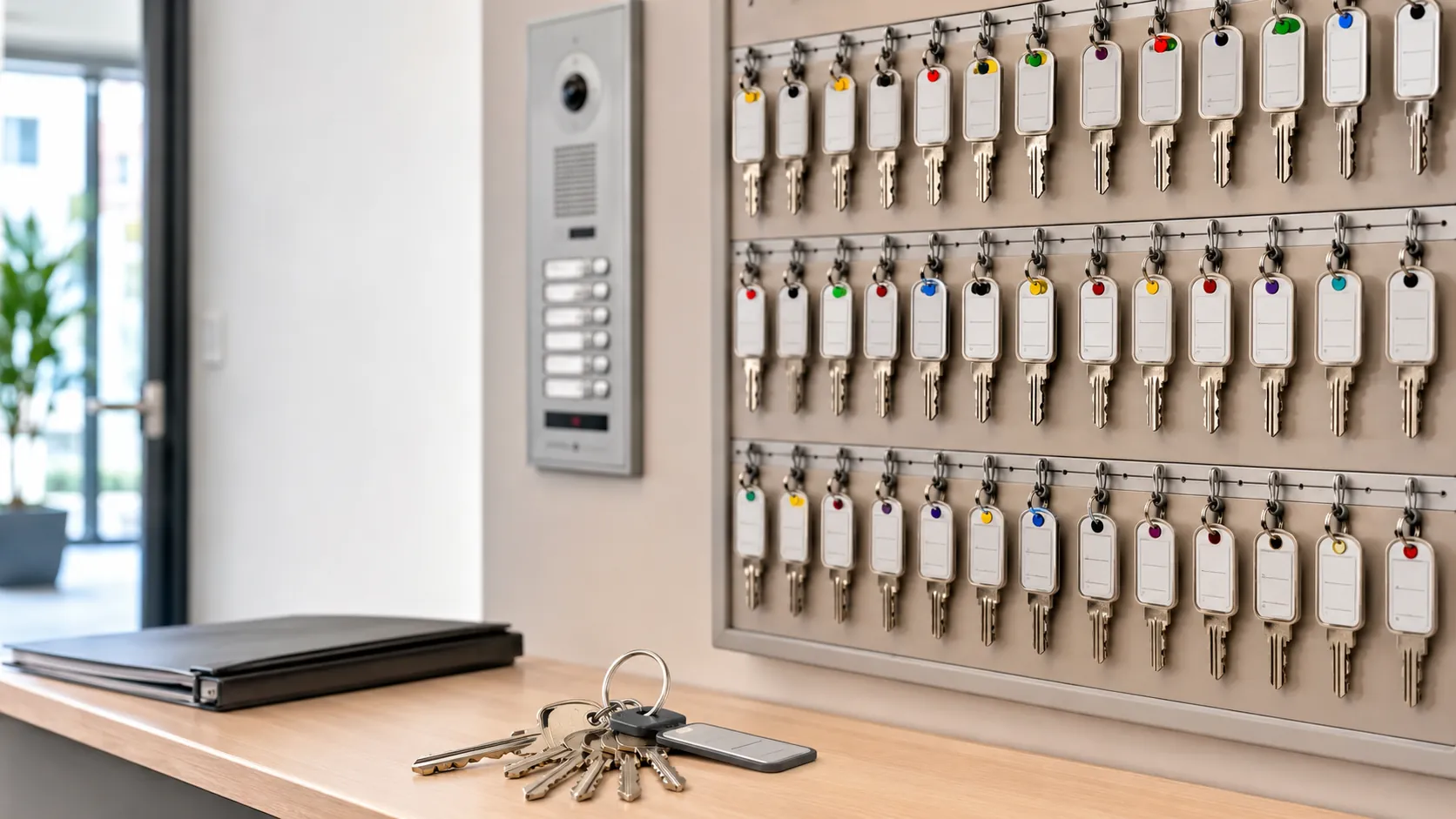
A master-key system is not a single lock. It is a coordinated system of many cylinders that work together to a plan. The core is the so-called locking hierarchy. Every key may open exactly the doors the plan provides for it, and no other.
To make that work, small pin pairs sit inside every cylinder, sprung one above the other. The key bit lifts these pins to an exact height, the shear line. Only when all pins stand on that line at the same time does the cylinder turn. In a system, extra shear lines are built in, so-called master pins. That is how one cylinder opens to more than one matching key: your own flat key and the master key.
The typical system types
- Central locking system (ZSA): Everyone has their flat key. In addition, all flat keys open the shared doors, the front door, cellar and bin room. The classic in an apartment block.
- General master-key system (GHS): More complex, several levels of master keys. More for commercial use, property management, large residential estates.
- Keyed-alike: All doors open with the same key. Convenient, but in security terms the opposite of clever, because one key really opens everything.
For most Frankfurt rental buildings we are talking about a central locking system. My tip from practice: when a new system is installed, always insist on a locking plan on paper. Who opens what. Without that plan, nobody can extend it cleanly later. How a cylinder works inside in detail and what multipoint locking has to do with it, I took apart in the piece on cylinders and multipoint locking.
Why these keys are copy-protected
A master-key-system key is not a hardware-store key. With good systems, ABUS, EVVA, Winkhaus, Kaba or BKS, every system comes with a security card. Without that card and without the signature of the authorised person you get no duplicate key. Full stop. That is by design. The key often has moving elements or borings that no standard copying machine can reproduce.
That is exactly why a single duplicate does not cost 4 euros like at the cobbler, but rather 15 to 60 euros, depending on the system and profile. That annoys a lot of tenants. But this very protection is the reason the system is secure at all. A profile anyone can copy is worthless in an apartment block.
Hands off cheap no-name systems without a security card. In Bockenheim I took over a system where the previous owner had had keys copied at a discount store. Nobody knew any more how many keys were in circulation. That is no longer a master-key system, that is a gamble.
Why a lost key costs so much
Here comes the point where people swallow hard. Lose a perfectly ordinary flat key that is not part of a system, and we swap one cylinder. 60 to 150 euros for a good security cylinder to DIN EN 1303, plus call-out and labour. Half an hour, done.
But lose a key that belongs to the master-key system and also opens the front and cellar doors, and the situation is different. Anyone who finds this key can theoretically get into the building, the cellar, the underground garage. And now comes the crucial part: you cannot simply redo one door. All the cylinders are matched to each other. Swap only the front door, and the old flat key no longer fits the front door, while the found key still opens the cellar.
In the worst case the system has to be changed over. That means: new cylinders for every door the lost key opened, plus new keys for every household, each one with a new security card.
A rough cost estimate from practice
| Item | Range |
|---|---|
| Single security cylinder (DIN EN 1303) | 60 to 150 EUR |
| Key with security card, each | 15 to 60 EUR |
| Changeover small system, 4 to 6 households | 700 to 1,500 EUR |
| Changeover medium system, 10 to 14 households | 1,500 to 3,500 EUR |
These figures are guide values from Frankfurt jobs, not set in stone. It depends on the system, on the number of shared doors and on the number of keys that have to be supplied. With ten flats, where each household needs two or three keys, the key money alone adds up considerably. An honest upfront estimate is also on our pricing page.
Locked out and in a hurry?
Price quoted up front, vetted partner business, ~22 minutes on site.
Who pays? The really tricky question
Now to tenancy law, because this is the part where most conflicts arise. Principle: whoever caused the loss is liable. If you, as a tenant, lose your key, the landlord can claim damages. So far so clear.
But, and this is huge: the landlord may not automatically renew the whole system at your expense. The case law demands two things.
- There must be a concrete risk of misuse. So the key really has gone missing, not just been mislaid in your own cellar. If the key is demonstrably somewhere safe, the risk is often absent.
- The changeover must actually be carried out. Notional costs, meaning the landlord bills but never swaps, the tenant generally does not have to pay.
That is a real lever. I have seen tenants billed a flat 2,000 euros for a changeover that never happened. You do not have to accept that. The Federal Court of Justice has ruled in a tenant-friendly way here several times. If you are unsure, also read who pays for the lock change, where I go deeper into the liability questions.
What insurance covers
Many private liability insurance policies expressly include damage to third-party master-key systems. Often listed under the keyword key loss. Check your policy carefully, because the cover limits vary widely, from 5,000 to 1,000,000 euros. Without this module you are left with the excess, or worse, the whole sum. The consumer advice centre expressly recommends paying attention to the inclusion of master-key-system damage when taking out liability insurance. Good advice, costs a few euros more per year at most and saves you from the four-figure hole when it counts.
Two cases from Frankfurt that show how it goes
Last week in Sachsenhausen: a tenant called me in a panic, his master key had been left on the bus. Six households, cellar, courtyard door. We first checked whether the key was really gone. Lost-property office, bus company, nothing. So a changeover. Final figure around 1,350 euros. His liability policy had the inclusion, he paid 150 euros excess. Had he not had the policy, the whole sum would have stayed on him.
Three weeks ago in Nordend, the opposite case: a landlady wanted to swap the entire system because a tenant had lost a flat key, which however did not open the shared doors. I waved it off. A single new cylinder for 95 euros plus two keys was enough. Nobody had to touch the system. Sometimes my most important job is to prevent an expensive and unnecessary changeover.
The lesson from both: always clarify first which doors the lost key actually opens. A pure flat key is a small problem. A master key is a big one.
How to avoid the drama from the start
- Treat the master key like cash. Do not label it, do not carry the address on the ring.
- Carry flat and master keys separately, never on the same ring.
- Report a loss immediately, to the landlord and, if applicable, the property management. Acting fast lowers the risk and strengthens your position.
- Before any changeover, demand a written quote, itemised by doors and keys. That way nobody bills more than necessary.
- When a new system is installed, go straight for expandable systems, so a single flat can be retrofitted later without redoing everything.
If something is acute, say you are standing locked out in front of the door in the evening, our emergency service will help, without putting the whole system at risk.
Common questions answered briefly
Does the whole system have to be swapped for every lost key? No. Only if the key belongs to the system and a real risk of misuse exists. A pure flat key with no access to shared doors often needs only a cylinder swap.
Can I have the changeover done by the cheapest provider myself? As a tenant you pay, but the landlord owns the system and determines the system and execution. Agree it together, otherwise there will be a dispute over the proportionality of the costs.
What if I find the key again later? If no changeover has happened and there was no real risk, usually all is well. If it was already swapped, the costs have unfortunately been incurred.
If you are planning a system yourself or want to extend an existing one cleanly, we are happy to advise on locking systems that are sensibly graded and expandable from the start. A well-planned system saves you exactly the costs this article is about.