The short answer for everyone living in a Hamburg period building who does not want to swap their beautiful old front door for a grey steel one: you do not have to. In nine cases out of ten a brick period door from the Gruenderzeit or Jugendstil era can be upgraded to offer modern burglary protection while still looking like 1905. The leaf stays, the technology behind it is renewed. That is exactly my daily work.
I am Anna, a locking-technology expert, and I spend half the week in stairwells between Sternschanze and Eimsbuettel, where red brick still shapes the streets. These doors were built to last a hundred years, and they do. It is just that the lock inside them often dates from a time when a simple ward key counted as secure. Let us talk about what to do and what to leave alone.
Two doors, two jobs: building entrance and flat door
The first thing I have to clarify when I enter such a building: which door are we actually talking about. In a Hamburg period building there are almost always two levels. The large communal entrance door to the street, often double-leaf, with a fanlight and carved detail. And behind it, a floor up, your own flat door.
The two have completely different jobs. The building entrance door does not seriously stop anyone who wants in, because during the day it is held open anyway by couriers, neighbours and tradesmen. It is a social threshold, not a security component. The real security line is your flat door. Whoever puts their budget into the wrong one of the two is paying for looks, not protection. My advice is unambiguous: the flat door first, then everything else.
Why the old flat door is better than its reputation
One thing I keep having to tell people in Eimsbuettel: your old flat door is often more solid than any hardware-store door today. Solid wood, a two-centimetre rebate, a frame still anchored in the masonry. The substance is there. What is missing is the technology. A leaf like this needs no replacement, it needs a better lock, a protective fitting and usually an additional lock. That is a fraction of the cost of a new door, and you keep your lovely old leaf.
What actually helps on a brick period building
Let us go through it in order, the way I recommend it on site. Not everything at once, but in the sequence in which each euro does the most.
The cylinder first. Old doors often still have a simple cylinder with no protection against drilling or pulling. A modern cylinder with drill and pull protection, plus a security fitting with a cylinder cover, that is the basis. With the cylinder I insist on an emergency function so it can be unlocked from inside even when a key is in the outside. What a lock replacement involves in detail is covered separately.
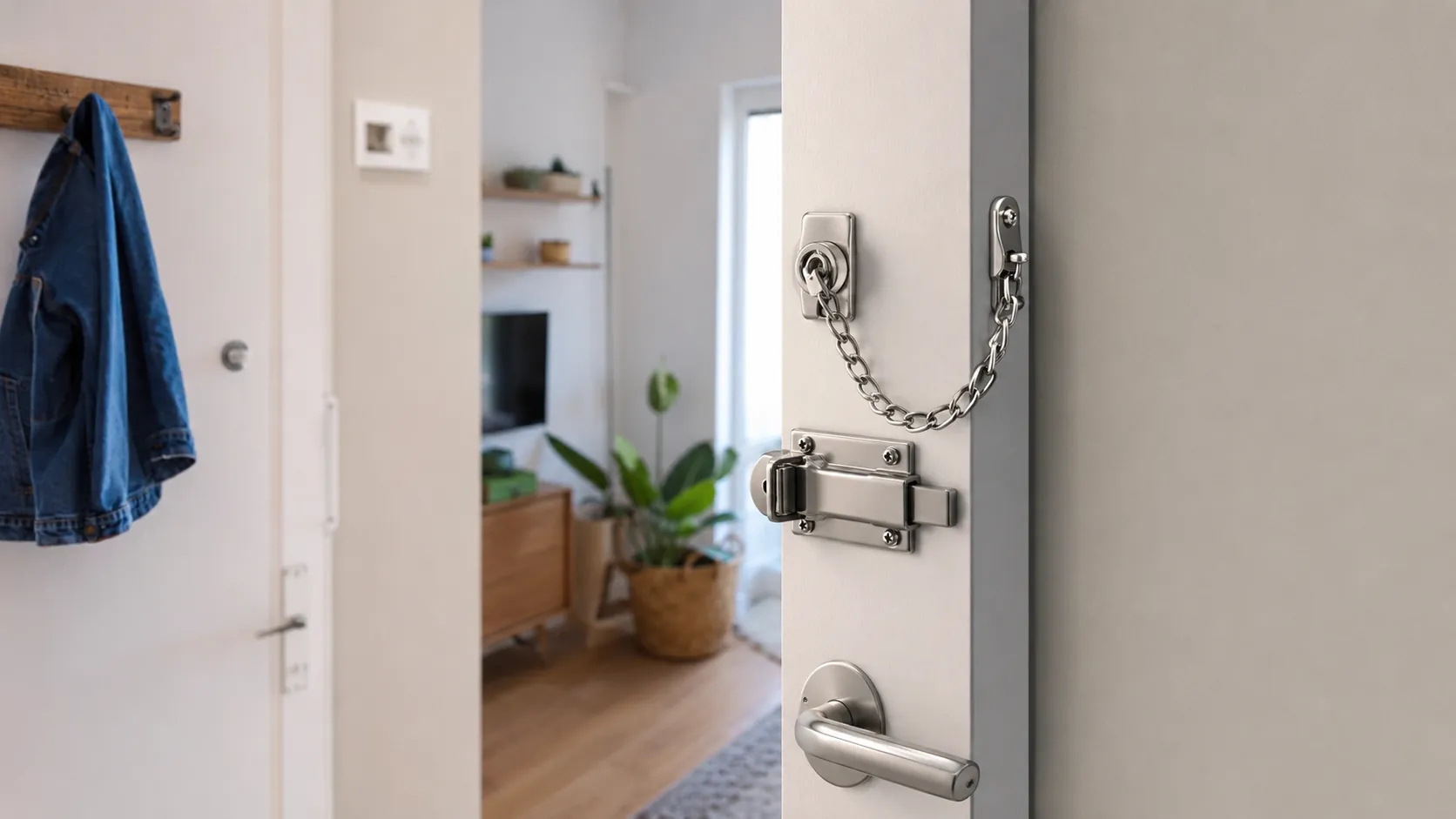
Then the steel cross-bar or additional lock. On old doors the cross-bar is my favourite, because it bolts right across the whole leaf and carries the force into both frame sides. On a solid wood leaf in a period building that holds enormously well. It sits on the inside, from outside you see only an unobtrusive lock. Heritage protection rarely has a problem with it, because the street side stays unchanged.
And third, the hinge side. Old doors often open outwards, and then the hinges are on the outside. This is where hinge-side bolts belong, small steel pins that engage in the frame when the door is closed. Cheap, invisible, effective. Anyone tackling it comprehensively will find the full range under burglary protection.
The Schanze: charm, open front doors and a realistic view
Now to the Sternschanze, because it is a special case. Around the Schulterblatt and Susannenstrasse there is a lot of Gruenderzeit, often with shops on the ground floor, plenty of through-traffic, plenty of anonymity. The building entrance doors here feel like they stand open more often than closed. That is part of the district, and I will not tell anyone to turn the Schanze into a fortress.
But that is exactly why the flat door counts double here. When the front door is practically always open, a stranger stands at your door within seconds, unnoticed. In a situation like that a cross-bar plus a good cylinder is not a luxury, it is the minimum. In the Schanze I have seen flats with an alarm system next to a flat door with a lock from 1970. That is the wrong order.
Last month in the Schanze
A case that shows well what this is about. Last month a couple called me from a period building near the Schulterblatt. Beautiful old door, original leaf, but it stuck and closed badly. They thought the door was finished and had to go. It did not. The leaf had settled minimally over the decades, and the bolt no longer met the strike plate cleanly. We realigned the strike plate, set a security cylinder with pull protection and fitted a cross-bar. Half a day's work. The hundred-year-old door now closes more snugly than on day one, and it is more secure than most new-build doors in the district. Replacing the leaf would have been a mistake, technically and financially.
Eimsbuettel: the Osterstrasse and the typical apartment
Eimsbuettel runs to a different beat, quieter, much residential, less through-traffic than the Schanze. Around the Osterstrasse the classic apartment buildings line up, three to five storeys, brick, solid stairwells. Here the flat door is usually easy to reach and the neighbourhood more attentive, which helps. Even so, I see the same weak point as everywhere: good body, tired lock.
In Eimsbuettel it often pays to look at the whole locking system in the building, especially when several parties share a master key for the entrance, cellar and flat. A clean locking system solves the problem of lost keys elegantly, without the whole house needing new cylinders straight away. That is a conversation I am happy to have with the owners' association before anyone rashly swaps everything.
Locked out and in a hurry?
Price quoted up front, vetted partner business, ~22 minutes on site.
Heritage protection, tenancy, and who is allowed to do this
Two questions come up every time. First, heritage protection. Many Hamburg period buildings are listed, but that usually concerns the externally visible facade and the street-facing design, not the inside of your flat door. A cross-bar inside, a modern cylinder, a hinge-side bolt, all of that stays invisible from the street and is usually entirely unproblematic. With work on the communal street-facing entrance door it gets trickier, so talk to the management first and, when in doubt, to the heritage authority. This is general information, not legal advice.
Second, tenancy. As a rule you may fit additional locks in a rental that can be removed again with little trace. A screwed-on cross-bar often falls into that category, a complete rebuild of the strike plate rather into an agreement with the landlord. What is concretely allowed here is explained well and neutrally by the consumer advice centre. And if you want to know which upgrade the police recommend, look at the prevention campaign K-EINBRUCH.
What it costs, honestly reckoned
Guide values for Hamburg. No fixed price, because every period door has its quirks, but ranges you can hold on to.
| Measure on the period door | Realistic range |
|---|---|
| Security cylinder with pull protection plus fitting | 130 to 280 euros |
| Steel cross-bar, supplied and fitted | 250 to 550 euros |
| Additional lock with locking bar | 150 to 350 euros |
| Hinge-side bolts, per door | 40 to 120 euros |
| Realigning the strike plate, adjusting the door | 60 to 150 euros |
A word of caution. If someone on the phone wants to completely renew an old period door for a flat price, unseen, hang up. These doors are judged on site, with a hand on the leaf. I measure the rebate first, check the frame, look at the strike plate, and then I tell you what makes sense. Anything else is selling, not advice. More guides on exactly these topics are in our guide.
Common questions
Do I really not have to replace my lovely old front door? In the vast majority of cases, no. A healthy solid-wood leaf from a period building is an excellent basis. What gets replaced is the technology, not the leaf. Replacement is only worth it if the wood is truly warped or rotten.
Will I run into trouble with heritage protection? With work on the inside of your flat door almost never, because it stays invisible from outside. With the street-facing entrance door you should speak to the management and authority first. When in doubt, ask before you drill.
Cross-bar or additional lock, which is better for a period building? For a wide solid-wood leaf I almost always take the cross-bar, because it bolts the whole width of the door and carries the force into both frame sides. The narrow additional lock is the smaller solution when space or budget is tight.
I have locked myself out, will the period door get damaged when it is opened? With clean work, no. A proper door opening on a period door is in most cases non-destructive, precisely because the good old lock has no armouring yet that would block picking.
My bottom line
Hamburg brick building gives you something no new build offers: a door with substance and history. Do not throw that away, upgrade it wisely. Flat door first, then the rest. A cylinder with pull protection, a cross-bar right across the leaf, the hinge side secured, and your hundred-year-old door beats any standard hardware-store door. In the Schanze that counts double, because the front door is rarely shut, in Eimsbuettel it often pays to look at the whole locking system in the building. If you are unsure, we come by as a locksmith in Hamburg and take a look. On emergency too, when it has to be quick, and all further answers are in the frequently asked questions. Oh, and in Ottensen, Altona-Altstadt, Neustadt and Barmbek-Nord stands the same lovely brick, the same doors, the same solution.