The short answer first, because it is why you are here: most front doors from Hanau's reconstruction, the typical doors of the fifties and sixties, you do not need to replace. You need to retrofit them. A new cylinder with pull protection, a proper strike plate, an add-on lock, and you have turned a charming old door into a secure one, for a fraction of what a new one costs. When that is no longer enough, I will tell you too, and honestly.
I am a locking-technology expert, sixteen years now, and I assess doors after break-ins and for insurers. That means I see every day what holds up and what only looks expensive. In Hanau this is a particular topic, and to understand it you have to glance briefly at history.
Why Hanau has so many doors cast from one mould
Hanau was largely destroyed in an air raid in March 1945. The old town was practically gone. What followed was reconstruction, fast, pragmatic, in the fifties and early sixties. That is why in Hanau you find a density of post-war buildings that few cities have. Whole rows in the Innenstadt, in Lamboy and in Kesselstadt date from that era, often with their original front doors, which surprisingly often still hang there.
And that is the point. These doors are well built. Solid wood, sturdy frames, fittings from a time when nothing was glued but screwed and mortised. Anyone who rips out such a door because a salesman scared them throws away substance that new hardware-store doors rarely reach. The problem is almost never the door leaf. The problem is the locking technology inside it, which has stayed at the level of 1958.
What on these doors is really outdated
When I open such a door and look inside, I usually see the same thing. A simple bit-key or an early profile cylinder without any pull protection. A thin strike plate held by two short screws in the soft frame wood. And a bolt that travels barely a centimetre into the plate. That is the weak point, not the wood. Exactly these three things can be swapped individually, without touching the door.
The cylinder is almost always the first thing that has to go
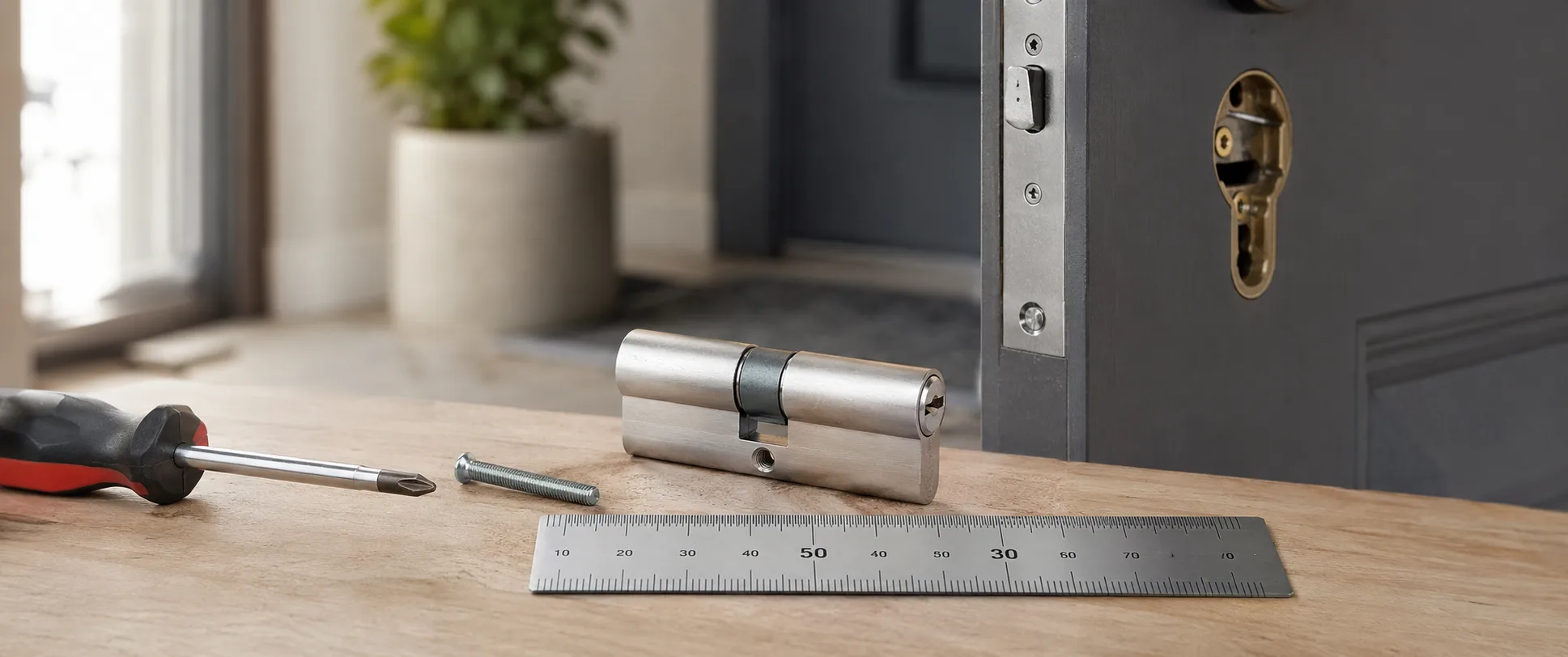
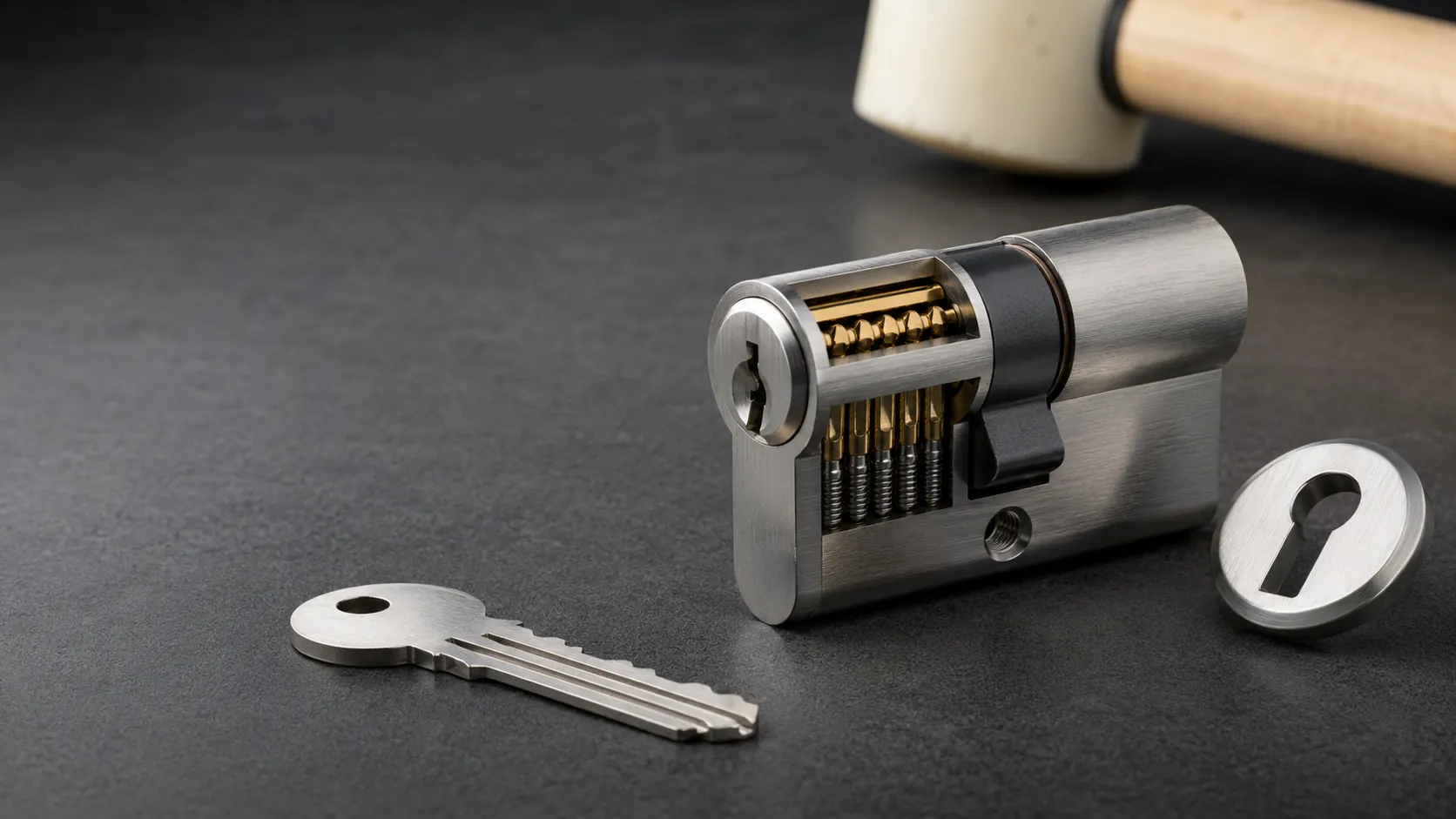
If your door still has an old cylinder protruding past the fitting, that is the most urgent job. Not because the key is bad, but because a protruding cylinder is ripped out with pliers in thirty seconds. A modern locking cylinder with pull and drill protection sits flush, absorbs the attack with hardened pins, and costs realistically 40 to 120 euros as a part, depending on the security level and whether you want an emergency function so it can be unlocked from inside even when a key is in the outside.
The correct length is crucial. A cylinder that protrudes again is money thrown away. That is why I measure on site before I order anything. Those few millimetres decide half your security. And yes, a good cylinder alone does not yet make a secure door, but it is the starting point everything else aligns to.
The strike plate everyone underestimates
Here I get blunt, because it annoys me again and again in reports: the best lock is useless if the bolt travels into a plate held by two short screws in rotten framing. On post-war doors the frame has often gone soft. A security strike plate, long, screwed deep into the masonry behind, turns exactly this weak point into a strength. It costs little and works enormously. If I were allowed to do only a single thing to an old door, it would often be this.
When retrofitting is enough and when it is not
Now the honest part, because I do not sell you retrofitting at any price. There are doors where I recommend replacement, and for good reason:
- When the door leaf has warped and no longer closes cleanly. A door that sticks or lets air through no longer seals or secures, whatever cylinder sits in it.
- When the frame is so rotten that no strike plate grips properly anymore. Then you secure into thin air.
- When you want insulation and sound protection at today's standard. A sixties door cannot deliver that by design.
In all other cases, and that is the majority, retrofitting is the smarter choice. Whether in a given case a full lock replacement or the targeted upgrade of the existing mechanism makes more sense, I only decide once I have opened the door and checked the frame. Anything else would be guesswork.
Recently in Kesselstadt
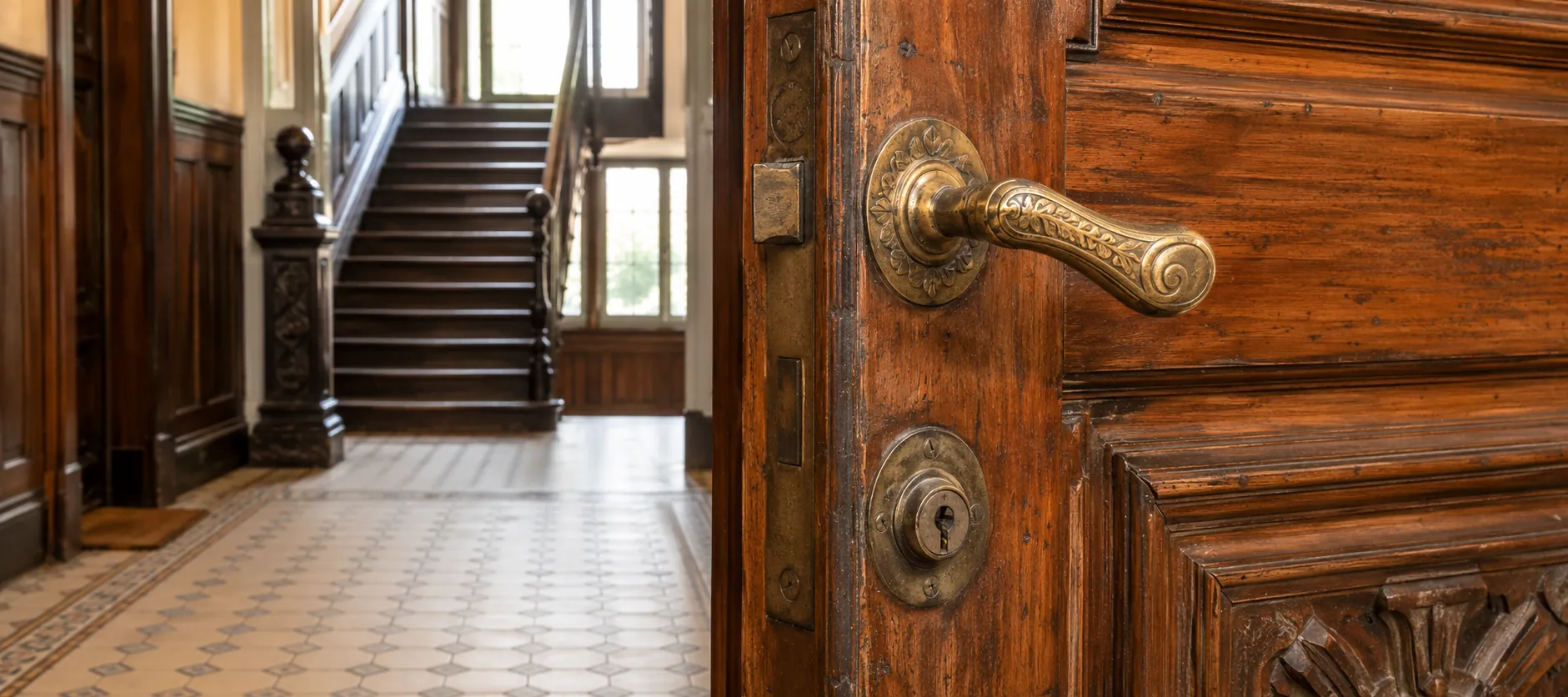
A case that stuck with me. An older couple in Kesselstadt, a flat in a reconstruction block from 1957, original flat door, heavy, dark, beautiful. An acquaintance had talked them into thinking it had to go, ancient after all. I unscrewed it. Inside, a bit-key lock you open with a bent wire, and a plate with two little screws. The door leaf itself? Sound to the core, solid, better than much of what is sold today.
We retrofitted a mortise lock with a profile cylinder, set a long security strike plate and added a door chain for opening on the latch. Cost well below what a new door with frame and fitting would have cost, and the result more secure than a standard off-the-shelf door. The two of them love that door, and rightly so. Sometimes retrofitting is not only cheaper but also the finer answer.
The bit-key and why it cannot stay
Many of these doors still have the original bit-key lock, that large, romantic-looking key. Let me say it plainly: as protection against burglary it is nothing. A practised hand opens such a lock with a simple tool in seconds, and copies are available on every corner. For the cellar door or a pure interior door it may do. For the flat or front door, a profile cylinder belongs in it.
The good news: converting from bit-key to profile cylinder is a standard job on most of these doors. And if you then want clean, copy-protected keys, have them cut properly straight away, rather than at the cheap machine where quality varies. A properly milled key lasts years, a soft blank fatigues and eventually breaks in the lock.
Locked out and in a hurry?
Price quoted up front, vetted partner business, ~22 minutes on site.
Maintenance, so the old technology lives long
Old doors reward care like almost nothing else. Twice a year a suitable care product into the cylinder, not oil that resins over and binds dust, but a graphite or teflon spray. Check the hinges, tighten them, a drop in the right place. Look at the seal, if there is one. It sounds banal, but most of the damage I assess is nothing but years of neglected wear.
A cylinder that becomes stiff announces itself. When the key catches, when you have to turn with force, that is no reason to ignore it, but the warning before the day it blocks completely or the key breaks. Then you stand outside. Whoever maintains the door in time needs us less often on emergency callout, and as a tradeswoman I honestly prefer that to the expensive job at ten in the evening.
And burglary protection, while I am at it?
If the door is open anyway, it pays to look at the whole. A door chain that lets you open a crack without releasing the door. A wide-angle viewer or a simple intercom. On ground-level doors a second locking point. These are small steps that turn a retrofitted door into a noticeably secure one. Which of them suits your situation is part of a proper consultation on burglary protection, and no, that does not mean you need all of it.
Anyone wanting to read up neutrally before buying anything will find understandable guidance from the consumer advice centre on what mechanical security can achieve. And anyone wanting to know how their neighbourhood stands can ask the city of Hanau and the local advice services. I link this deliberately, because informed customers make the better decisions.
Frequent questions
Is retrofitting worth it at all on such an old door? In most cases yes, because the door leaf itself is the best thing about the door. You swap the technology, not the door. Only once the frame or leaf is finished does the calculation tip.
Can I change the cylinder myself? The cylinder yes, if you measure correctly and buy the right length. Screwing the strike plate in deep and checking the mechanism is better left to someone who knows the old systems.
Can I still get spare parts for a sixties door? For the security technology yes, because profile cylinders and strike plates are standardised. For original decorative fittings it gets harder, but those do not concern security.
Is an old solid-wood door not inherently insecure? No. The wood is often better than today's. What is insecure is the old locking technology, and that you swap out in a targeted way. This is general information, not legal advice on tenancy or heritage matters.
Roughly what does a typical retrofit cost? Cylinder, strike plate and an add-on lock as a package often sit in the low three-figure range in material, plus fitting. Still a fraction of a new door with installation.
My bottom line
Hanau's post-war doors are better than their reputation. The wood holds, the technology does not, and it is exactly the technology you swap out rather than sacrifice the whole door. Start with the cylinder, secure the strike plate, add an extra lock, and maintain the lot twice a year. That way the charm of the old door survives and the security is up to date. If you are unsure whether your door is a case for retrofitting or replacement, have it looked at professionally once. We have gathered the most common questions on this in our FAQ, and an overview of our guides is in the guide section.