Straight to the point, because it is the first question I get on the phone: burglars in Hanau and the surrounding area do not break in at random, they break in where it is quick and quiet. And the best protection is not an alarm that goes off after the break, but a door or window that holds out against the screwdriver long enough. Most offenders give up after a few minutes of fruitless prying. Everything I am about to tell you turns on exactly that.
I have worked in burglary protection for fourteen years, advising households and small businesses around Hanau, and every week I see the same two things: homes that spent a lot of money on tech nobody operates, and homes where three hundred euros in the right spot would have stopped the break-in. Let us talk about the right spot.
Where burglaries in Hanau actually happen
Burglars are creatures of habit, not geniuses. They like escape routes, darkness and anonymity. In Hanau that means, concretely, the row-house and semi-detached rows in the outer districts. In Mittelbuchen and Klein-Auheim the gardens sit at the back, often onto field paths or green strips, out of sight from the street. In Grossauheim the proximity to the railway and arterial roads means someone is gone again quickly. And in a quiet cul-de-sac in Wilhelmsbad there is often nobody home during the day to notice anything.
The pattern is almost always the same. At the front, the handsome door nobody works on, because it faces the street. At the back, the patio or balcony door that gets pried, because nobody sees it. The clear majority of residential burglaries run through exactly these levered windows and patio doors, that is true across the country and no different in Hanau. If you know that, you also know where your money belongs: at the back, not the front.
Why the statistics deceive and what they still tell us
I am not going to invent case numbers for Hanau, because honestly they swing from year to year and tell the individual household little. What the police crime statistics of the BKA do reliably show is the nature of the offence: residential burglary remains largely an opportunistic crime, the clearance rate is low nationwide, and a very high share of attempts fail because of good mechanical security. That is the only figure that counts. Not how often, but how easily.
The patio door is your weak point number one
If you live in a row house from the seventies or eighties, and there are plenty of those in Hanau, then your patio door is probably a sliding or tilt-and-turn door with perfectly ordinary roller cams. They hold the door shut, but they hold up to no lever. A screwdriver under the frame, a short jerk, the whole thing springs open. Ten seconds, no noise.
The answer is called mushroom-head locking. Instead of round cams, mushroom-shaped bolts engage sturdy strike plates and dig in when someone tries to lever. On newer windows this can partly be retrofitted, on older ones you fit lockable add-on locks, top and bottom, that hold the sash in the frame. I almost always recommend tested components to DIN, which you recognise by the resistance class RC2. Anything below that is decoration.
What does it cost? Realistically you are at 80 to 250 euros in material per window or patio door depending on the type, plus fitting. Securing a whole ground floor rarely costs more than a single well-equipped burglary does in damage and nerves. What suits your particular door in detail is something we settle in an on-site consultation, which is also described on our page about burglary protection.
The front door: do not forget it, but put it in perspective
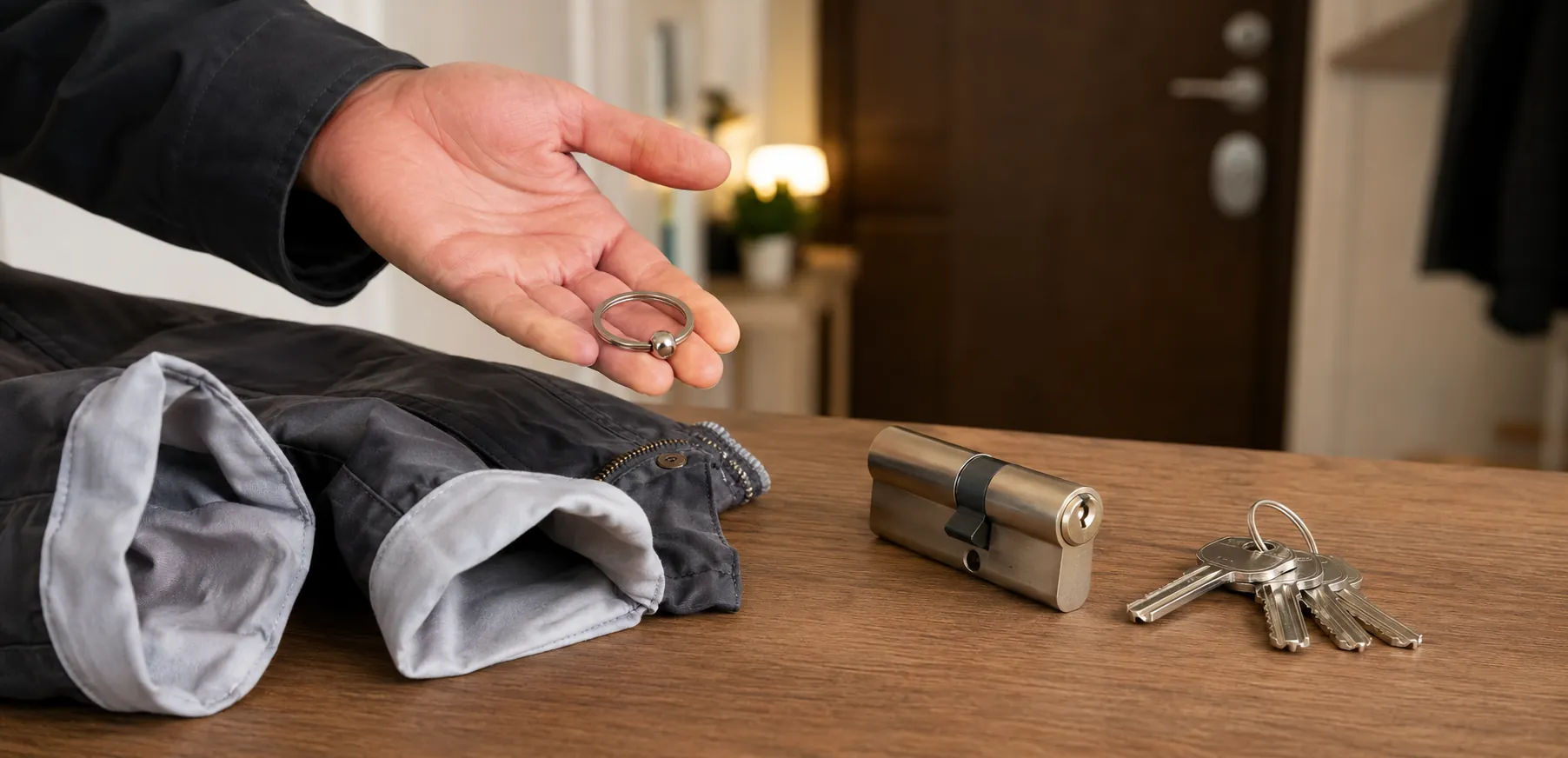
Now I am going to reverse my own statement a little. The front door is rarely the way in, but it is often the afterthought in security, and that annoys me. Because a weak front door invites a different method: pulling the cylinder. If your locking cylinder protrudes even two or three millimetres past the fitting, someone sets pliers on it and rips it out along with the mechanism. Open in thirty seconds.
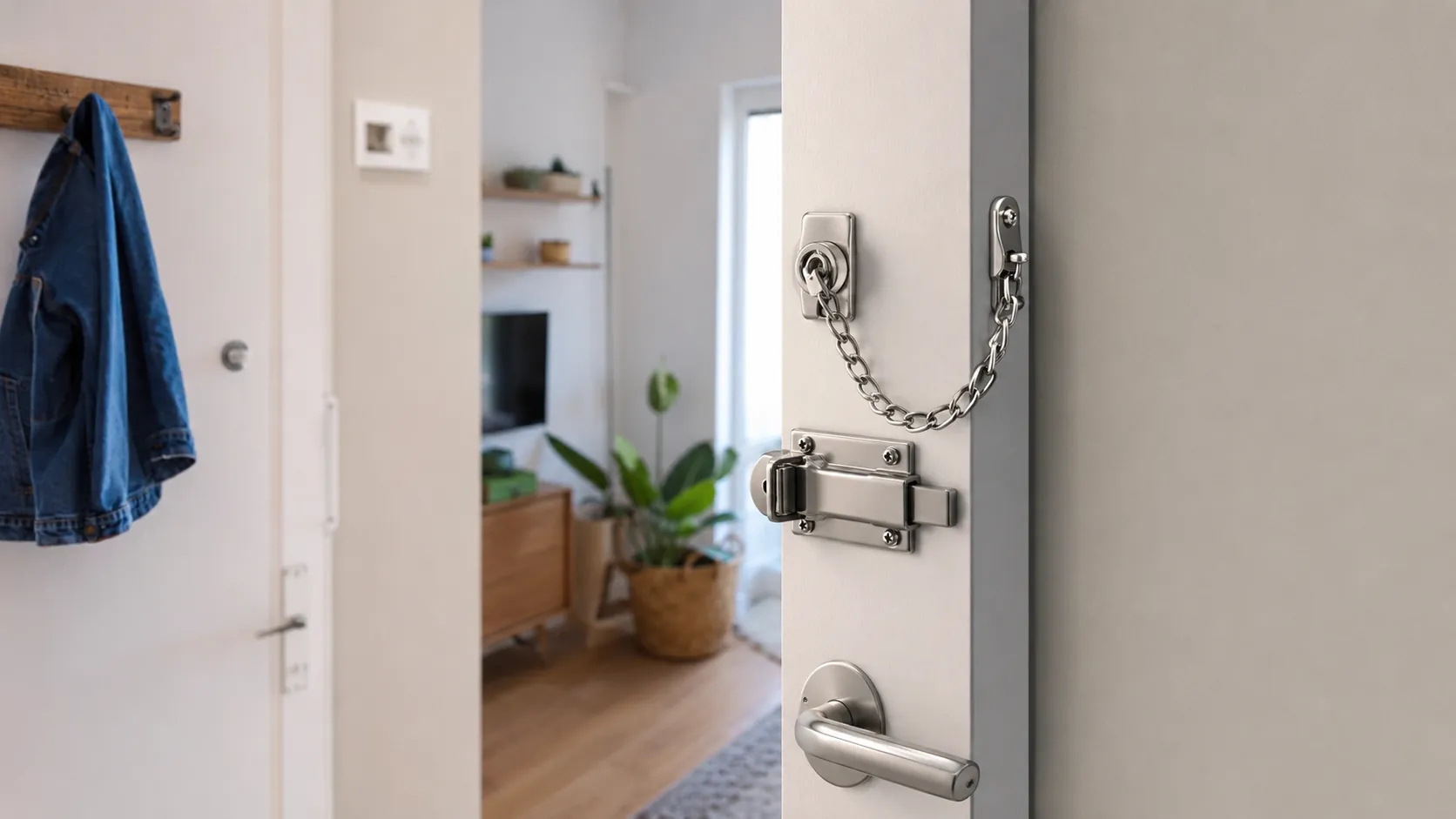
Against that, a very concrete trio helps: a security cylinder with pull protection, a protective fitting with a cylinder cover, and a strike plate worth its name. If your locking cylinder protrudes, or you have never changed it since moving in, that is the cheapest big security gain you can buy. Whether a full lock replacement makes more sense than upgrading the old mechanism depends on the door leaf, and you only see that on site.
Last week in Klein-Auheim
A case from last week, because it is so typical. A family in a mid-terrace house in Klein-Auheim, garden at the back by the field edge. The neighbours were on holiday, and the family themselves had their patio door pried open in broad afternoon daylight. Jewellery gone, drawers in chaos, the classic sequence. When I came to retrofit, I showed the woman the lever mark: cleanly set under the handle, because that was the only locking point. We fitted lockable add-on locks top and bottom and replaced the handle with one that resists levering. Material cost around 210 euros. The damage from the break-in: a three-figure sum on the door alone, plus everything that was not insured. The order was unfortunately the wrong one.
Neighbours beat technology
Sellers of expensive alarm systems do not like to hear this, but it is true: an attentive neighbourhood is the most effective and cheapest burglary protection there is. In the settled row-house rows of Mittelbuchen or Wilhelmsbad this often still works on its own. Where it does not, arrange it. Who notices that my roller shutter goes up in the morning while I am away? Who takes the parcel, so no notes stick to the door signalling an empty home?
The police crime prevention service offers free on-site appointments for this, and the consumer advice centre explains neutrally which tech is worth its money and which is not. I link them deliberately, because I do not want to sell anyone something they do not need. A look at the guidance from the consumer advice centre before buying a camera system has saved more than one person from a bad purchase.
Locked out and in a hurry?
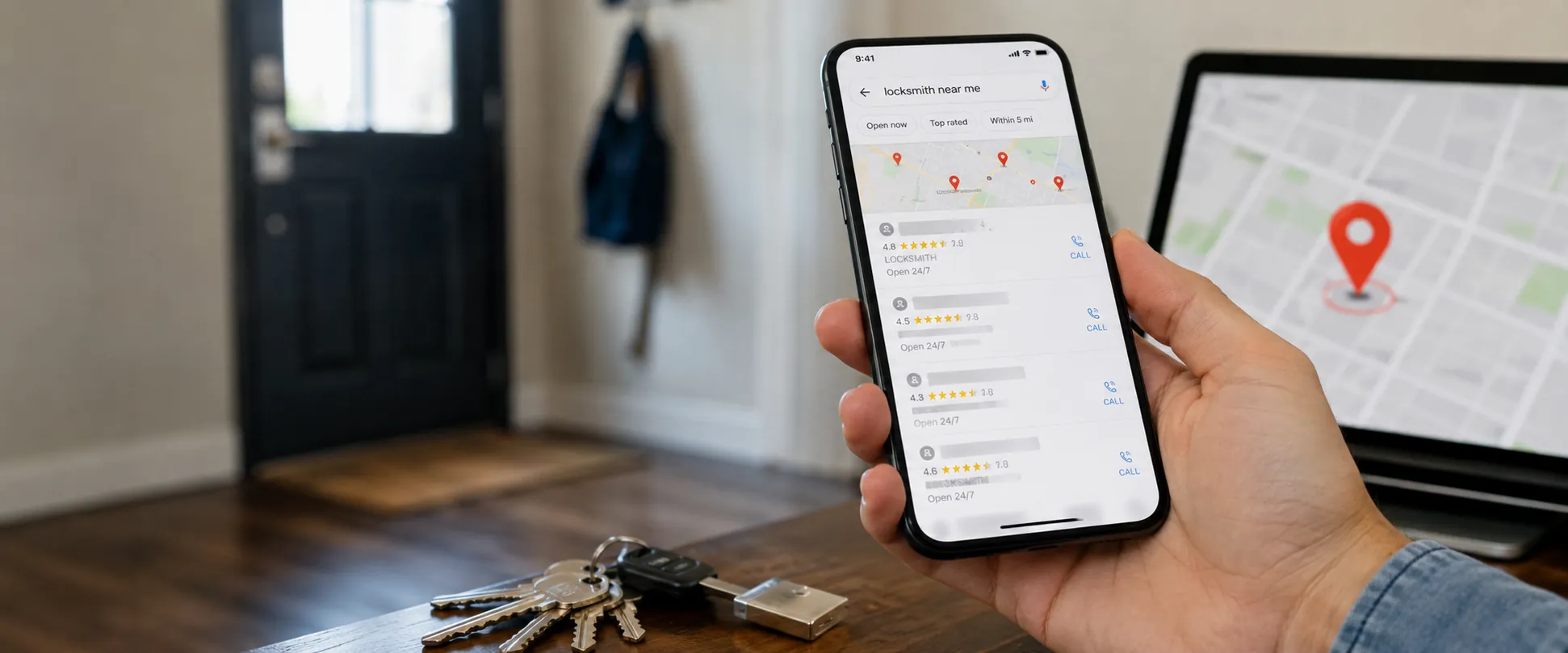
Price quoted up front, vetted partner business, ~22 minutes on site.
Alarm, camera, light: what pays off and what does not
My view, bluntly, after fourteen years: cameras rarely prevent a burglary, they document it. Nice for the investigation, secondary for protecting your living room. Motion detectors with light, by contrast, do work, because they light up the escape route and create attention, exactly what an offender avoids.
An alarm system makes sense, but only as a supplement to the mechanics, never as a replacement. An alarm that goes off when the window is already open comes too late for what you care about. First reinforce the door, then signal. In that order. If you have several entrances or a granny flat, a well-thought-out locking system is sometimes worth it, so you are not juggling five keys.
The three questions I ask everyone
- Where is your least visible access point? That is where protection starts, not at the front.
- How old are your window fittings? Standard fittings installed before 2005 are almost always just roller cams without lever protection.
- Does your cylinder protrude? If so, that is the first job, whatever else is pending.
What I would do, in this order
If you live in a row house in Hanau and start on a limited budget, then like this:
- First secure the rear patio or balcony door, because that is where break-ins statistically happen.
- Then the ground-floor windows, above all those onto the garden and the side.
- Then check the front door cylinder and fitting for pull protection and replace them.
- Only then think about motion lighting and, if at all, an alarm system.
That is not a sales list, it is the order in which your money buys the most security. An overview of all the services we use to carry this out is on our services page. And if it has already happened and the door has to close again today, we are reachable on emergency callout at the weekend too. How we work in Hanau and its districts is set out on our page for Hanau.
Frequent questions
Is a 20-euro hardware-store bolt enough? As a supplement, better than nothing, as the main security, no. Look for tested components and clean fitting. A good lock badly fitted holds less than a simple one set correctly.
Will insurance pay if I retrofit? Some contents insurers reward tested security technology with better terms. Ask before you buy, and keep the invoices. This is general information, not insurance advice.
I rent, am I even allowed to do this? Add-on locks and window locks are usually unproblematic if they leave little trace. Talk to the landlord, often they even cover part of it, because it protects their property.
Does an alarm without mechanical security do anything? Little. The burglar is inside before anyone reacts. Mechanics first, then the signal. Always in that order.
How long does such a retrofit take? A ground floor with a patio door and three or four windows we usually manage in one morning. You do not need to renovate or chisel anything open for it.
My bottom line
Burglary protection in Hanau is neither witchcraft nor a matter of expensive electronics. It is a matter of the right order. Secure first what the offender tries first: the door round the back that nobody sees. Make it hard for the screwdriver, and you have done most of the work, because most attempts simply fail on time. If you are unsure where your weak point lies, have someone with a trained eye take a look. We are happy to answer questions beforehand, and the most common ones are also in our FAQ.