The short answer first: for a normal flat in Frankfurt, RC2 is enough in the vast majority of cases, and for the cylinder you want DIN EN 1303 with a high attack-resistance grade. Anything above that is wasted money for most rented flats, anything below it is too thin for me. Now to the codes, because the labels are deliberately confusing.
I have been advising people on burglary protection for fourteen years, and I see the same thing every week. Someone buys a fitting or a cylinder because the box says "security". A class on it? Nowhere. That is exactly where the problems start.
Why the standards matter at all
A standard is a tested promise. It says: under defined conditions this part withstood an attack for a certain time. Not marketing, but a test report from a lab. Without a standard you only have the manufacturer's word, and that is worth little in burglary protection.
The second reason is your insurance. After a break-in the home contents insurer likes to ask: which class did your door have, which cylinder was fitted? Whoever can show a tested product is on the safe side. Whoever fitted a 19-euro cylinder from the bargain bin will argue longer if it comes to that.
DIN EN 1627: the class of the whole door
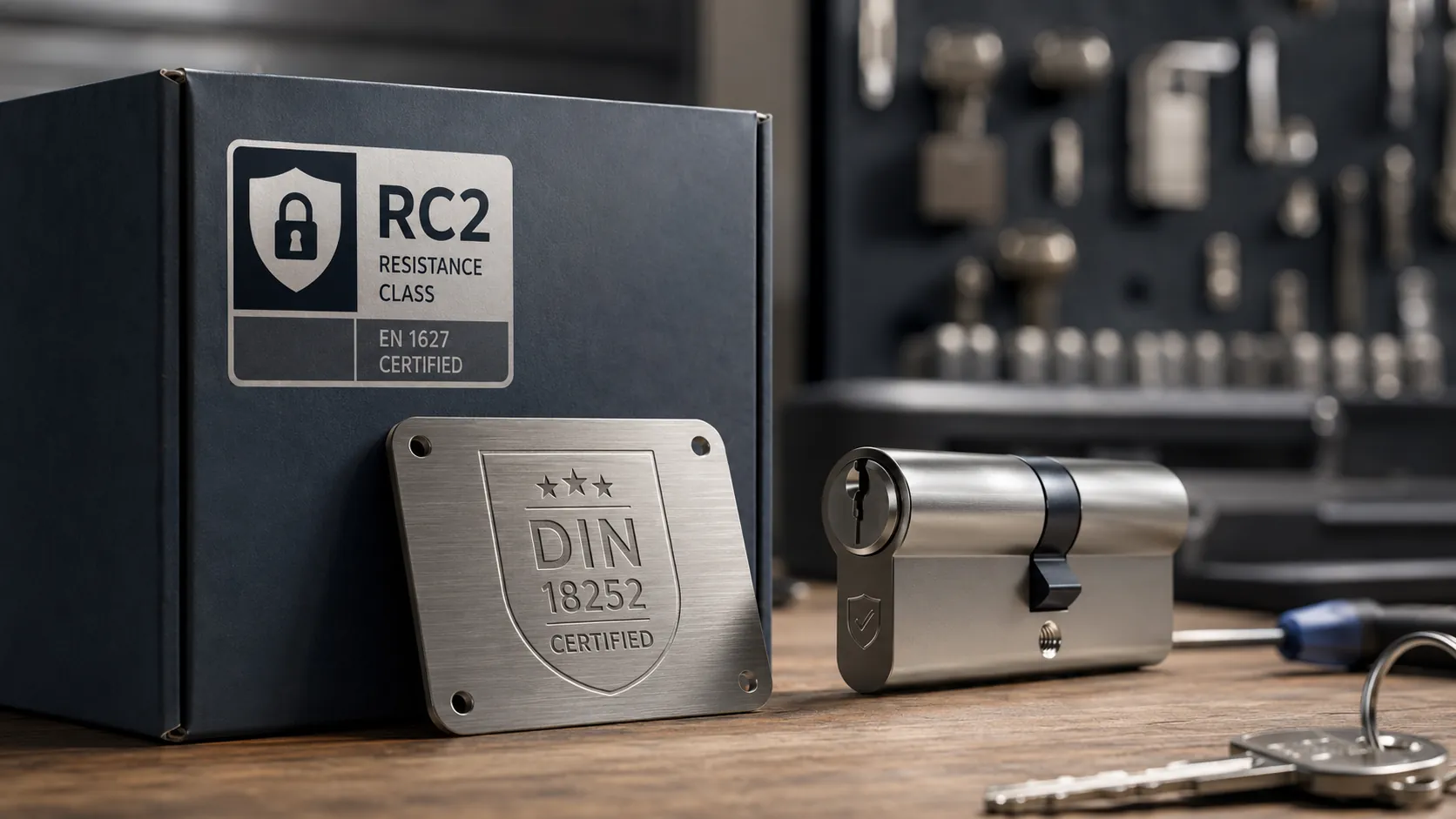
When people talk about RC, they mean the complete unit of door, frame, lock and fittings, tested to DIN EN 1627. RC stands for resistance class. The key word is "complete". The class applies to the tested overall system, not to a single part.
The grades, short and honest:
- RC1 N: basic protection against physical force like jumping at or shouldering the door. Against tools? Barely anything. Too little for a flat door.
- RC2 N: resists an opportunist with simple tools like a screwdriver, pliers and a wedge for around three minutes. That is the sensible minimum for a front door or flat door.
- RC2: like RC2 N, but with extra requirements for the glazing. Relevant for doors with glass panels.
- RC3: holds longer and against heavier tools like a second crowbar. For ground floors, detached houses and exposed locations.
- RC4 to RC6: object protection, commercial use, vaults. Practically never needed in normal residential settings.
For a third-floor flat in Nordend I recommend RC2 N. For a ground-floor patio door or an end-terrace house in Niederrad I lean towards RC3. The reason is simple. The burglar on the ground floor has quiet, cover and time. The one on the third floor has none of that.
Three minutes sounds like little. It is not. Most opportunists give up after a short while if it does not crack open. That is exactly what RC2 targets. It is not about the professional with an angle grinder, it is about the one who wants in fast and out fast.
DIN EN 1303: the cylinder on its own
This standard describes the lock cylinder as a single part. It is often given as a six-digit code, and each digit stands for something. For you, two positions at the end are decisive: drill protection and manipulation protection, meaning protection against picking.
The attack-resistance scale runs in practice from 0 to 2. A 0 means: no tested protection. A 1 means increased, a 2 means high attack resistance. When a manufacturer advertises the high grade, the cylinder has hardened pins against drilling and a barrier against picking it open with a tool. That is exactly what I want to see on a front door.
What I look at specifically in a good cylinder:
- Drill protection: hardened steel pins in the core and in the housing.
- Pull protection: so the core cannot be ripped out with a screw.
- Pick protection: extra security pins, often with a profile card and a copy-protected key.
- Suitable for locking systems: in case you later want several doors on one key, see our locking systems.
Brands I fit with a clear conscience: ABUS, BKS, Winkhaus, EVVA, Kaba. With EVVA and Winkhaus you get security cards, without which nobody simply orders a duplicate key. The no-name cylinder from the bargain bin for 12 to 19 euros? Hands off. It will not survive a drill for twenty seconds.
Last week I was at a customer's place in Westend. He proudly showed me his hardware-store "security cylinder", 19 euros. No drill protection, no pull protection, and it even stuck out two millimetres at the front. Exactly the spot a burglar grabs. We swapped it for a tested branded ABUS cylinder, around 90 euros for the part plus fitting. The difference in a break-in attempt is enormous.
VdS and the police recommendation: the voluntary seals
VdS is not a DIN standard, it is a testing body that insurers in particular recognise. VdS issues its own classes, commonly the grades A to C, or N, B, BZ depending on the product. A VdS-certified cylinder or protective fitting has passed extra tests. If your home contents insurance sets specific requirements, VdS is worth a look.
Alongside that there are products that are "police recommended". That is not a law and not a standard, but a police list of tested, burglary-resistant technology. According to the Police Crime Statistics, the crime-prevention bodies still see residential burglary as a real risk, even if the figures fluctuate over the years. For more background see the police. In my experience most of these attempts are exactly the ones that fail at RC2.
Locked out and in a hurry?
Price quoted up front, vetted partner business, ~22 minutes on site.
The fitting: the often forgotten part
This is the most common mistake in thinking. The best cylinder is no use if the fitting is weak. Protective fittings are tested to DIN 18257 in classes like ES1, ES2 and ES3. ES1 is basic protection, ES2 has a cylinder cover against twisting off and pulling, ES3 is the most robust variant.
My rule of thumb: a good cylinder belongs in a fitting at least to ES1, on exposed doors ES2. The cylinder cover stops anyone grabbing the cylinder and simply twisting it off. Without that cover the expensive drill protection in the cylinder simply does not apply, because the attacker does not even drill, he twists.
What costs what: an honest overview
| Part | Class | Material approx. |
|---|---|---|
| Standard cylinder without protection | DIN EN 1303, attack 0 | 12 to 25 EUR |
| Security cylinder | DIN EN 1303, attack 1 to 2 | 60 to 150 EUR |
| Protective fitting | DIN 18257 ES1 | 40 to 90 EUR |
| Protective fitting with cover | DIN 18257 ES2 | 90 to 180 EUR |
| Door upgrade towards RC2 | DIN EN 1627 | from around 400 EUR upwards |
Fitting comes on top in each case. You will find the exact range on our pricing page. If the door jams at night and nothing works any more, that is a case for the emergency service, not for a consultation.
Where manufacturers play games
I see three tricks again and again. First: "security cylinder" is printed on it, but no class. Security is not a protected word. Demand the DIN EN 1303 figure in black and white. Second: the RC2 class is advertised for the door, but a cheap cylinder is in the box. An RC2 door with the wrong cylinder is no longer an RC2 door. Third: "high security" or "armoured protection" without any test declaration. Pure advertising.
Quick questions, quick answers
Is RC2 really enough for my flat? For the typical upper-floor flat, yes. On the ground floor or for detached houses, one grade higher.
Can I just swap the cylinder and be safe? Better than nothing, but half a job. Without a matching fitting a gap remains. If you are only swapping the lock, first read the guide on protection against picking.
Do I have to have VdS? Only if your insurance requires it. Otherwise a clean DIN class is the more important figure.
My verdict
Buy classes, not marketing words. RC2 N for the door, a cylinder to DIN EN 1303 with high attack resistance, plus a fitting to ES1 or ES2. For most Frankfurt flats that is the right, honest choice, and it costs considerably less than the expensive gimmicks pushed on you in the shop.
Which burglary protection actually fits your door is something we are happy to assess on site. If you are unsure what is fitted at your place, get in touch through our contact section. I will tell you honestly whether an upgrade is worth it or whether your door is already good enough.