Let me take the panic away right now. Lock picking, the crochetage, is far rarer in real burglaries than YouTube would have you believe. Most offenders pry, they do not pick, because prying is faster and takes no skill. Still, the protection is worth it, because a cheap cylinder opens in seconds and a good one makes picking practically pointless. In 22 years as a master locksmith I have had plenty of both on the workbench.
The real protection lies not in a trick. It lies in the mechanics of the cylinder, in a clean security fitting and in flush mounting. Three things, no more. Whoever understands that spends their money in the right place, not on glossy marketing.
What actually happens during picking
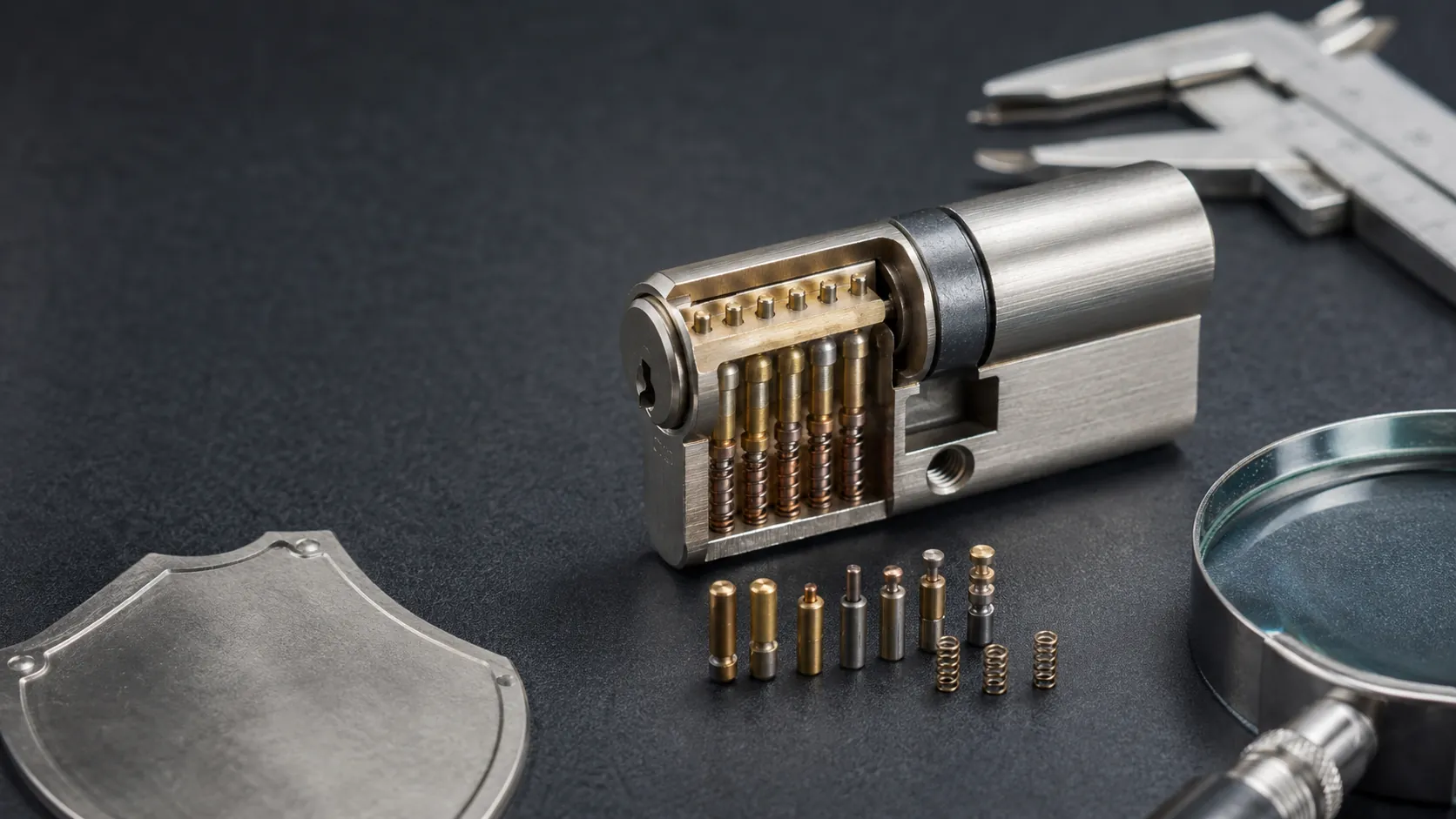
Inside a cylinder sit small pairs of pins. With the correct key inserted, every shear line lines up exactly with the height of the core, and it turns. In picking, the offender applies light turning pressure with a tension tool and lifts the pins one by one with a thin needle to exactly that shear line. Pin after pin. When they all sit, the cylinder turns as if the key had been used.
On a simple standard cylinder with no security elements, a skilled hand manages this alarmingly fast. Under a minute is no rarity. And almost without traces. That is the unpleasant part. No broken frame, no splintered wood, nothing the home contents insurer recognises as a break-in trace. I have seen cases where the victim had to prove a burglary even happened, and that is bitter.
But, and this is the point, the real burglar in Frankfurt does not pick. He has neither the time nor a steady hand in a stairwell. He pries at the frame with a screwdriver, or he pulls off the protruding cylinder with a pipe wrench. Protection against crochetage therefore almost always means protection against exactly these mechanical attacks too.
The three things that really protect
A cylinder with real pick resistance
Here the wheat separates from the chaff. A good security cylinder has security pins, so-called spool pins, plus tight tolerances and often a second locking level. That makes picking so laborious that it practically only works in the lab, not on your door.
Look for the DIN EN 1303 standard and for makers who know their craft: ABUS, BKS, Winkhaus, EVVA, Kaba. An ABUS Bravus or a Winkhaus keyTec are solid choices. Stay away, by contrast, from the 8-euro hardware-store cylinder with no markings. It is exactly what it looks like.
Price ranges from practice:
| Cylinder type | Parts price | Pick resistance |
|---|---|---|
| Standard hardware store | 8 to 25 EUR | none |
| Brand cylinder, basic | 35 to 60 EUR | low to medium |
| Security cylinder | 60 to 150 EUR | high, with drill and pull protection |
| High security with security card | 120 to 250 EUR | very high |
For the vast majority of Frankfurt front doors, the middle row is exactly right. More is rarely needed.
A security fitting that covers the cylinder
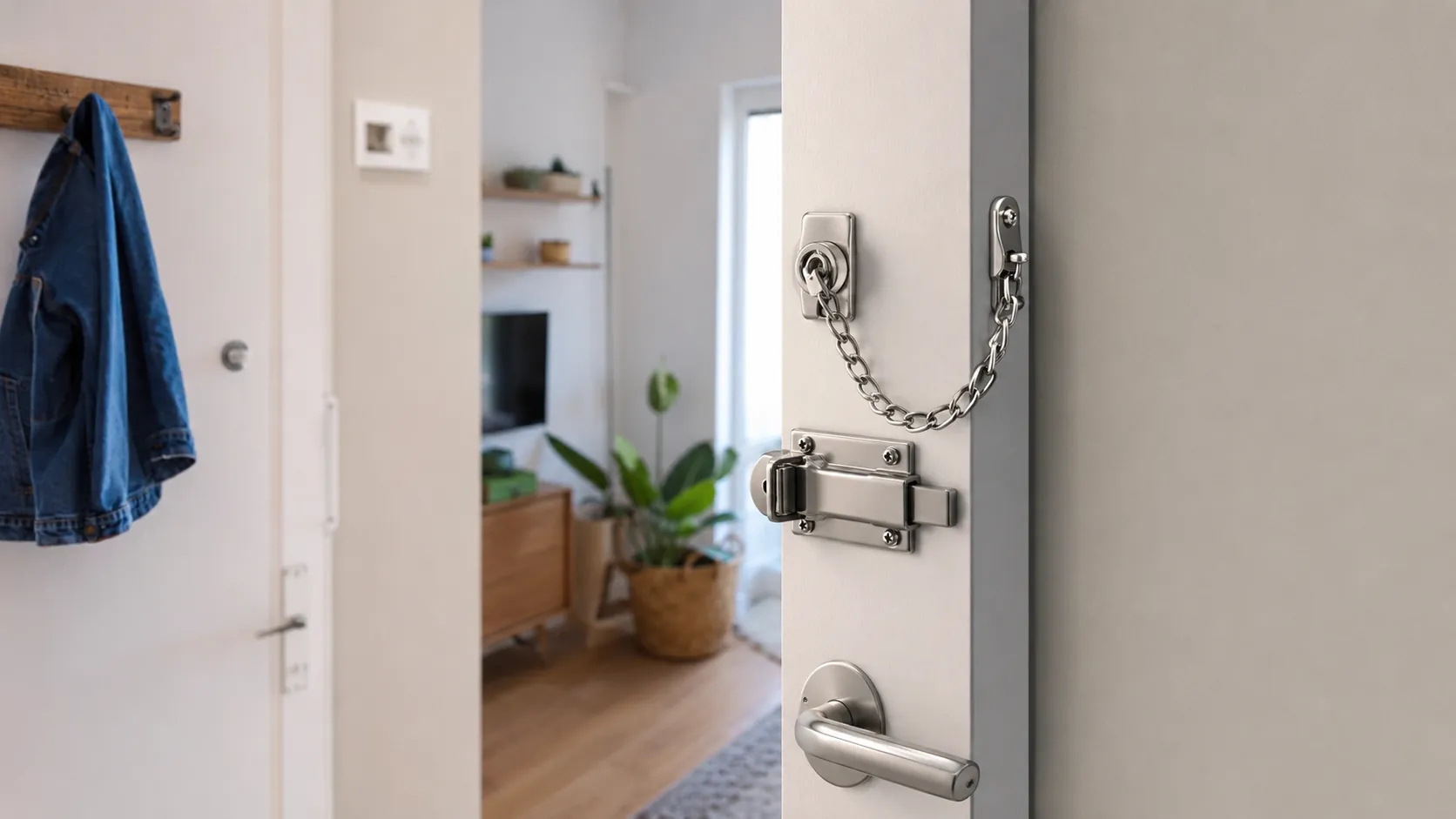
The best cylinder is no use if someone simply pulls it out or snaps it. That is why a security fitting belongs with it. It covers the cylinder so the pliers find no grip. Look for DIN 18257, class ES1 for normal flats, ES2 for higher demands, for instance on the ground floor or for the flat door onto the stairwell.
A good fitting with core-pull protection costs 40 to 120 EUR. That is well-invested money. Without it, even a high-security cylinder is just an expensive half measure.
Flush mounting, the underrated classic
If the cylinder protrudes at the front, it is exposed. Full stop. It should stick out no more than three millimetres, otherwise it can be gripped with pliers and twisted off, no picking, no noise. I check that first at every consultation. And surprisingly often that is exactly the weak point of an otherwise decent door.
Last week in Bockenheim. An elderly lady, a lovely old flat door, cylinder from 2009. It stuck out a good eight millimetres. I swapped it for a precisely fitted security cylinder that sits flush, plus an ES1 fitting. Parts cost around 130 EUR, labour on top. She had been considering having a complete multipoint locking system fitted for 600 EUR, which another provider had talked her into. She did not need it.
The myth of the expensive lock
Last year a man from Nordend came to me, utterly convinced he needed the priciest high-security system on the market because he had seen a picking video. His door already had a good fitting and sat cleanly. We fitted a 95-euro cylinder with pick and drill protection, nothing more.
That suits his risk, a second-floor flat in Nordend, and withstands any picking attempt a real burglar would ever make. He was sceptical at first because it seemed too cheap to him. That is exactly the thinking error. You do not measure security by the price tag, but by the DIN class and the mounting.
Do not buy fear. Buy mechanics.
Locked out and in a hurry?
Price quoted up front, vetted partner business, ~22 minutes on site.
How much protection your door really needs
That depends on the risk, not on the brochure. A few honest rules of thumb from practice:
- Flat from the second floor up, decent stairwell: a mid-class security cylinder plus an ES1 fitting is almost always enough.
- Ground floor, raised ground floor or front door with street access: here ES2 pays off, plus a cylinder with a security card against uncontrolled copying.
- Detached house in Sachsenhausen or Niederrad: the door should additionally be rated RC2 to DIN EN 1627, because here the whole door build counts, not just the cylinder.
Which protection levels interplay beyond that, I broke down in the piece on the seven security levels. A good cylinder alone does not make a secure door. It is always the interplay of cylinder, fitting, strike plate and frame.
If you are fundamentally unsure which locking type even fits your door, the guide on cylinder, multipoint or deadbolt helps. And whoever wants to read up on the DIN classes in peace will find a clear overview in the piece on DIN standards and resistance classes.
Common questions, briefly answered
Can I swap my cylinder myself? If the door is open and you know the correct length dimension, yes. It is one screw and the forend-screw trick. With a security cylinder and fitting I would still have it checked, because the pull protection only works with correct mounting.
Does an electronic lock make picking obsolete? It shifts the problem. A good mechatronic system cannot be picked, but the electronics bring their own weak points. For a normal flat door, good mechanical protection is usually cheaper and more robust.
Does insurance help? To a degree. The police crime statistics from the BKA have shown for years that basic mechanical protection makes most burglaries fail at the attempt. Insurers partly reward that with better terms. Ask before you retrofit.
My sober advice
A good security cylinder plus a security fitting, cleanly and flush mounted, is the right protection against crochetage for the vast majority of Frankfurt front doors. It costs far less than the glossy systems and stands up to the real risk.
If you are unsure whether your cylinder is any good, we sort it out during lock replacement or a burglary protection consultation. An honest estimate of the costs is on our pricing page. And if it ever has to be quick, we are reachable through the emergency service.
Protection against picking is no black art. It is the right cylinder, mounted cleanly. No more, no less.