Up front, because it surprises most people: an old, heavy period door is often sturdier than a modern flat door, but its lock rarely is. That contradiction is exactly what makes central Frankfurt period buildings so distinctive. The leaf holds, the lock gives way. I do a lot of retrofitting in Nordend, the Altstadt and the edge of the Innenstadt, and almost always the door leaf is the best part of the whole system. The mechanics behind it are the weak spot, not the wood.
I am a smart-lock technician, and in a period building I am the one who often tells you: hands off the app, fix the mechanics first. That sounds odd coming from me. But it is true.
Why period-building locks are their own league
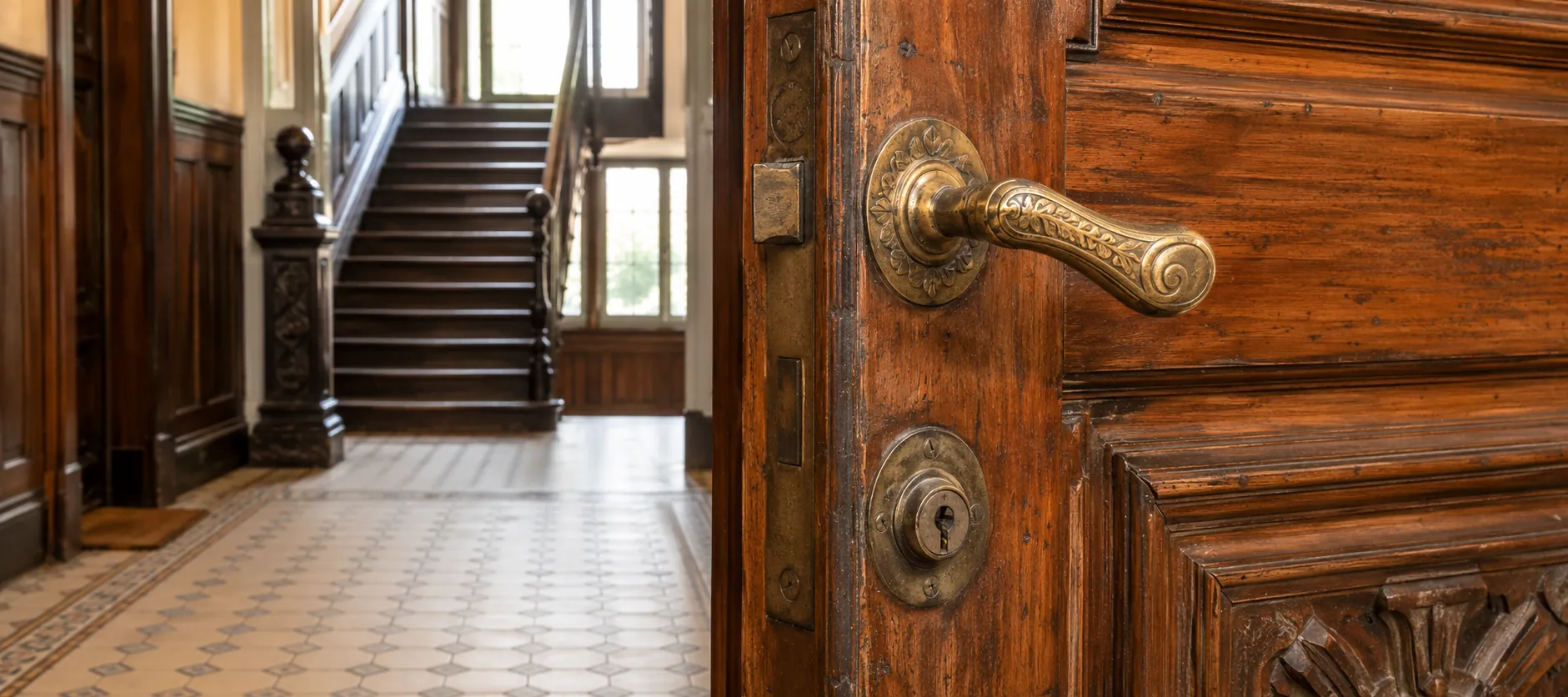
Many of these doors still carry a mortise or even a box lock from before the war. Often with a bit key, the big flat thing with the cut-out bit. Pretty. A joke in security terms. With a little practice such a bit-key lock opens in under a minute, and that is no secret, anyone who sets their mind to it knows it.
Add to that quirks that modern fittings do not simply tolerate:
- Unusual backsets, often 55, 60 or odd in-between values, where standard cylinders will not sit without adaptation.
- Faceplates and bores that do not match today's DIN, so a new lock will not drop in one to one.
- Tall, profiled door leaves where standard fittings sit badly, visually and technically.
- Heritage protection or a conservation statute that limits or forbids drilling into the leaf.
That does not mean nothing can be done. It means you measure before you buy. A modern profile cylinder to DIN EN 1303 can go in in many cases if the lock has a euro-profile cut-out or is properly converted. If the door still has the round bit-key cut-out it gets more involved, but rarely impossible.
The most common mistake
People think the thick door is the security. It is not. A door is only ever as strong as its weakest point, and in a period building that is almost always the lock, closely followed by the strike plate. I have seen doors of four centimetres of oak, solid as a safe lid, and right next to them a strike plate hanging on two short screws in soft old wood. One kick, the plate tears out, the door is open. The wood was never the problem.
Retrofitting without ruining the period building
My order is always the same. Cylinder first. Then the protective fitting. Then add-on locks that are screwed on rather than drilled in. In that order you get the most security per euro spent.
On the cylinder I do not go below one with pull and drill protection. A cheap DIY-store cylinder for 12 euros is wasted money in a period building. A decent ABUS, BKS or Winkhaus cylinder with a security card runs 60 to 150 euros as a part. You do not save here, because this is exactly where the burglar attacks.
Then the protective fitting to DIN 18257, at least ES1, better ES2 with a cylinder cover. It protects the cylinder from being snapped or pulled, the most common method on old doors. A good fitting costs 40 to 120 euros.
Under heritage protection I like surface-mounted cross-bar locks. They hold a lot, spread the force across the whole door width and come off with little trace if the authority demands it. How a multi-point cylinder and an extra bolt work together is in multi-point locking and extra bolts. For the full upgrade against burglary, the burglary-protection advice is the right starting point.
Last autumn in the Altstadt
Last autumn I was at a couple's place in the Altstadt. A gorgeous 1905 door, box lock with a bit key, brass fittings, all original. They were set on a smart lock, already had one in the cart. Honestly, that was the wrong route here. The old lock would have had to be replaced first, and I was not allowed to drill into the listed door leaf. The effort was out of proportion to the benefit.
Instead we fitted an ABUS cylinder with pull protection and an ES2 protective fitting, plus we reset the strike plate with long screws into the masonry. Around 240 euros together, material and labour. That is safer than any smart lock on rotten mechanics. The app came a year later, once the lock had been swapped anyway.
The street door downstairs that everyone forgets
A topic of its own in a period building is the street door on the ground floor. Almost everyone forgets it. The best flat door is little use if the building door to the courtyard has not latched properly in thirty years.
In Nordend, the corner towards Bornheim, I often see splendid entrance doors with a worn-out lock that anyone walks straight through. The latch hangs, the bolt does not catch, the door stands ajar. Whoever wants in is in, without touching a tool.
Here a joint solution through the owners' association pays off. Alone, hardly anyone carries the cost, and together it gets cheap per party. A proper self-locking panic function for the building entrance door runs 400 to 900 euros depending on the door, divided by eight parties that is a manageable amount. If the building is being renovated anyway, a locking system for the whole house is the clean route, one key for the street door, cellar and flat.
Locked out and in a hurry?
Price quoted up front, vetted partner business, ~22 minutes on site.
When smart tech really pays off
Now to my actual trade. I happily install smart locks, but only when the mechanics underneath are sound. On a solid profile cylinder a motor lock or a mounted smart drive makes sense. On a hundred-year-old box lock it does not.
A retrofit smart drive, set on the inside over the existing cylinder, costs 150 to 350 euros. But it only works if the key runs clean and the cylinder turns easily. In a period building that is often exactly the problem. Warped door, sticking bolt, stiff lock, and the motor no longer manages reliably. Then you stand at your own door and the drive hums, and the door does not open. Worse than without.
My honest rule of thumb:
- Mechanics smooth, profile cylinder in place, door closes clean: smart pays off, even a motor lock.
- Old box lock, bit key, warped door: renovate first, then we talk about smart.
- Rental flat with uncertain permission: nothing that drills, at most an add-on that comes off without a trace.
Once the mechanics are modernised, many routes open up, from lock replacement to the right smart solution. What the individual steps roughly cost you will find in the price overview.
Renting in a period building: what you may do
A great many period flats in central Frankfurt are rentals, and there the rule is: clear up what is allowed first. The cylinder may usually be swapped, as long as you keep the old one and put it back when you move out. As soon as drilling is involved, into the door leaf or the historic fabric, you need the landlord's okay, and with heritage protection often the authority's on top.
By the way, whoever loses the key to a locking system often pays for the whole system anew, not just their own cylinder. That surprises many and can get expensive. More on that in who pays for a lock change.
If you want the exact picture of what is allowed in a period building and under tenancy law, the consumer advice centre offers neutral notes on tenant duties and locks.
Answered briefly
May I retrofit at all in a listed period building? Yes, but selectively. Screwed cross-bars and a cylinder swap are mostly unproblematic, drilling into the leaf needs a clearance.
Is a smart lock worth it in a period building? Only when the mechanics are right. Cylinder and strike plate first, then the app.
What does a sensible basic upgrade cost? Cylinder, protective fitting and a reset strike plate realistically run 180 to 320 euros, material and labour together.
Who is in a hurry? If the door no longer closes or you are locked out, the emergency service helps, and for calm planning you reach us through contact.
Bottom line: a period building deserves respect for its fabric and honesty about the tech. Measure first, modernise the mechanics, and make it smart only when the lock underneath can carry it. A beautiful old door with an honest lock is dearer to me than any app on a ruin.