I hear this question on the phone almost daily, and the honest answer is: in most cases reinforcing is enough, and it costs a fraction of a new security door. A well thought-out upgrade often runs 200 to 500 euros. A tested new door quickly hits 1500 euros and more. But there are clear limits, and I will name them before you spend a cent.
I sit on the phone, not on the building site. That means I hear the start of hundreds of these stories. And I hear how they end too, when the colleague comes back and tells me what he found on site. I write this from that double perspective.
The short answer, in one sentence
Reinforce a sound door, replace a rotten one. That is the rule of thumb, and it gets ignored just as often.
The expensive mistake almost always runs the same way. Someone buys an add-on lock at the hardware store for 60 euros, screws it onto a 40 year old veneered door and feels safe. But they are not. Because the burglar is not interested in your new lock. He pries next to it, at the weakest point, and on an old door that point is usually the door leaf itself or the frame.
What reinforcing really achieves
Most break-ins in Frankfurt are not high-tech. That is the first thing that surprises people on the phone. No lock picking, no pick gun, no pro with special tools. It is simple prying with a screwdriver at the lock or hinge side, often in under a minute. The police call it the standard case, and the BKA statistics, the police crime report, have shown the same trend for years: a large share of residential break-ins stay stuck at the attempt, because the door simply holds long enough. That is exactly where retrofitting comes in.
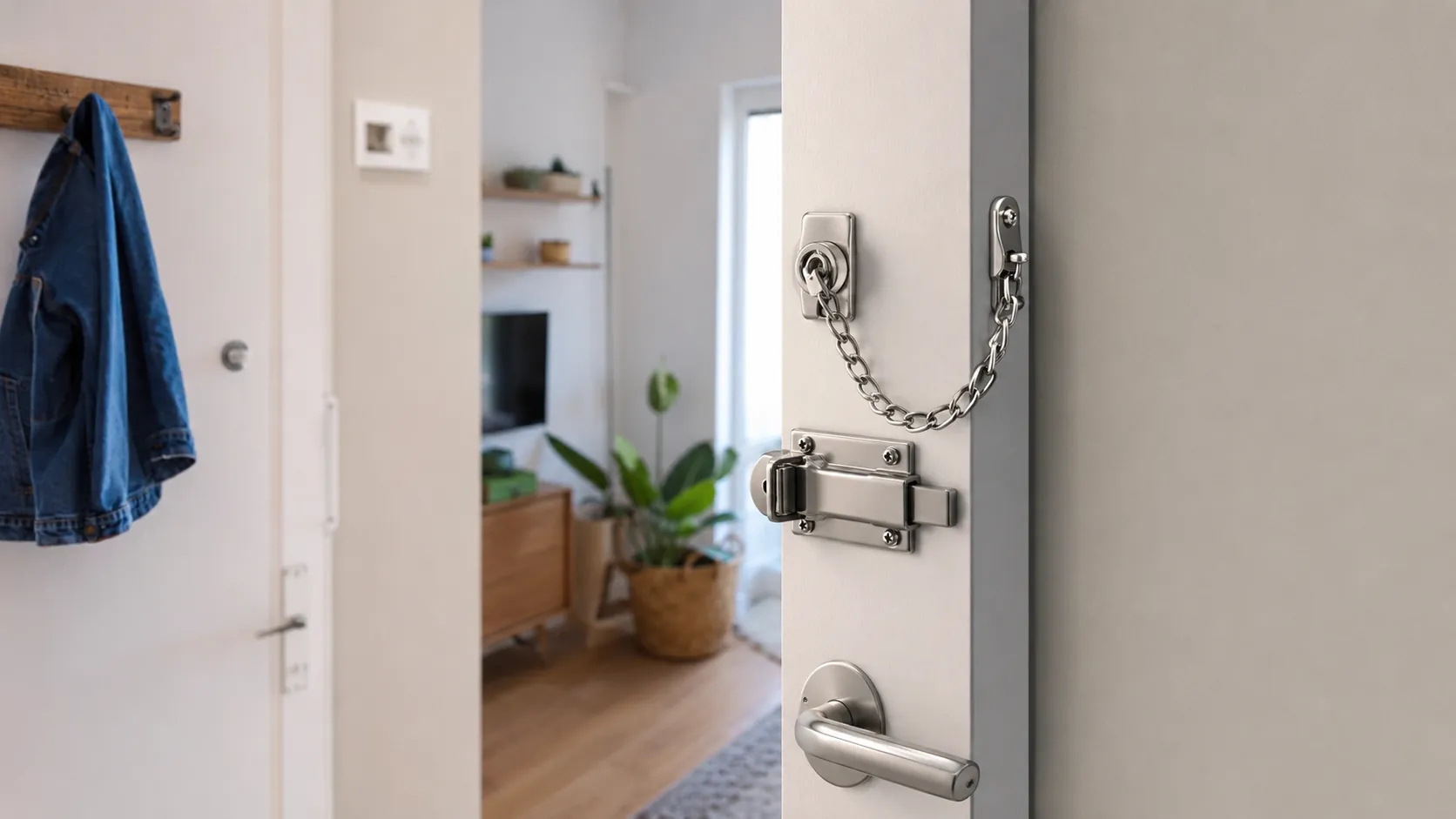
Retrofit parts help very well against this prying. The most important ones, in the order they actually matter:
- Cross-bolt lock. It spreads the force across the full width of the door and anchors into the wall on both sides, with strike boxes left and right in the reveal. It is the single most effective measure there is. Brands like ABUS PR2700 or Burg-Waechter lead the field here. Fitted price: roughly 250 to 450 euros.
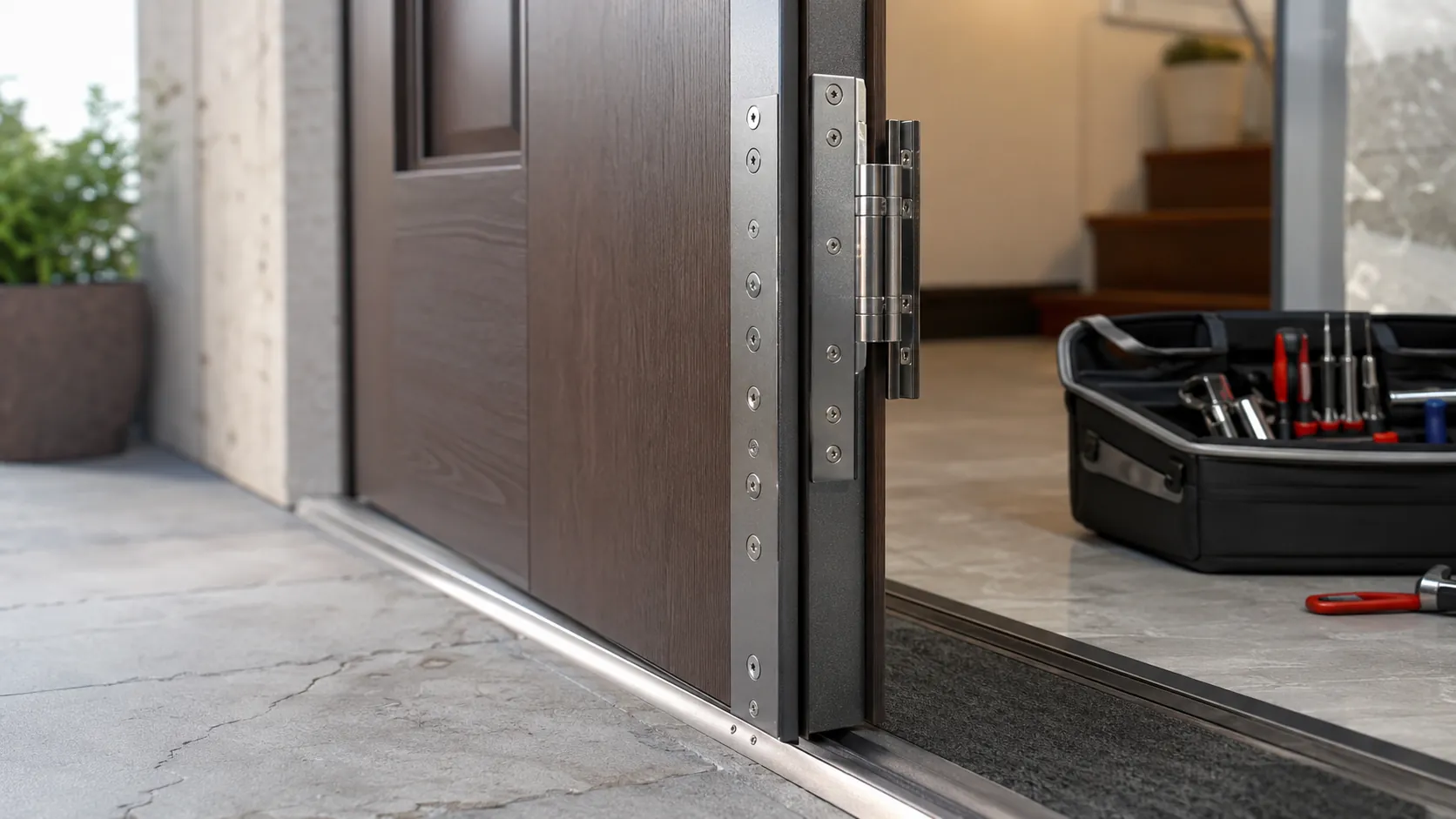
- Hinge-side bolts. They stop the door being levered out on the hinge side. Most people only think of the lock side and forget the hinges completely. They cost little, ABUS hinge bolts run 20 to 40 euros each, and they close a real gap.
- Protective fitting with a cylinder cover. It protects the cylinder from being snapped off or pulled. Look for DIN 18257 ES1 or better ES2. ES2 covers the cylinder completely. Roughly 60 to 140 euros.
- Tested cylinder with anti-drill and anti-pull protection. The basis of it all. A good security cylinder to DIN EN 1303 from ABUS, BKS, Winkhaus or EVVA costs 60 to 150 euros as a part. The cheap 15 euro cylinder off the shelf is pulled out by an intruder with a screw and pliers in seconds. Hands off it.
Combine these parts on a solid door and you get surprisingly close to a tested RC2 door to DIN EN 1627, in security terms, and at a third of the price. Which classes lie behind this exactly, and what RC2 versus RC3 really means, you can read in our piece on DIN standards and resistance classes.
A little price orientation
So you have an idea of what gets quoted realistically on the phone:
| Measure | Material | Fitted, roughly |
|---|---|---|
| Swap security cylinder | 60 to 150 EUR | 120 to 250 EUR |
| Protective fitting ES2 | 60 to 140 EUR | 130 to 280 EUR |
| Hinge-side bolts (pair) | 40 to 80 EUR | 100 to 180 EUR |
| Cross-bolt lock | 150 to 300 EUR | 250 to 450 EUR |
| Full package, good old-build door | 500 to 900 EUR |
These are honest ballpark figures for Frankfurt, not a teaser price. Anyone who quotes you a fixed price on the phone without having seen the door is guessing. And anyone luring you with an 0800 number and cash only, keep your hands off them. How to spot such firms is in our piece on dodgy locksmiths.
Locked out and in a hurry?
Price quoted up front, vetted partner business, ~22 minutes on site.
When reinforcing is not enough
Now the limit, the one hardest to convey on the phone. If the door leaf itself is weak, meaning a thin hollow interior door used as a flat entrance, or if the frame is rotten or sits loose in the wall, even the best additional lock helps little. Then the intruder does not pry the lock but the whole leaf or the frame. You anchor the best bolt in the world into a wooden frame that is already crumbling. That is physically pointless.
How do you spot this yourself, before the colleague arrives? A few pointers:
- The door is visibly warped and only closes when lifted.
- The veneer is peeling, the leaf sounds hollow when you knock.
- The frame wobbles when you push hard against it.
- It is a pure interior door with no reinforcement at all, often the case in old buildings.
- You see traces of an earlier break-in attempt on the frame.
If more than one of these applies, I would honestly advise against the retrofit and look instead at a lock replacement or a new door straight away.
Two stories from the receiver
Last week a customer from Hoechst called. Old flat door, veneered, visibly warped, he described it to me on the phone. He insisted on just an add-on lock, he had already made up his mind. My colleague drove out, looked at the leaf and advised against it. Reinforcing a decrepit door is throwing money away. The customer was disappointed at first. A week later he called again, thanked us and ordered the new door. Saying that honestly, even when it brings us less revenue at first, is part of how we work.
And the counterpart. The month before last, a caller from Nordend, old-building flat, but a solid front door from the sixties, heavy, snug in the frame. She was scared after a break-in at her neighbour and was already thinking about a completely new security door for well over 2000 euros. The colleague looked, knocked, checked the frame. All sound. We fitted a cross-bolt lock, an ES2 protective fitting and hinge bolts. Final price just under 800 euros. She has felt much better since, and she saved over 1200 euros. That is exactly the difference I am talking about.
How to go about it, step by step
Have the door looked at before you buy anything. That is the most important sentence in this whole text. A good firm tells you whether the leaf and frame can carry the upgrade, and that only works on site.
- No blind purchase at the hardware store. First have the door assessed, then decide.
- Have the substance checked: door leaf, frame, anchoring in the wall.
- If the substance is sound, burglary protection by retrofit is almost always the smarter and cheaper choice.
- If it is not, honestly look at a new door. It hurts on price, but it is the only thing that helps.
- Have the measures explained and get a written price. A rough orientation is on our pricing page too.
If you are unsure what makes sense for your door, call or write to us via the contact form. I or a colleague will go through it with you on the phone, without anyone having to drive out right away.
Frequently asked questions
Is an add-on lock enough on its own? Rarely. On its own it does little, because the hinge side and the cylinder stay open. As part of a package it is strong.
Can I get funding for the retrofit? There are KfW programmes for burglary protection. The conditions change, check the current ones on the KfW site before you start.
Will insurance pay after a break-in? That depends on your contract. A retrofit often improves your position, because you show that you made it harder for the intruder.
What about rented flats? As a tenant you usually need the landlord's consent for fixed installations. Talk to them first, many even chip in.
Bottom line: reinforcing a sound door is usually the more honest and cheaper solution. Reinforcing a rotten door is window dressing. The difference is decided by your door leaf, not your lock. And that is exactly why every sensible consultation starts with a look at the door, not with a sales pitch.