Bumping is the technique most people fear the most, and on cheap cylinders rightly so. With a prepared bump key and a short tap, a basic cylinder springs open in under ten seconds. The good news from eleven years at the bench: a modern security cylinder with anti-bump construction makes the trick practically useless. So you do not need panic, you need the right part in the lock.
I have been building locking systems since I was nineteen. I have demonstrated bumping a hundred times, on old cylinders, on new ones, on supposedly secure ones. And I will tell you plainly how to recognise whether your door is at risk and what really helps.
What bumping actually is
A bump key is not some special tool from the dark web. It is an ordinary blank with all its teeth filed down to the deepest cut. It looks like a saw blade in miniature. A semi-pro files one himself in twenty minutes.
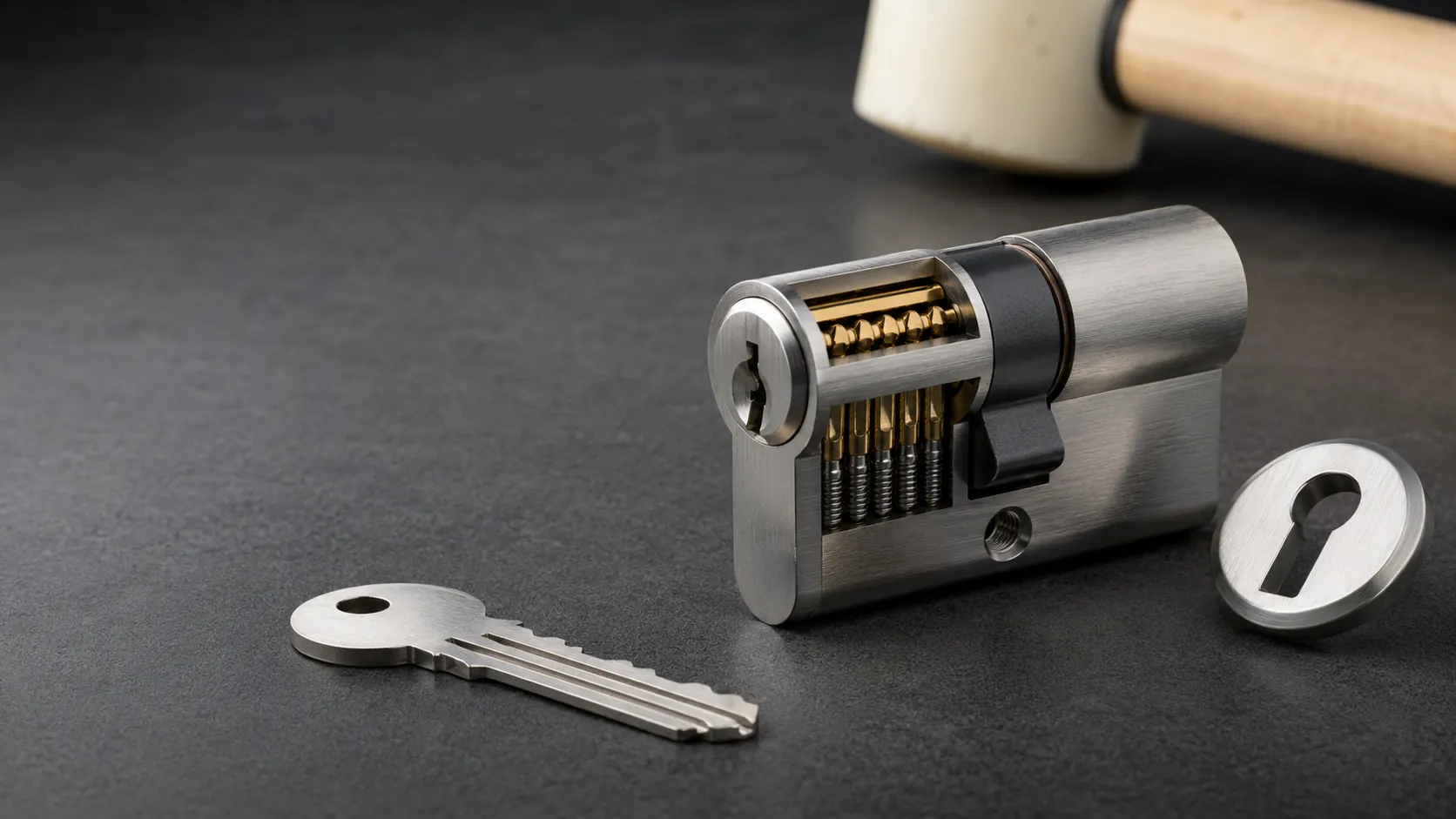
It goes into the keyway, gets pulled back a touch, then comes the tap from behind. A hammer handle, a small block, sometimes just the heel of the hand. The impulse travels through the key pins onto the driver pins. For a fraction of a second the upper pins jump above the shear line. In exactly that moment the offender applies light turning pressure to the key, and the core spins.
Under ten seconds. Almost no trace. That is exactly what makes it nasty. With a forced window the insurer sees the break-in. With a bumped door it stands there asking where the break-in marks are.
Why it works physically
Newton. Nothing more. On the tap the key pin transfers its kinetic energy to the driver pin while barely moving itself, much like the Newton's cradle on a desk. The upper pin flies up for a moment, the lower one stays down, and right then the shear line is clear. A simple pin mechanism has nothing to set against this.
So the weak point is not the lock as a whole, only the bare pin-pair mechanism. Where nothing dampens the impulse, the trick works. This is precisely where the protection comes in.
Is your cylinder at risk? Three quick checks
You do not need to be a pro to make a first assessment. Just look.
- Origin. If the key shows no manufacturer, no profile number, only a bare hardware-store logo, assume the worst. These twelve-euro standard cylinders are the typical bumping victims.
- Security card. Did you get a security or code card with your purchase, the one you use to order spare keys? Then it is a better profile, often with active elements. Good sign.
- Key shape. A key that is toothed only along the top and otherwise smooth is usually a simple pin cylinder. Keys with dimples, side milling or moving elements point to reversible-key profiles that are much harder to bump.
Last week in Bornheim I had exactly such a case. The customer swore her lock was secure, the landlord had only just fitted it. I looked at the key: smooth, toothed on top, no maker's name. Thirty seconds later the door was open, with no tool except a bump key from my pocket. She went quiet. Then she nodded.
What reliably protects against bumping
A lot of nonsense gets sold here. I sort it by what actually holds at my bench.
The anti-bump cylinder, the most honest solution
This is the core. Good cylinders from ABUS, BKS, Winkhaus, EVVA or Kaba no longer work with simple pin pairs alone. They use special pins of different masses, sprung elements, anti-impact pins or a second locking level, magnetic or mechanical. The impulse runs into nothing, because the energy no longer acts cleanly on a free pin pair.
What to look for:
- The "anti-bump" or "bump-resistant" labelling, or a reversible-key profile with an active element.
- DIN EN 1303 as the base standard for the cylinder. For higher demands, a cylinder that fits a door system tested to DIN EN 1627 in RC2 or RC3.
- Drill protection and pull protection, ideally together with a security fitting to DIN 18257 ES1 or ES2. Because an offender who fails at bumping next tries core pulling.
On price: a solid anti-bump cylinder costs 70 to 150 euros as parts. Open-ended for locking systems, but for a normal flat door you are right in that corridor. Hands off offers that promise you "anti-bump" for 19.90 euros. That is usually just a sticker.
Active locking systems
Where a moving locking element in the key engages alongside the normal pins, one that a simple tap cannot move into the right position, bumping is finished. These reversible keys with sprung pins in the bit are my favourite for families who want a locking system with several keyed-alike keys anyway. How such a thing is built I explain in detail under locking systems.
Clean fitting
The best cylinder is useless if it sticks out a centimetre. Then the offender puts a pliers on it and pulls. The cylinder must sit flush, at most three millimetres of overhang, and behind it a security fitting with a cylinder cover. This combination catches not only bumping but also what comes after.
Locked out and in a hurry?
Price quoted up front, vetted partner business, ~22 minutes on site.
What does NOT help, honestly
- A second security mat or film. Has nothing to do with the cylinder mechanism.
- WD-40 in the lock. If anything it makes it run more smoothly, so even more convenient for the offender. Care yes, but with graphite or lock spray, not creeping oil.
- A strip of tape over the keyhole. Sounds absurd, but I have seen it. Does nothing.
- Expensive smart-lock add-ons on a cheap cylinder. If the cylinder underneath stays bumpable, you have only screwed electronics onto a weak point.
Short and honest, the most common questions
Is bumping really that common? It is one of several methods. According to the Police Crime Statistics, residential burglary has moved in waves for years, and a share of cases stays low on traces, which fits mechanical methods like bumping. Solid figures you find at the Police Crime Statistics of the BKA. I rely on what I see at doors, and I regularly see vulnerable cylinders.
Do I have to replace the whole door right away? No. In most cases a cylinder swap is enough. That is half an hour of work, often less.
Can I do it myself? Yes, if you can handle two screws and a tape measure. You need the right size, measured from the centre of the screw to each side. How that works is laid out step by step in the guide changing the cylinder yourself.
Is an anti-bump cylinder enough on its own? Against bumping, yes. Against a determined burglar who pries or pulls, the cylinder belongs in an overall concept of fitting, strike plate and where needed multipoint locking. Which build suits which door I sort out in the guide on cylinder, multipoint or deadbolt.
A second case, this time in Sachsenhausen
A customer in Sachsenhausen had already called another service before me. They had fitted him a "bump-proof" cylinder for 240 euros. I looked at the part. It was a simple standard cylinder with a sticker, parts value maybe 25 euros. I took it out, put in a real anti-bump cylinder with a security card, parts 95 euros plus half an hour of work. He reported the old invoice to the consumer advice centre. Things like that make me angry, because they ruin trust in the whole trade.
My advice from the workshop
If your cylinder is older and came from a hardware store, assume it is not bump-proof. Full stop. The swap is no big deal and money well spent. Do not let anyone charge you 300 euros for a cylinder that is really worth 25. What a fair price looks like you can see transparently in our price overview.
If you are unsure, we check your cylinder during lock replacement or advise you fully on the right burglary protection. And if the door is open right now and you feel uneasy, you reach us through the emergency service. No slogan protects against bumping, only the right cylinder. Fitting one is quick and one of the few things in burglary protection where you gain a lot for little money.