Security on a door is not a single point but a chain of seven levels. When one fails, the next takes over. These seven layers, from the latch to key control, are what I have explained to customers in Frankfurt for nearly 20 years, because only then do you grasp why an 18 euro cylinder and a 110 euro cylinder are two completely different worlds.
I am a security technician. My daily work is safes and locking systems, and the same rule applies to both: drilling comes last, thinking comes first. I do not consider a door secure because an expensive key hangs on it. I consider it secure when I cannot immediately see which level gives way first.
The seven levels, from outside in
Do not picture the door as a plank with a hole in it. Picture it as seven hurdles lined up one behind the other. Each has a job. Each can fail on its own.
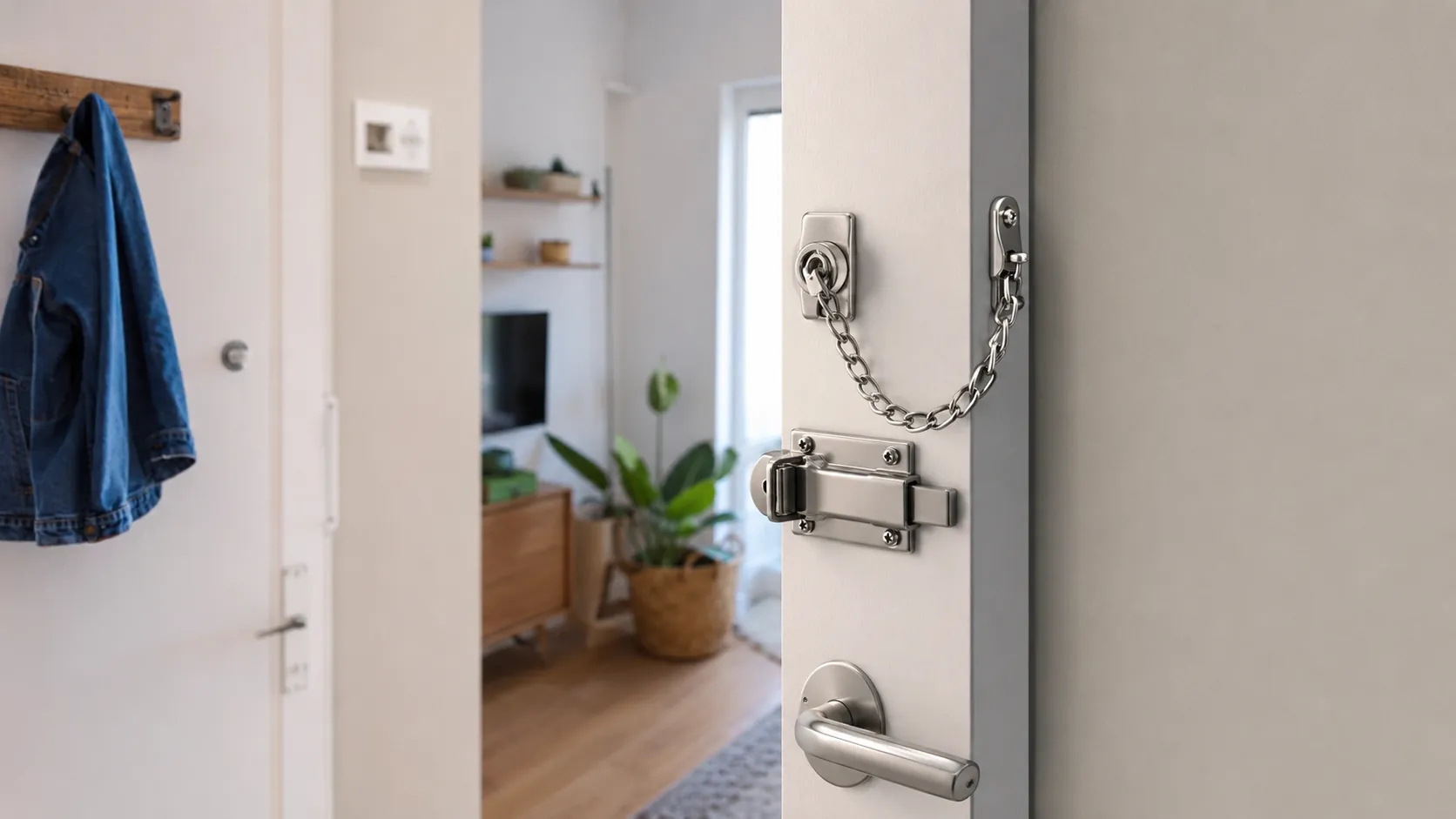
- The latch. Keeps the door shut, not secure. On a slammed, unlocked door, only the latch holds. That is why such an opening is fast and cheap, and why nobody should drill for it.
- The deadbolt. Only locking pushes the bolt forward. One turn is good, two are better, because the bolt then sits deeper in the strike plate and the leverage path gets longer.
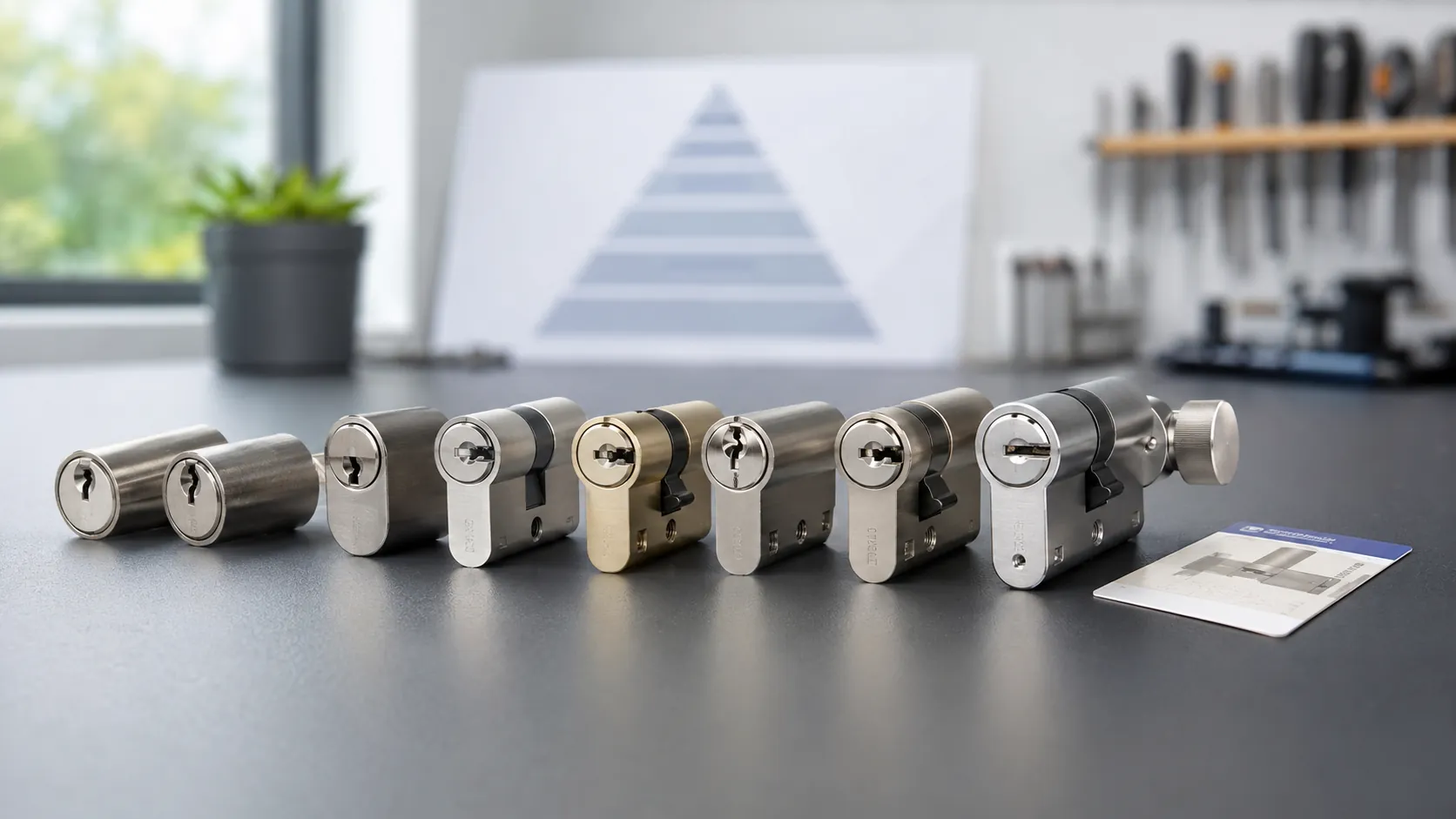
- The cylinder. The heart of the door. This is where it is decided whether someone gets through with simple tools. Look for the DIN EN 1303 standard and brands like ABUS, BKS, Winkhaus, EVVA or Kaba.
- Drill protection. Hardened pins and plates inside the cylinder that blunt a drill bit. Without it, a cylinder is done in minutes.
- Pull protection. Stops the cylinder being torn out with a screw, the so-called cylinder pull. For that you need a security fitting to DIN 18257, ideally ES1 or ES2.
- Pick protection. Complex pin geometry and locking elements that make lock picking harder. More on that in our piece on protection against lock picking.
- Key control. A patent-protected key that is not copied on any street corner. Spare keys only come with a security card, and only from the manufacturer. This is the level that makes the difference after a lost key.
Sounds like a lot. It is not. Most of these levels sit in two parts: the cylinder and the fitting. If those two are right, you have covered five of the seven layers.
Why the chain matters, not the most expensive part
An expensive cylinder in a cheap tin fitting is like a safe with a cardboard lid. That is not a metaphor, that is daily life.
Last week in Nordend. A customer, very proud, shows me his cylinder. 140 euros, top brand, security card, the works. But the fitting next to it was the cheapest hardware-store tin, screwed from the outside, and the cylinder stood two millimetres proud. I pointed with my finger at where a pair of pliers would have grabbed. A burglar could simply have pulled the expensive cylinder out, never touching the fine mechanism. We swapped the fitting for 70 euros for an ES2 security fitting that covers the cylinder flush. Suddenly the chain held.
The most expensive cylinder is worth nothing if the weakest link sits beside it. So with every door I look at that first: not the price on the key, but the level that gives way first.
Where Frankfurt doors typically fail
In the old buildings in Bornheim and Nordend it is almost always the fittings. Beautiful old doors, well-kept cylinders, and in front of them a long escutcheon you lever off with a screwdriver. In the ground-floor flats in Niederrad and Gallus it is the patio door, not the front door. The cylinder up front can be as good as it likes. And in the Bahnhofsviertel I most often see the opposite: good fittings, but a cheap cylinder with no drill protection, because someone saved at the wrong end.
The classes, short and without the jargon
You do not need to memorise a standard. But two numbers help when buying, because they map exactly to levels four through seven.
DIN EN 1303 classifies the cylinder. The relevant spot is the digit for attack resistance. Grade 0 means no drill or pull protection, hands off for a flat door. Grade 1 is entry level. Grade 2 is what I recommend for a normal Frankfurt flat door. On top of that comes key control, often shown as its own attack class with drill and pull protection.
DIN 18257 classifies the fitting. ES1 is solid. ES2 has cylinder coverage and resists drilling and tearing far longer. For flat entrance doors I recommend ES1 as a minimum, ES2 if the door is at ground level or easily reached.
And the really big class: DIN EN 1627, the resistance classes RC2 and RC3. But those describe the complete door including frame and fitting, not just the cylinder. RC2 is the standard insurers and the KfW want to see in housing. RC3 for exposed locations. Do not let anyone sell you an RC3 cylinder. The class applies to the door as a system, not to a single part.
Locked out and in a hurry?
Price quoted up front, vetted partner business, ~22 minutes on site.
An honest price range
So you do not get fleeced on the phone, here are the ranges I work with. Parts only, without installation.
| Part | Cheap | Solid | Recommendation |
|---|---|---|---|
| Standard cylinder, no protection | 15 to 40 EUR | not for the front door | avoid |
| Security cylinder with drill and pull protection | 60 to 90 EUR | 90 to 150 EUR | covers levels 4 to 5 |
| Cylinder with key control and card | 90 to 160 EUR | up to 200 EUR | when loss is a risk |
| Security fitting ES1 | 30 to 60 EUR | solid | minimum for a flat door |
| Security fitting ES2 with cylinder cover | 60 to 120 EUR | very good | ground-level doors |
Add the labour. A cylinder swap on a normal door is done in 20 to 40 minutes. Anyone who quotes you triple-figure extras for that, or wants to drill even though the door was only slammed shut, does not belong in your flat. You can see the full range on our price overview.
Common questions from the consultation
Do I really need all seven levels? No. A third-floor flat has a different risk than a ground-floor flat in Niederrad with a patio door. My standard for the normal Frankfurt flat door: a security cylinder with drill and pull protection, plus a security fitting. That covers levels three to six. Key control comes in when several parties share one system or a key has been lost.
Does a cylinder with an emergency function make sense? Yes, almost always. It lets you open or lock from outside even when a key is inserted on the inside. Anyone who has been locked out because a child left the key in the lock inside knows the value. It costs a few euros more and saves the expensive callout when it counts.
Is a locking system overkill for a townhouse? It depends on how many doors you manage. As soon as the front door, cellar, garage and garden gate should run on one key, a well-planned locking system makes sense. Which locking type suits your door is covered in our guide on cylinder, multipoint or deadbolt.
What happens when the chain does break
One more story, because it shows why level seven is no luxury. Last month in Sachsenhausen, a tenant loses her keyring with an address tag on it. A classic. Without key control she would have had to swap every cylinder in the building, because any locksmith could have copied the found key. But with a security card it was clear: no card, no spare key, and the card was in the safe. We only had to swap the one cylinder of her flat door. 110 euros instead of four figures. That is exactly what the level is for.
If at some point nothing works any more, the door is shut and the key is gone, that is a case for the emergency service, not for panic. And anyone who wants to know which levels their door already has, I will look at it calmly in a burglary protection consultation.
My conclusion after 19 years
Security is not a number on a key, it is the level that holds last. Spend your money where your door is weak, not where the seller has the highest margin. A good cylinder and a matching fitting beat any expensive single part with no partner.
And if you want to know whether burglaries are rising or falling in your area: the police crime statistics from the BKA map the trend in residential burglary. Read them by all means. But the chain on your own door decides more in the end than any statistic.