Let me be blunt up front: a good smart door lock is convenient and secure enough for daily life, but it fails more often than a good mechanical lock. Most of the smart-lock callouts I get at night have a banal cause. Dead battery. No WiFi. The app hangs. Plan for that and you are fine. Try to live without a backup key and sooner or later you end up calling me, usually at three in the morning, in the rain.
I have been working the night shift in Frankfurt for eight years, and over the last three or four years the number of smart locks on my callouts has exploded. That does not mean the things are bad. It means people buy them, install them, and then forget plan B. That is exactly what this is about.
The short answer: reliable enough, if you do it right
A decent smart lock from Nuki, ABUS or Burg-Waechter has no higher failure rate in normal use than your WiFi box. You do not run into problems constantly. But the residual chance that it jams is clearly higher than that of a simple thumb-turn cylinder that just always turns.
The difference is the consequence. When a mechanical lock starts to jam, you notice it gradually, the key gets stiffer, you have time. When the electronics die, they die instantly. In the middle of the night. With no warning, if you swiped away the battery alert in the app.
The build type you pick decides everything
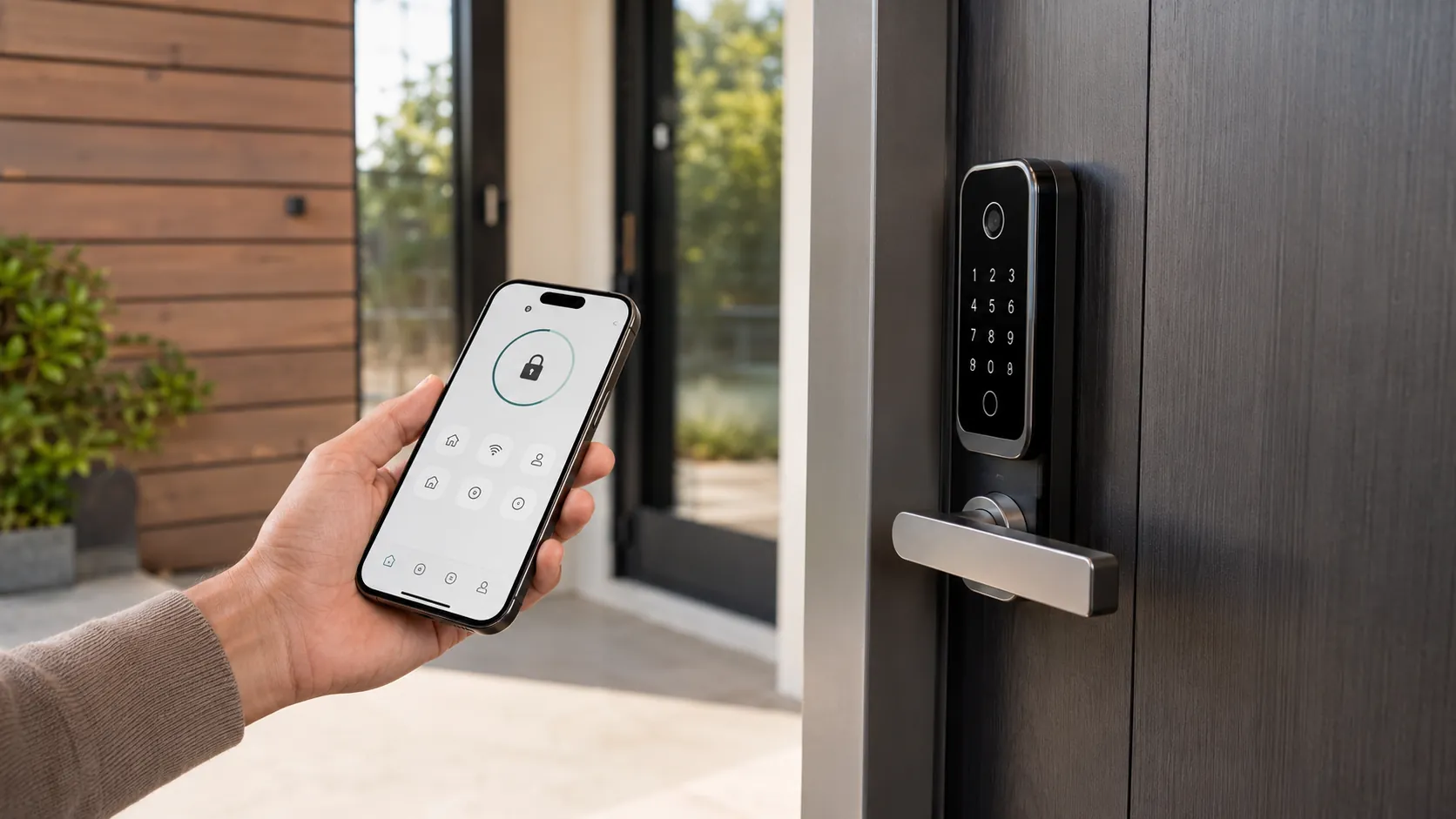
The common models are retrofit kits that sit on the inside of your existing thumb-turn cylinder. Nuki does this, ABUS with the HomeTec Pro, Burg-Waechter has one too. The big upside: nothing changes on the outside. The mechanical key keeps working from outside.
That matters to me. That key is your lifeline when the electronics quit. I preach this to every customer.
Then there are the fully integrated electronic locks where the cylinder itself is electronic, like Winkhaus with the blueSmart system or EVVA with Xesar and AirKey. These are serious systems, often in office buildings and apartment blocks. That belongs in the hands of a professional, it is nothing for a quick DIY job.
And then there is the cheap junk. Nameless radio locks for 39 euros off a marketplace, often with no mechanical backup at all. Hands off. When the battery dies on those, you are stuck outside, and I have to drill. That gets expensive and it is unnecessary.
What I actually check before buying
- A mechanical backup must be present. Always. No lock without a real key or an external emergency-power option.
- The cylinder underneath has to be worth something. DIN EN 1303, with anti-drill and anti-pull protection. A good security cylinder costs 60 to 150 euros, that is money well spent.
- Battery packs over button cells are my preference, you get an honest charge level.
- Hands off devices whose app only runs through a distant cloud. If the company goes bust tomorrow, your lock is electronic scrap.
Where the real benefits are
So this does not just sound like a hit piece: for some households the tech is a genuine win. It locks automatically the moment you leave. That kills the classic question of whether it was locked or not. You give the babysitter or the cleaner a time-limited access without handing over a key. And if a key goes missing, you revoke the digital access in seconds instead of swapping a whole locking system.
Last month I had a case in Bockenheim. A family, three kids, keys vanishing constantly. For them the smart lock was worth its weight in gold, because nobody got locked out anymore. Cost of a solid retrofit device: around 150 to 250 euros, plus roughly 80 to 120 euros if I set it up cleanly and adjust the door properly while I am at it. Because a smart lock on a sagging door is like a sports car on flat tyres.
For landlords with holiday flats, or for older people who need to let in their care service, the time-limited access is genuinely handy. There I see the point immediately.
Locked out and in a hurry?
Price quoted up front, vetted partner business, ~22 minutes on site.
Where the risks really are
The biggest risk is not the hacker. It is the power.
A radio link that drops. An app that misbehaves after an update. A battery that dies at the wrong moment. Those are the three classics that get me out of bed at night. Of the theoretical radio hack that everyone online talks about, I have had exactly zero real cases in eight years. Of the dead battery I have had dozens.
The second thing is the mechanical base. A smart lock does not make a weak door stronger. If there is a cheap cylinder underneath with no anti-drill protection, the app does nothing against someone who simply snaps the cylinder off. That takes less than thirty seconds. All that lovely radio encryption is irrelevant then, because the burglar takes the physical route.
If you actually want security, you combine the tech with a tested cylinder and solid burglary protection. The police and the BKA have said it for years: mechanical basics first, electronics on top. According to the police crime statistics from the BKA, most break-in attempts fail on good mechanics, that is door, fitting and cylinder, not on a clever app.
Three failures I see again and again
So you know what really happens at night, three typical callouts from my own work.
The classic: dead battery, no backup key. Two weeks ago in Nordend. Young couple, smart lock, mechanical key lying inside on the dresser. The app had been nagging about the battery for days, they had ignored it. At half past one I was standing at the door. With a backup key in his pocket it would have been a non-event.
The second: the door falls shut, the auto-lock snaps closed, the phone stays inside. The smart lock can open nothing from outside if your phone is the only key. Happens more often than you would think.
The third: the lock goes out of mechanical adjustment because the door sags. The motor can no longer fully throw the bolt. Then it beeps, flashes red, and nothing moves. Here the problem is almost never the software, it is a door that was never set up properly.
What does it cost me when it goes wrong
Plain talk on prices, because people always ask.
| Situation | Fair range |
|---|---|
| Daytime, door fell shut, backup key on hand | 80 to 150 euros |
| Night, weekend, holiday, simple opening | 150 to 250 euros |
| Smart lock dead, no backup, drilling needed | 250 euros and up plus a new cylinder |
| Good security cylinder as a replacement | 60 to 150 euros in parts |
You can see it: the expensive case is always the one with no mechanical backup. You avoid exactly that for zero euros by choosing the right device when you buy. If you want to know more about prices, we lay it out transparently under pricing, and in an emergency the emergency service is ready.
And if the tech is blowing up in your face at night: call before you start drilling yourself. Through contact you reach someone on the phone fastest, who can tell you on the line whether you even need a callout.
My advice from the field
Only buy devices with a mechanical backup. Change the batteries before the app warns you, not after. And always keep a real key within reach, ideally at a neighbour's or at your parents', not inside on the dresser.
If you are thinking about a swap anyway, read our piece on lock replacement first and see when a cylinder swap yourself really makes sense. For the mechanical basics, the multipoint locking guide is a good start, that often does more than any app.
Bottom line: smart locks are not a gimmick, but they are no security miracle either. They are convenient, they save you grief, and they work as long as you do not forget plan B. Forget it, and we will meet at night. In the rain. At your door.