
I install smart locks, and yet almost every week someone asks me: are burglaries in Germany actually going up? The honest answer is uncomfortable. According to the BKA police crime statistics (PKS), residential burglary has moved in waves for years, with a clear low during the pandemic and a clear rise afterwards. I deliberately do not quote precise national totals. They shift every year, and anyone throwing an exact number at you usually wants to sell you something. The patterns matter more. Because they barely change.
And it is exactly those patterns that can really protect you. Not the headline, not the fear.
The short answer first
Burglaries are rising again, but slowly and not everywhere equally. The decisive finding of the PKS is a different one: a very large share of all attempts fail. Offenders give up when the door or window does not yield in the first few minutes. That is not theory. I see it on every second job where I am called out after an attempt.
Anyone who has understood this saves a lot of money on the wrong things.
What the PKS trends have shown for years
Three things are stable over the years, and according to the BKA that is no accident:
- A large share of burglaries stays at the attempt stage. The offender often fails against good mechanics and gives up after a few minutes. That is the single most important figure, even if the news rarely mentions it.
- The clear-up rate is low. Do not count on the crime being solved or on your jewellery coming back. Prevention beats investigation, every time.
- The dark season is the peak. From October to February, with early dusk, the numbers rise noticeably. A dark, unlit flat at 5 pm signals to the offender: nobody is home here.
These three points sound banal. They are not. They tell you exactly where your money should go and where it should not.
Why the attempt rate decides everything
Do not picture the typical offender as a Hollywood pro. Most are opportunists, often hunting for quick cash. They carry a simple screwdriver, no special tools. They pry at the window or the patio door, because that is quiet. If it does not work after two or three minutes, they move on. To the neighbour. To the next door.
This is where everything is decided. Not at the camera. At the mechanics.
Regional differences, honestly placed
The PKS reports the rate per 100,000 inhabitants. And there the city-states and dense urban areas usually sit above average, rural regions below. So far, so predictable. But be careful: you cannot generalise this down to the individual street. Within a city the risk varies enormously.
For Frankfurt that means, concretely:
- Ground floor and basement are clearly more exposed. Someone living at street level has a different risk than someone on the fifth floor with no balcony access.
- Easily reached patio and balcony doors are the favourite target. They are often worse secured than the front door and sit in the shade.
- Homes near escape routes such as rail lines, green strips or motorway ramps are more popular, because the offender can disappear quickly.
In Niederrad, in the Gallus or on the edge of Bockenheim I see this constantly in practice. Terraced house with a garden and a poorly secured patio door: high risk. Flat on the fourth floor with only a front door: statistically a whole different world. In the Nordend with its many well-kept old apartments it is often the basement and raised-ground-floor windows that get tilted open.
A point I make often: do not look only at your district. Look at your specific flat, your position in the building, and your weakest door.
Locked out and in a hurry?
Price quoted up front, vetted partner business, ~22 minutes on site.
Why the statistics in particular give me a clear opinion
Precisely because I install tech, I say it plainly: a camera films the burglary. It does not prevent it. I have customers who installed an 800-euro camera system and whose patio door can still be pried open with a 5-euro screwdriver. That is the wrong order.
What deters offenders in the first minutes is mechanical resistance. Concretely:
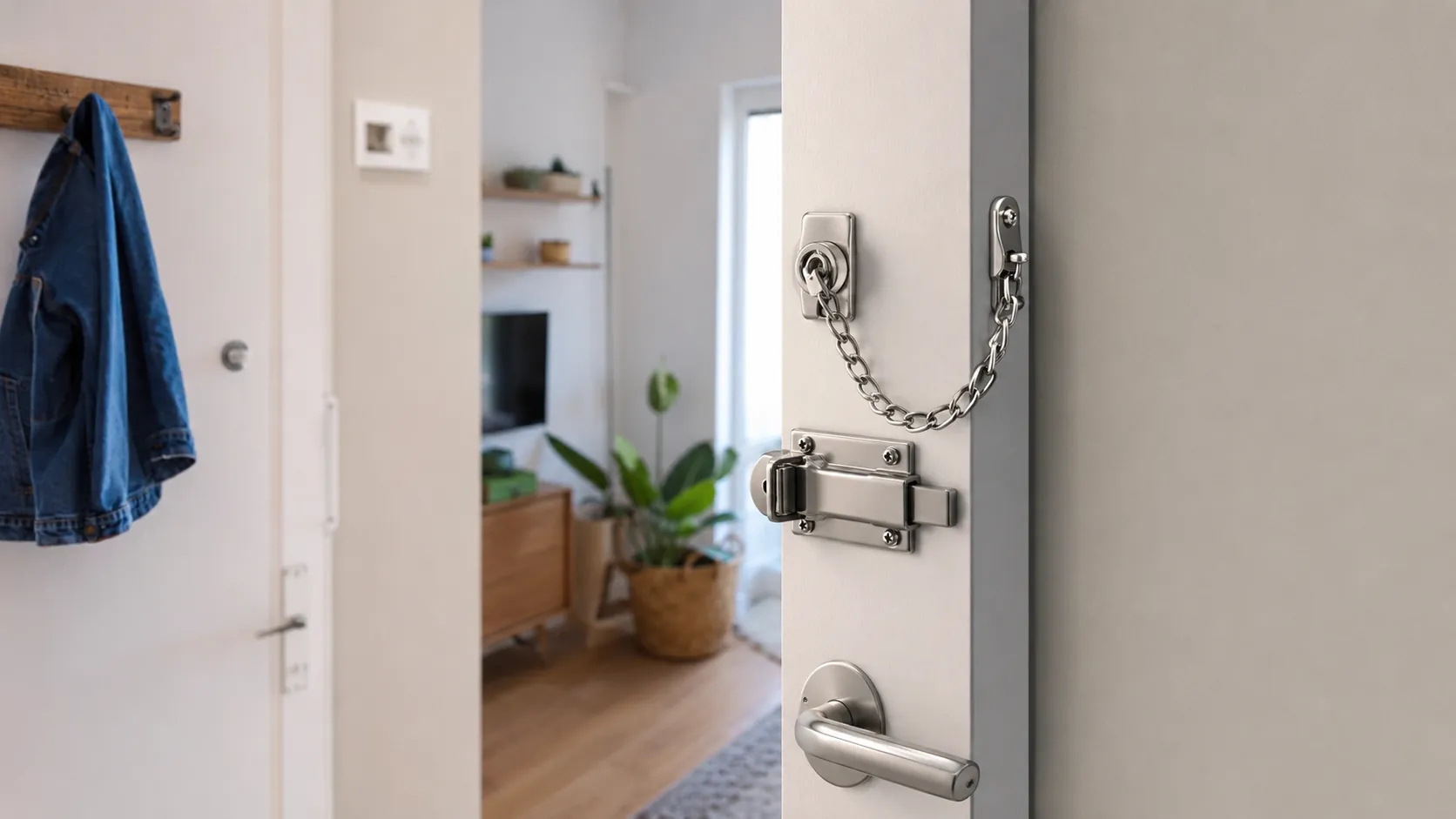
- A good locking cylinder with pull protection and drill protection, ideally to DIN EN 1303, from ABUS, BKS or Winkhaus. Not a no-name cylinder for 8 euros from the DIY store.
- A security fitting to DIN 18257, at least ES1, better ES2, that prevents the cylinder being drilled or twisted off.
- Mushroom-head pins on windows and patio doors, plus lockable window handles.
- For new builds or renovations: burglary-resistant components to DIN EN 1627, resistance class RC2 is fully sufficient for the vast majority of private homes.
That lines up exactly with the PKS finding that so many crimes stall at the attempt. Anyone not inside after two or three minutes usually gives up. Smart tech complements this sensibly, when the mechanics are right. It never replaces them. More on the logic of the security levels in our piece on the seven security levels.
What does sensible protection really cost?
Here is a rough orientation from practice, so you do not have to believe every figure quoted on the phone:
| Measure | Realistic price |
|---|---|
| Security cylinder with pull protection (part) | 60 to 150 EUR |
| Security fitting ES1/ES2 (part) | 40 to 120 EUR |
| Mushroom-head pins retrofitted per window | 80 to 150 EUR |
| Lockable window handles each | 20 to 40 EUR |
| Cross-bar lock for the front door | 250 to 450 EUR |
Plus labour, depending on effort. Anyone quoting you 1,500 euros for a simple retrofit without having seen the door belongs on the reject pile. How to spot dodgy providers is in our guide spotting a locksmith scam.
An evening in Sachsenhausen
Last autumn I was with a customer in Sachsenhausen who wanted to upgrade after an attempted break-in next door. The offenders had pried the patio door there, in under a minute, with a screwdriver. At my customer's place the exact same door was unsecured. For a good 300 euros we retrofitted mushroom-head pins, lockable handles and a security cylinder. No smart device, pure mechanics. That is exactly my recommendation before anyone pours money into cameras. She later added a camera, but as a complement, not a replacement.
Two weeks before that, in the Gallus, the opposite. A young tenant called me because his fancy app doorbell supposedly secured everything. The flat door was a cheap lock with no security fitting, the cylinder stood two centimetres proud and could be gripped by hand. I swapped the cylinder and fitted an ES2 plate, together under 200 euros in material. The app could stay. But now it secures a door that actually holds.
Common questions, briefly answered
Is an alarm system worth it? Yes, as a complement. It deters and alerts, but only if the door holds do you win the decisive minutes. Mechanics first, then alarm.
Is upgrading worth it in a rented flat? Often yes, and much can be done without structural changes. Lockable handles and a better cylinder are reversible. For larger measures, speak to the landlord first.
Is RC2 enough or do I need RC3? For a normal private home RC2 is almost always enough. RC3 is for particularly exposed locations or high-value contents, and it costs significantly more. Do not let anyone talk you into RC3 when RC2 will do.
Does more light really protect? Yes. Motion sensors and lit entrances are cheap and effective, because they remove exactly the dark anonymity that opportunists seek.
What you can do today
Statistics are good for understanding. But they secure no door. If you want to know where your home really stands, a sober burglary protection consultation is worth it, with no sales pressure. Practical tips on securing a door against prying and picking are in our guide on protection against lock picking. And if something has already happened and you need someone fast, you can reach us via the emergency service.
Look at your weakest door this evening. Push against the ground-floor window. Does the cylinder stand proud? Can the handle turn without a key? Those are the questions that count. The statistics only confirm what the door in front of you already reveals.