First the essential: whoever loses a key is in principle liable for the resulting damage, but not automatically for replacing a complete locking system. What matters is whether the loss actually creates a concrete risk of misuse. That exact point is constantly handled wrongly in practice, and tenants pay sums they never should have paid. I am not a lawyer. But I have accompanied cases like this for over twelve years, and I have read the letters of hundreds of property managers.
Let me sort this out from the start. Because between "I lost my flat key" and "I have to pay 4000 euros for a system" lie whole worlds, and the manager usually tells you the expensive version first.
The two cases that decide everything
At the core there are only two situations, and you need to know which one you are in. It changes the bill by a factor of twenty.
Case one: a simple flat key that only opens your own front door. That is the normal case in most of Frankfurt old buildings. Bornheim, Nordend, large parts of Sachsenhausen. Each flat has its own cylinder, the key fits nowhere else.
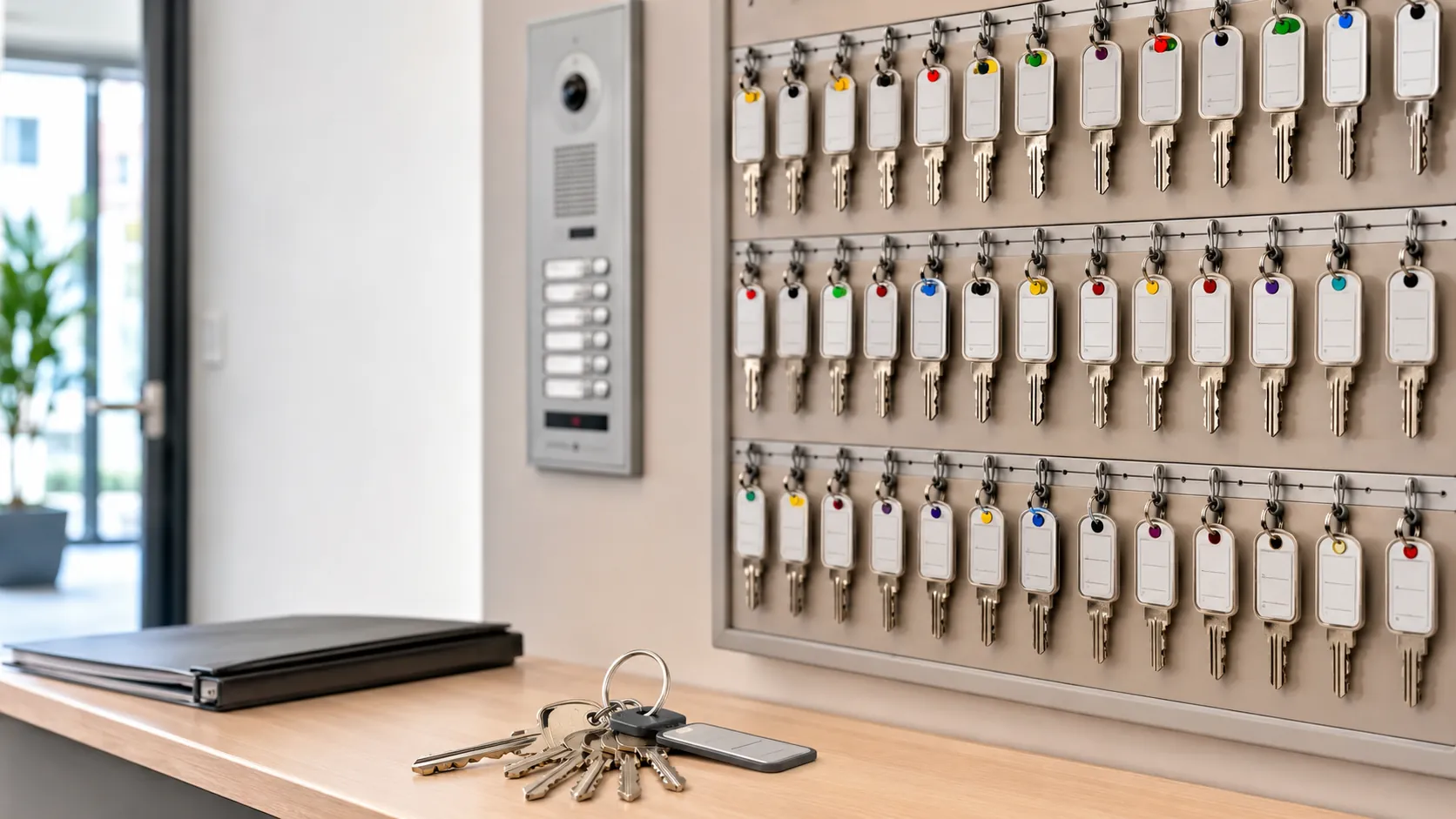
Case two: a key that belongs to a locking system. Meaning a system where one key opens several doors, the main entrance, the cellar, the bin room, sometimes the underground garage and all flats via a master key. You find this more in newer builds, in the big complexes in the Gallus, on the Riedberg, in many Niederrad blocks.
So the first question you have to settle is not "who pays", but: what kind of key was it in the first place?
A single key: manageable, and usually cheaper than you think
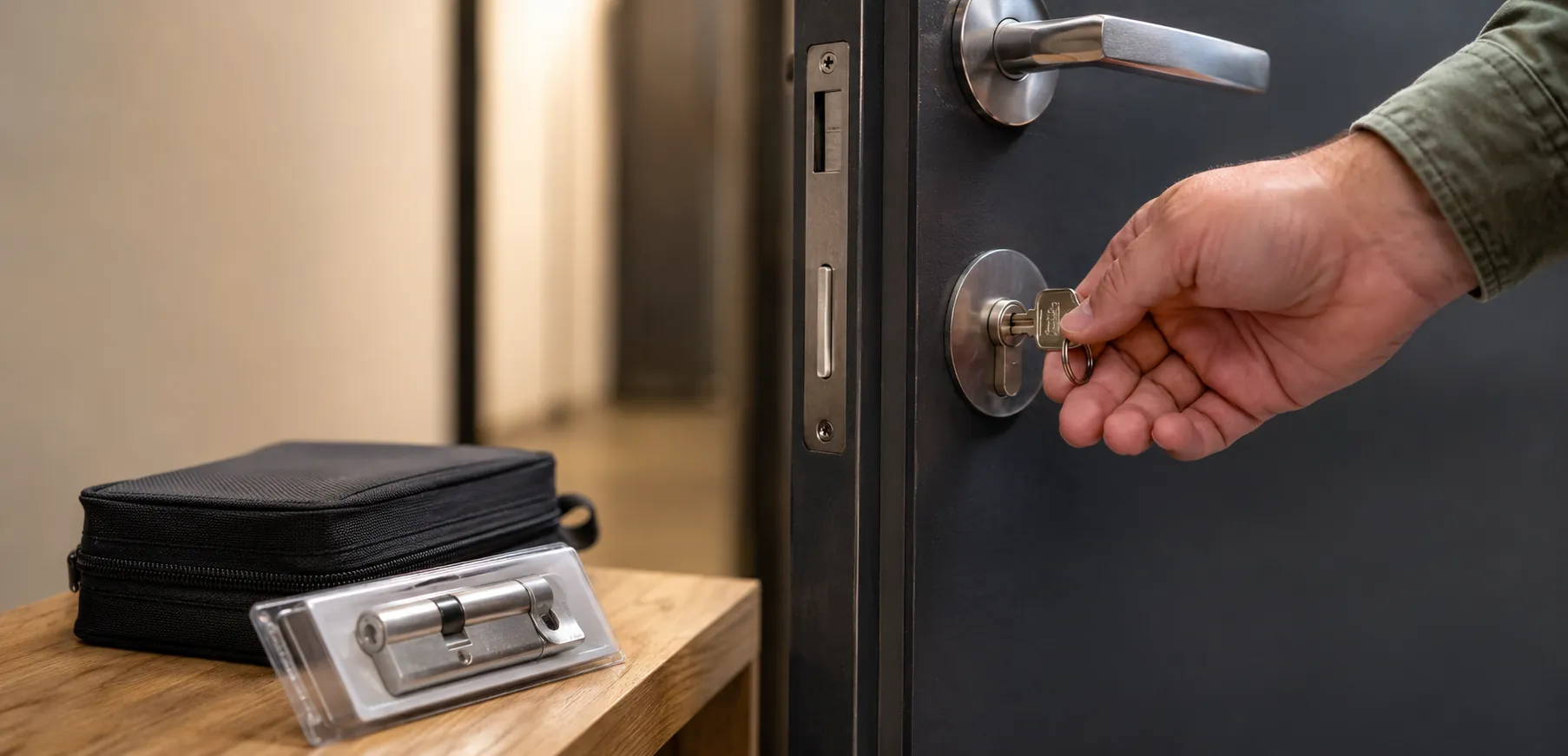
If you lose an ordinary flat key, the matter is small. The sensible and common step is to swap the cylinder so a found key is useless. Done. No drama.
A good security cylinder with an emergency and danger function, the kind that still locks even when a key is inserted on the inside, runs between 60 and 130 euros for the part. Brands like ABUS, BKS or Winkhaus, all tested to DIN EN 1303. Add the labour. The bottom line at a proper firm usually lands between 90 and 170 euros. How the swap works in practice and when you can do it yourself is in our guide on changing a cylinder yourself.
You usually carry this cost. You caused the loss, so you are liable for removing the risk. That is fair and undisputed.
A tip from practice: insist on a plain cylinder swap, not a "repair" or even a whole new lock with fittings. Some managements suddenly write things into the estimate that have nothing to do with your lost key. A worn-out door from 1962 is not damage you caused.
Locking systems: this is where it gets expensive, and where too few push back
If the lost key belongs to a locking system, the replacement can run into four figures. With twenty parties, several doors and central cylinders we are quickly talking about 2000 to 5000 euros. That is the number managers use to pressure tenants.
And now the point most people do not know.
Replacement of the whole system must not be demanded reflexively. What is decisive, according to the case law, is whether there really is a concrete risk that the key falls into the wrong hands and the system is misused. It is about the real damage, not the abstract risk that theoretically someone somewhere might find a key.
The Federal Court of Justice held exactly this in a much-cited ruling: the tenant only has to reimburse the cost of replacement if the system is actually replaced because of the existing risk of misuse. In plain words: if the system is not replaced at all, there is nothing to pay either. And if there is no concrete risk, the replacement is not justified.
When the concrete risk is missing
If the key was lying anonymously in the world, with no address clue, no flat number, no connection to you at all, and was lost far away, then this concrete risk is often missing. An example: you lose the key on holiday in Italy, on the beach. Nobody who finds that key knows which door in Frankfurt it belongs to.
In such a case a full replacement may not be justified. And then you do not have to pay for it in full either.
When the risk is real
It looks different if there was an address tag on the keyring. Or if the key was stolen together with your wallet and ID. Then the finder or thief knows exactly where the door is. Here the risk of misuse is concrete, and replacing the system can be justified. Be honest with yourself. Whoever stonewalls here loses in court.
Locked out and in a hurry?
Price quoted up front, vetted partner business, ~22 minutes on site.
Last winter in Ostend, and a case from Bockenheim
Last winter I advised a tenant from Ostend. The property manager demanded replacement of the entire system for over 2000 euros, just because she had lost a single key at the swimming pool. Anonymous. No clue pointing to her flat, no name tag. We demanded in writing that he set out the concrete risk of misuse, and after consulting the tenants' association the demand melted away considerably. In the end she paid for the swap of her own cylinder, just under 140 euros, and not a cent more.
Another case, a few months earlier, went the other way. A tenant from Bockenheim had lost his whole bag in the car, with his key and a piece of addressed mail showing his full address. No argument helped there. The address was out in the open, the system served twelve parties, the management replaced it rightly. He paid. His contents insurance covered part of it, because he had a key-loss clause. That is exactly why I tell everyone: check your policy.
What you should actually do
A short list I give every person who asks me:
- Document immediately how and where the key was lost. Date, place, circumstances. Note it down the same day.
- Check whether the key carried an address clue. If there was none, that is your strongest argument. If there was one, it weakens your position, and honesty is wiser than tactics.
- Ask for a written estimate, broken down into parts and labour. Accept no round flat-rate sum without proof.
- Ask whether the system is actually being replaced. As long as it is not replaced, you owe nothing.
- Report the loss to your contents insurer. Many policies cover key loss, often up to 2000 or 3000 euros.
With an affected locking system a professional assessment helps to judge whether a partial swap is enough or the whole system has to go. Often it is enough to re-key only the outer doors and the lost cylinder. Who pays what in detail we also cover in our piece on who pays for the lock change. And if you are thinking about security anyway, it is worth a look at burglary protection, because a modern cylinder is more than just damage control.
Common questions from my consultations
Do I have to pay before the system is replaced? No. As long as the system stands and is not replaced, no damage has occurred that you would have to reimburse. Do not pay into the blue.
The manager threatens a lawyer. What now? Stay calm. Have them set out the concrete risk of misuse and get yourself some backing. For the legal fine points the tenants' association is the right address, especially with four-figure demands. Membership costs less than a single lawyer letter.
What if I find the key again later? Then you should report it. If the system has not yet been replaced, the whole matter usually resolves itself.
Do I need a secure cylinder fast because the situation unsettles me? Then our emergency service is there, especially evenings and weekends. A cylinder swap often takes less than twenty minutes.
Bottom line
You are liable for the damage you caused. You are not blindly liable for every demand someone puts on your table. The concrete risk of misuse is the yardstick, not the manager's alarm and not the highest number in the estimate.
With a single key you swap the cylinder and you are out, usually for under 170 euros. With a locking system you check two things: was there a concrete risk, and is the system really being replaced. If one of those is missing, you do not pay the full price. Ask questions. Do not let anything be forced on you. And report the loss to your insurer before you talk about money.