Quick answer first, so you do not have to keep scrolling: old keys do not belong in the household bin, and they do not belong in a kitchen drawer for years either. After a lock change they are technically useless, but they give away more about you and your home than most people realise. I have handled insurance claims and written loss reports for sixteen years, and the rules I give you here come straight from that corner.
The most important distinction up front. There are two kinds of old keys: those that genuinely no longer open anything, and those that quietly still open something. The first kind is scrap metal. The second is a security risk. Treat them the same and you have made a mistake.
Why the household bin is the worst option
Picture the rubbish bin in the back yard. A key clinks on top, next to a torn envelope with your name and address on it. For someone who deliberately goes through bins, and those people exist, that is a gift. Key plus address plus the information that something has just been done to the lock here.
For a single standard key to an already-replaced cylinder, the risk is manageable. The lock is gone, the key opens nothing. It gets delicate in exactly two situations.
First: locking systems. If only one cylinder in the building was changed, say the flat door, then your old key may still open the front door, the cellar, the bin room or the underground garage. These keys are anything but useless. They are actually more dangerous than before, because nobody expects them anymore.
Second: keys with a profile. On a modern security key from ABUS, EVVA, BKS or Winkhaus, the cut is visible in the profile. A specialist reads from it which system is installed. That is not a disaster, but it is unnecessary when you can avoid it.
How to dispose of old keys properly
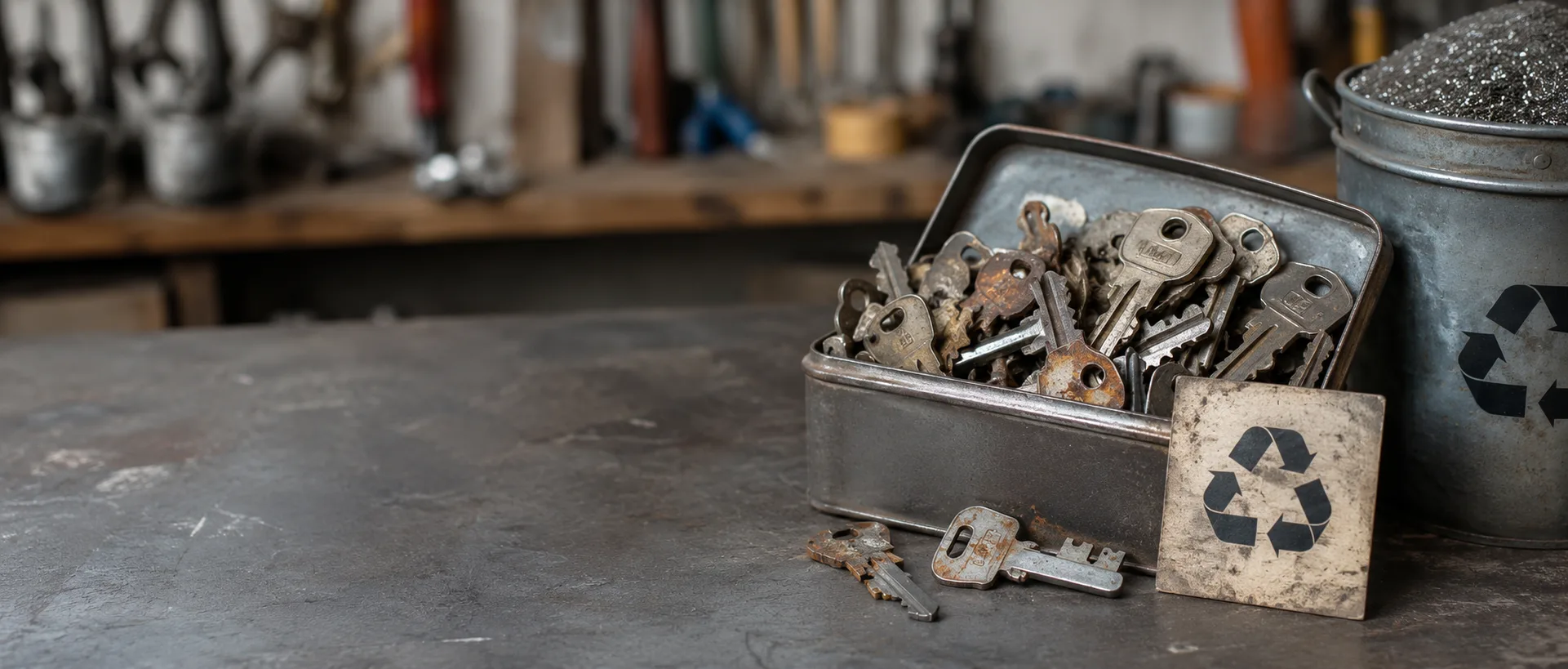
Here is the practical part. Brass is a recyclable material, and at the recycling centre it goes into scrap metal, gets melted down and is gone for good. That is the clean solution for most keys.
For critical keys, the ones that might still open something somewhere, I go one step further:
- Cut through the bit, that is the toothed or milled side, with a hacksaw or file it down. That destroys the locking information.
- Or bend or snap the key blade in a vice. For thin flat keys a pair of pliers will do it.
- Only then take it to scrap metal.
For a perfectly ordinary flat key to a replaced cylinder, sawing is overkill. For the last valid key of a still-running locking system, it is exactly right. Last week in Nordend I had precisely this case: a homeowners association had replaced the flat-door cylinders one by one, but the front-door locking carried on. So the old flat keys still opened the front door. I advised the manager not to simply collect those keys and drop them in a drawer, but to saw off the bits. Ten minutes of work, and one residual risk was off the table.
What you should never do
Do not drop them in the neighbour's mailbox thinking they will sort it out. Do not leave them lying in the hallway. And definitely do not sell them on classifieds, even if some old warded keys look pretty. A key with a readable profile in a stranger's hands is always a residual risk, and it costs you nothing to render it useless first.
Which keys you absolutely keep
Now the other side. Do not throw everything out, or you will be empty-handed the next time you need a copy or face a claim. Keep:
- The security card for the new cylinder or system. Without that card no reputable firm will cut you a duplicate. It is your proof of ownership and your ordering authorisation in one.
- Keys to locks still in use. Mailbox, garden gate, bike cellar, common room. These are often forgotten when the flat-door cylinder is swapped.
- For a locking system, the key-number list documented by the provider. It records which number was issued to whom.
- The invoice for the lock change. More on that in a moment, because your insurer needs it.
What you can dispose of without hesitation: every key to the replaced cylinder, provided it opens nothing else. They only have collector value if they are genuine old pieces, ornate warded keys from grandmother's day. A modern reversible key is not a collector's item.
Locked out and in a hurry?
Price quoted up front, vetted partner business, ~22 minutes on site.
What your insurer really wants to see
This is the part most people underestimate, and it comes up again and again in my reports. A home-contents insurer often covers the lock change after a lost key, if it is insured. But in a dispute it wants evidence. It wants to see that what happened was properly documented.
In concrete terms:
| Document | Why it matters | Keep |
|---|---|---|
| Lock-change invoice | Proof of amount and date | At least until the claim closes |
| Security card | Proof of ownership, duplicates | Permanently |
| Key-number list | Who held which key | As long as the system runs |
| Loss report or police report | Documents the trigger | Mandatory for theft |
With a locking system the key management is the heart of the matter. Who held which key, which one was cancelled, which is missing. If you cannot prove that, settlement gets sticky. So keep the invoice for the lock replacement and the key list together, ideally in one envelope with the security card. Sounds fussy. Saves you weeks when it matters.
If you want to do it fully properly, check with the consumer advice centre on what your own contents policy actually covers for lost keys. The terms vary more than people think, and some policies do not cover replacing a locking system at all, or only up to a cap.
Two cases from practice
Last week, a case from Ostend. Tenant moved out, one flat key missing at handover. The landlady had the cylinder swapped, kept the new key set complete and handed the old keys in at the recycling centre. Crucially: she had photographed how many old keys she had beforehand and filed the invoice for the change. When a deposit dispute flared up months later, everything was provable. That is exactly how it should be.
Another case, same district, less pretty. A family in Sachsenhausen had refitted the front-door hardware after a burglary, but collected the old keys in a drawer. Three of them, loose, with no note. Two years later nobody could say whether they were the old or the new ones. Result: another cylinder swap for safety, because no one wanted to risk it. Pure precaution cost, avoidable with two minutes of labelling.
The lesson from both: it is not only about throwing things away. It is about traceability. Write on the keyring which key goes to which door. Note the date of the change. Tape and a marker pen will do.
Common questions
Can I put old keys in normal household waste if the lock has been swapped? Technically yes, safely no. At the very least make the profile unrecognisable, or better, take it to scrap metal. The effort is minimal, the peace of mind real.
Do I have to return old keys to the landlord? Yes. On move-out all issued keys go back, and lost ones must be reported too. Keep no copies. Ignore this and you risk paying for a cylinder swap. Details in the guide on who pays for a lock change on a tenant change.
What if I am not sure whether a key is still in circulation? Then assume the worst and swap. A new cylinder costs around 15 to 40 euros in parts for a standard model, a good security cylinder to DIN EN 1303 more like 60 to 150 euros, plus fitting. That is cheaper than a burglary through a forgotten key. If you are unsure, ask quickly via our contact page, or check the price overview first.
The whole thing in one sentence
Defunct standard keys go to scrap metal, keys that still open something somewhere are made useless first, and the security card plus invoice stay filed. If you are having the cylinder redone around a flat handover anyway, you will find the honest costs and the procedure in our guide on the lock replacement service, and you can fold in the clean documentation at the same time. It is no big deal. It is just discipline.