Anyone moving to Frankfurt from abroad trips over the same thing almost every time: you lift the handle upward before locking, then turn the key twice. In France or Italy you simply pull the door shut. Not here. The reason is a piece of engineering that makes German doors noticeably safer: the multipoint lock. And the most expensive mistake is not using it.
I have been advising people on burglary protection for fourteen years, and this one thing I explain more often than anything else. Not because it is complicated. Because it is counterintuitive if you do not know it.
What really happens when you lift the handle
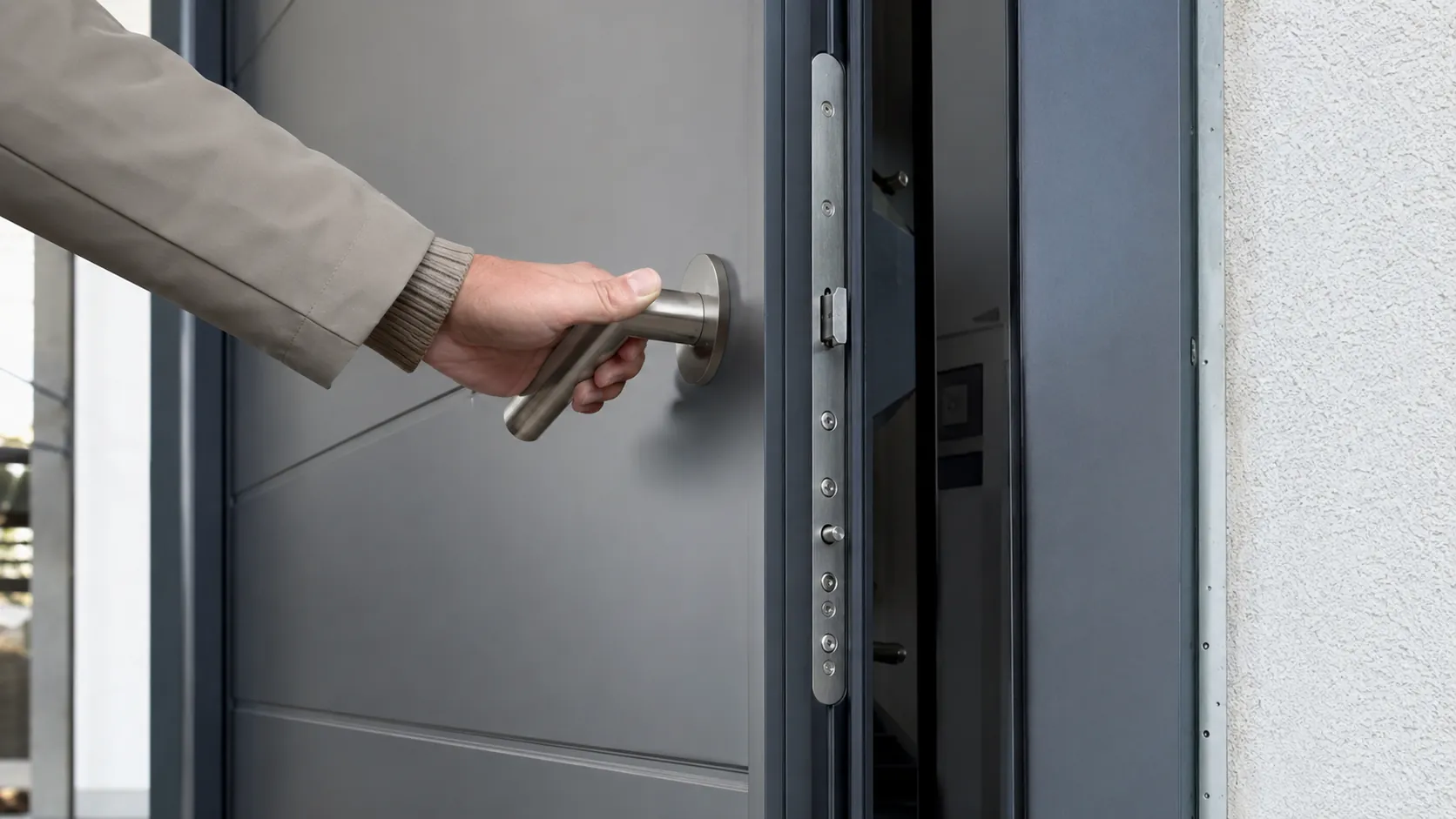
Many German flat and front doors hold no single bolt but a lock that engages at several points at once. This is called a multipoint lock. When you push the handle up, extra bolts, swing hooks or roller cams shoot into the frame at the top and bottom. Only turning the key then locks the whole thing solid. Otherwise the bolts just sit there loose.
The result: the door no longer hangs on the lock in the middle alone but is held at three, five or more points. Top, bottom, centre.
Why does that matter so much? Levering is still the most common break-in trick. The intruder sets a screwdriver or a crowbar between door leaf and frame and pries. On a door with only one central bolt, one point where the wood gives way is often enough. With a multipoint lock the crowbar would have to fight the whole height of the door. A hook holds at the top, a bolt at the bottom, the bolt in the middle. That takes time. And time is exactly what no burglar has.
The different designs in brief
Not every multipoint lock is the same. In practice I see three types:
- Swing hooks: sturdy hooks that claw sideways into the strike plates. Very good against levering. Found on good front doors.
- Roller cams: small rollers that travel into the frame. Solid, but a bit weaker than hooks against brute prying.
- Bolts or round bolts: plain round bolts top and bottom. Better than nothing, but the classic in the mid price range.
My tip if you are buying new: swing hooks plus a tested strike plate. An RC2 door to DIN EN 1627 is the sensible minimum standard for a flat here. RC3 if you live on the ground floor or in a detached house. The norm describes how long the door withstands a break-in attempt with certain tools. RC2 means roughly three minutes against simple tools, RC3 five minutes against heavier ones. Sounds like little. In practice it is a lot.
Pulled shut is not locked
This is the decisive point, and exactly where the costly mix-up happens. Pull the door shut only and it is again held by the latch alone. That little angled tongue that clicks in when the door falls shut. Nothing more.
All that fine multipoint locking does nothing until you lift the handle and turn the key. Whoever just pulls it shut at night has an expensive security door working like a cheap one. It is like owning a safe and leaving its door standing open.
Let me put it plainly: a pulled-shut door can be opened by a child with a plastic card. The latch can be pushed back. It takes seconds, I have done it myself often enough on door openings. How cylinder and bolts work together, and why the cylinder stays the weak point, I explain in our piece on cylinders and multipoint locking.
The most common tenant mistake
Many people think the multipoint lock is automatic. That all the bolts already claw in when you pull the door shut. They do not. There are automatic versions, so-called self-locking locks, where the hooks trigger as the door falls shut. But those are the exception and mostly fitted only in newer or upgraded doors. In Frankfurt period buildings, and we have plenty of those, it is nearly always manual work: handle up, key round.
A story from Hoechst
Last winter a couple in Hoechst called me, freshly arrived from Spain. Back home you simply pulled the door shut, that was it. So they had pulled the Frankfurt door shut only for weeks, because they simply did not know the lift-the-handle habit. One evening a break-in attempt was noticed, the door was only latched and would barely have held a determined shove. Nothing happened, but the fright stuck deep.
We showed them the system on the spot. Five minutes. They have locked up properly every evening since. The door itself was top quality, by the way, a proper RC2 front door with swing hooks. They had simply never known they were leaving all that potential on the table.
A second story, because it shows the other extreme. The week before last in Nordend, an elderly lady. Her key snapped in the cylinder mid-turn, so with the multipoint lock fully deployed. Door completely locked, three swing hooks in the frame, impossible to open from outside. That is the flip side. We had to pull and replace the cylinder, because the snapped tip sat deep inside. A door opening on a locked security door is real professional work, not cheap pushing. In the daytime something like that runs fairly at around 90 to 150 euros for the opening, the new security cylinder adds 60 to 150 euros on top, depending on the protection class.
Locked out and in a hurry?
Price quoted up front, vetted partner business, ~22 minutes on site.
More protection, but also a responsibility
The multipoint lock is genuine burglary protection, not marketing talk. By the trend of the police crime statistics, many break-in attempts already fail on resistant mechanics. The intruders break off when it takes too long or gets too loud. That is exactly what the locking is for. If you want to upgrade your burglary protection, you will find sensible options under burglary protection. The official figures on residential burglary you can read at the BKA, and the trend is clear: good mechanics work.
But protection has a flip side, and I name it openly. With a fully locked door, a snapped key or a faulty lock means you can barely get in from outside. That is then not a case for the emergency service round the corner, but for someone who knows what they are doing.
What I advise you
- Use the locking, every evening. The most expensive door does not protect if it is only latched.
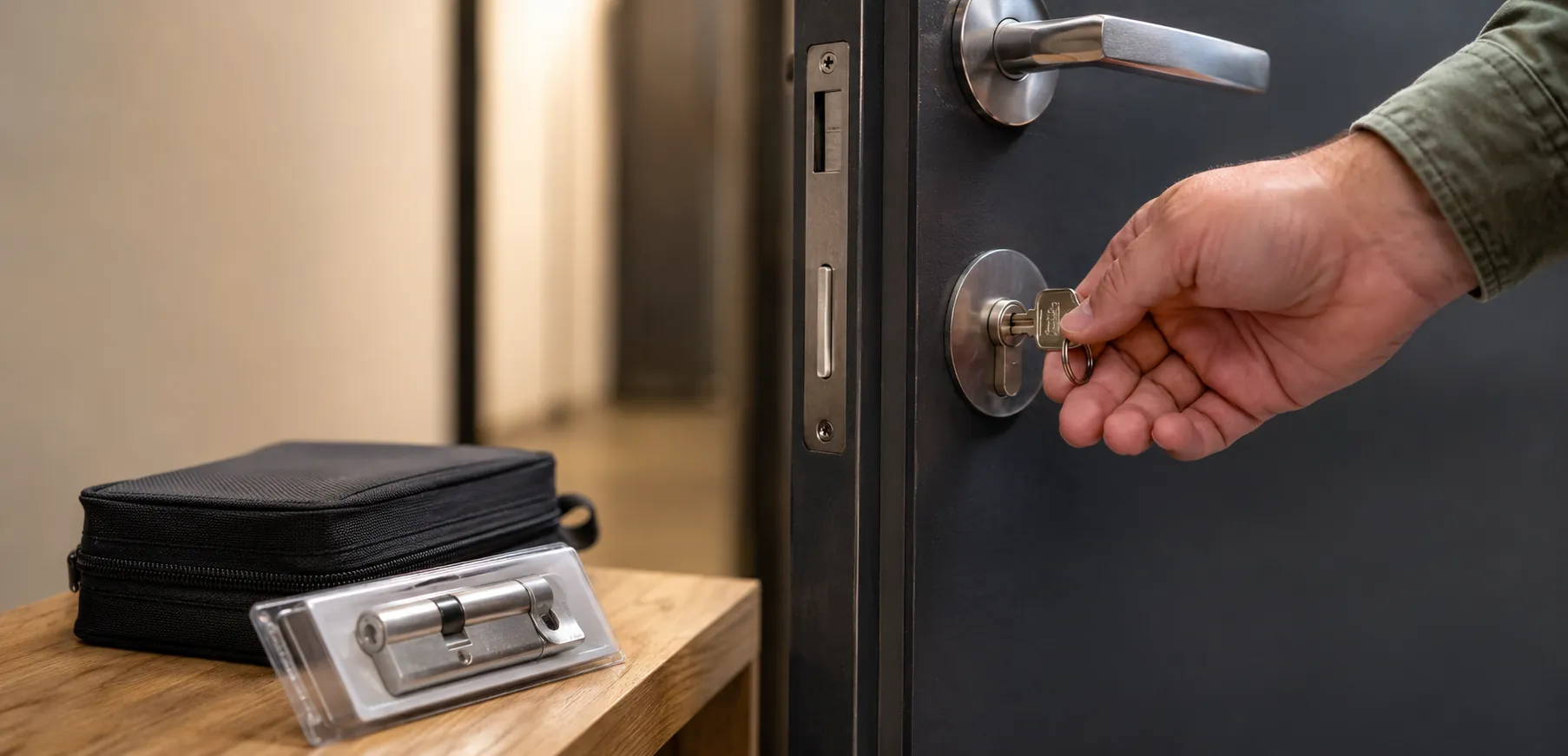
- Do not leave the key in from the inside. On many cylinders that blocks opening from outside in an emergency. A good security cylinder with an emergency-and-danger function solves it, ABUS, BKS or Winkhaus build such things. Look for DIN EN 1303.
- Check the strike plate. The best locking is useless if the hooks grab into thin metal screwed into two crumbling plugs. Sturdy, long-screwed strike plates are the cheapest upgrade there is, often under 50 euros plus fitting.
- Hands off cheap 12-euro cylinders from the hardware store. They can be pulled or picked, no matter how good the multipoint lock behind them is. The cylinder is the weak point, not the bolt.
Frequent questions
Do I really have to turn twice? It depends on the lock. On many multipoint locks the bolts shoot out on the first turn and the second turn additionally locks the deadbolt. On others one full turn is enough. When in doubt: turn until you feel a clear stop and the handle no longer moves.
How do I tell if I have a multipoint lock? Lift the handle with the door open and look at the narrow edge of the door leaf. If bolts or hooks shoot out top and bottom, you have one. If the lifting feels solid and takes some force, that is a good sign.
Is upgrading worth it in a rented flat? Often yes, and the landlord must agree. Structural changes need permission, but burglary protection is in the interest of both sides. Talk to the landlord before you drill. Exactly what tenant and landlord have to bear is a topic of its own, on which we have the piece who pays for the lock change.
And if the locking gets stiff? Do not force the turn. Usually the door is just slightly warped or the mechanism is dry. A little care helps, see my piece maintaining a lock and its lifespan. If it sticks and grinds, better have it adjusted once before the key snaps.
In short
If your door feels solid when you lift the handle and several bolts shoot out, you have a multipoint lock. Use it. Handle up, turn once or twice, done. It costs three seconds and replaces half an alarm system. For questions about the right door or about upgrading, our team is happy to advise via contact.