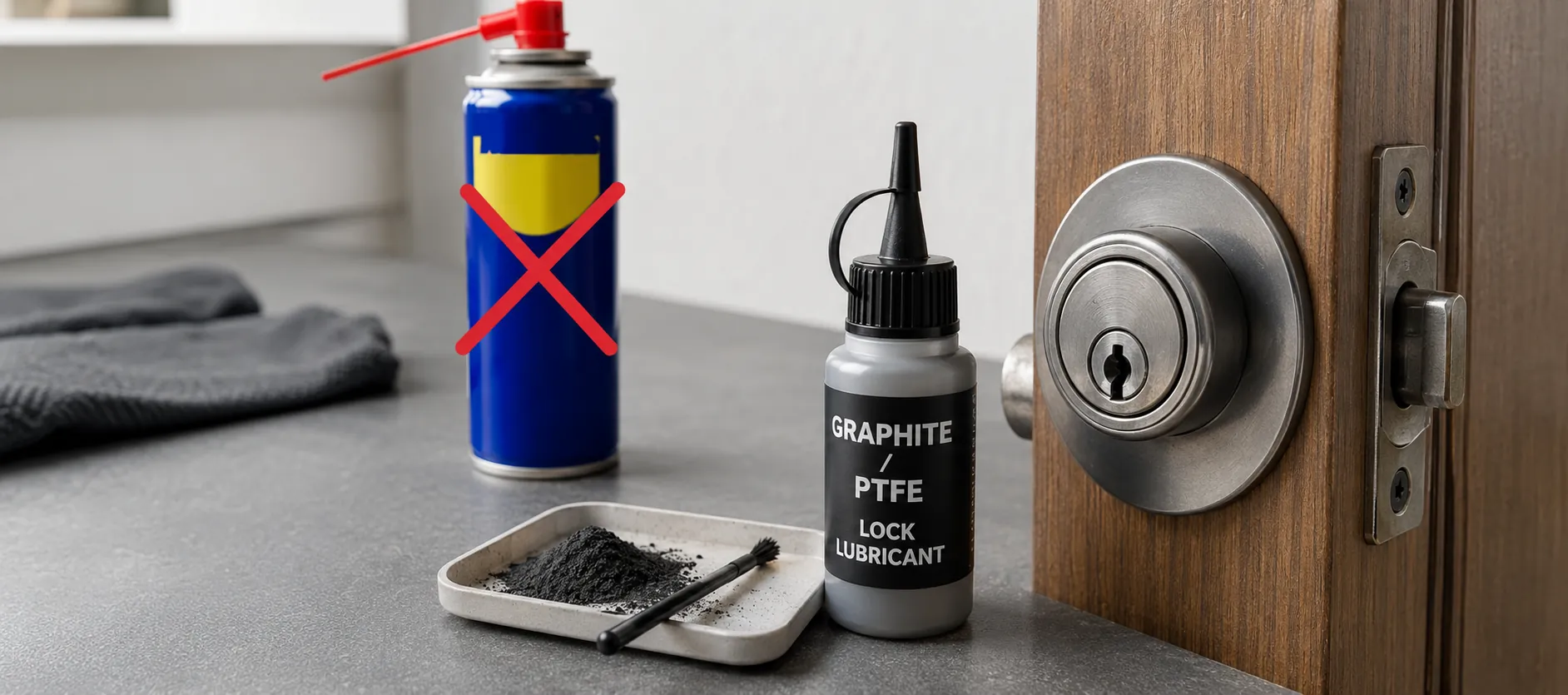
Plain talk, because I have to open up this mistake every week: do not use WD-40 or oil on your locking cylinder. Never. That is not a lubricant for a lock, it is a creeping oil, and it gums up inside into a sticky film that binds dust and clogs the pins. What you actually lubricate with: graphite or a lock spray based on PTFE, that is Teflon. That is it. No magic involved.
I work the night and weekend shift in Frankfurt. It feels like every third sticking cylinder I open at two in the morning is caked with the wrong can. And almost always it was well meant.
The short answer, if you are in a hurry
- Right: graphite powder or PTFE lock spray. Dry, no dust binder.
- Wrong: WD-40, sewing machine oil, gun oil, chain spray, vaseline, cooking oil. Anything that goes sticky after a few weeks.
- How often: once a year is enough. Before winter is a good time.
- How much: a short burst, not half the can.
If you only read this and act on it, you save yourself my night surcharge. Honestly.
Why oil and WD-40 slowly kill a lock
A profile cylinder is fine mechanics inside. Tiny, spring-loaded pins sitting in two rows that have to be brought to exactly one height when you turn the key. These pins need a lubricant that attracts nothing. It has to be dry.
Oil and creeping oil do the exact opposite. At first it feels great, the key slides, everyone is happy. But oil is thin and sticky at the same time, it pulls in dust, lint, street grime and pollen. After a few months you have a tough paste in the cylinder that blocks exactly what it was meant to protect. In winter moisture joins in, the whole thing tightens up, and the cylinder seizes.
WD-40 on top of that is not even a real lubricant, it is a creeping and rust solvent. Part of it evaporates and leaves a sticky residue behind. Great for a rusted screw on the garden gate. A time bomb in a locking cylinder.
The word every locksmith hates: resin
Gumming up is the technical term for what happens. The oil oxidises over time and turns sticky like an old honey jar. I then poke around in the cylinder with a probe and pull out brown crumbs. That is not normal wear, that is homemade. And the bitter part: often the cylinder is still mechanically fine, just glued up inside. Cleaning is possible, but it costs time, and at night time costs money.
What to actually use, concretely
There are exactly two things that belong in a cylinder.
Graphite powder. The classic. Available at the hardware store for three to five euros a can, lasts forever. Completely dry, binds no dirt. A little into the keyhole, key in, turn a few times. Downside: it is black and can rub off on the key if you overdo it.
PTFE or Teflon lock spray. From a specialist shop, five to ten euros, made for cylinders. Brands like ABUS or Burg-Waechter have their own cans for this, labelled "lock" or "cylinder spray". A short burst into the keyhole, work the key a few times, done. Cleaner than graphite, a bit pricier.
Both work. In the van I use the PTFE spray, because it is faster and does not rub off. At home graphite would do fine too. The basics of care, when and how often, are covered in detail in maintaining a lock so it lasts.
A trick from the trade
Treat the key, not just the hole. Rub a little graphite on the teeth or spray briefly onto the key, then insert it five or six times and pull it out. That spreads the lubricant exactly where the pins run. It is cleaner and more even than chasing half the can into the hole. And with graphite, less is more. Too much powder clumps over time just the same, only dry.
Locked out and in a hurry?
Price quoted up front, vetted partner business, ~22 minutes on site.
Two stories from the night shift
Last month, Saturday night, a customer in Sachsenhausen. The key would not move a millimetre, neither in nor out, and he stood at his own door with the shopping bag. Talking it through, it came out: two weeks earlier he had sprayed WD-40 in himself because it was catching a bit. Result: total seizure. I pulled the cylinder, soaked it in brake cleaner, blew it through, treated it with PTFE, and it ran again. 130 euros night surcharge, which he could have saved with a four-euro can of graphite.
Different job, two weeks ago in Bornheim. An older lady, apartment door, the key still turned but heavily, and she was afraid she would one day not get in. She had done nothing wrong, the cylinder was simply ten years old and never cared for. A short burst of PTFE and five turns through fixed it. Ran like new. Cost me ten minutes, and I only charged her the call-out, because it almost felt embarrassing. Sometimes it really is that simple.
If the key turns loose instead and nothing grips, it is not a lubrication issue but usually the cam inside the cylinder. Everything on that is in the key turns but does nothing. Please do not go at that with spray, it does not make it better.
What you must never do
- No oil, no WD-40, no gun oil, no sewing machine oil. Even if the neighbour swears it works.
- No grease, no vaseline. That binds even more dust than oil.
- Do not force the cylinder round when it sticks. You will snap the key off, and then we are talking about a replacement instead of four euros of powder.
- Do not relubricate every month. Once a year is enough, anything else is a waste of material.
- Do not mix graphite AND oil. The combination becomes a black smear that I only get out with a full removal.
When lubricating no longer helps
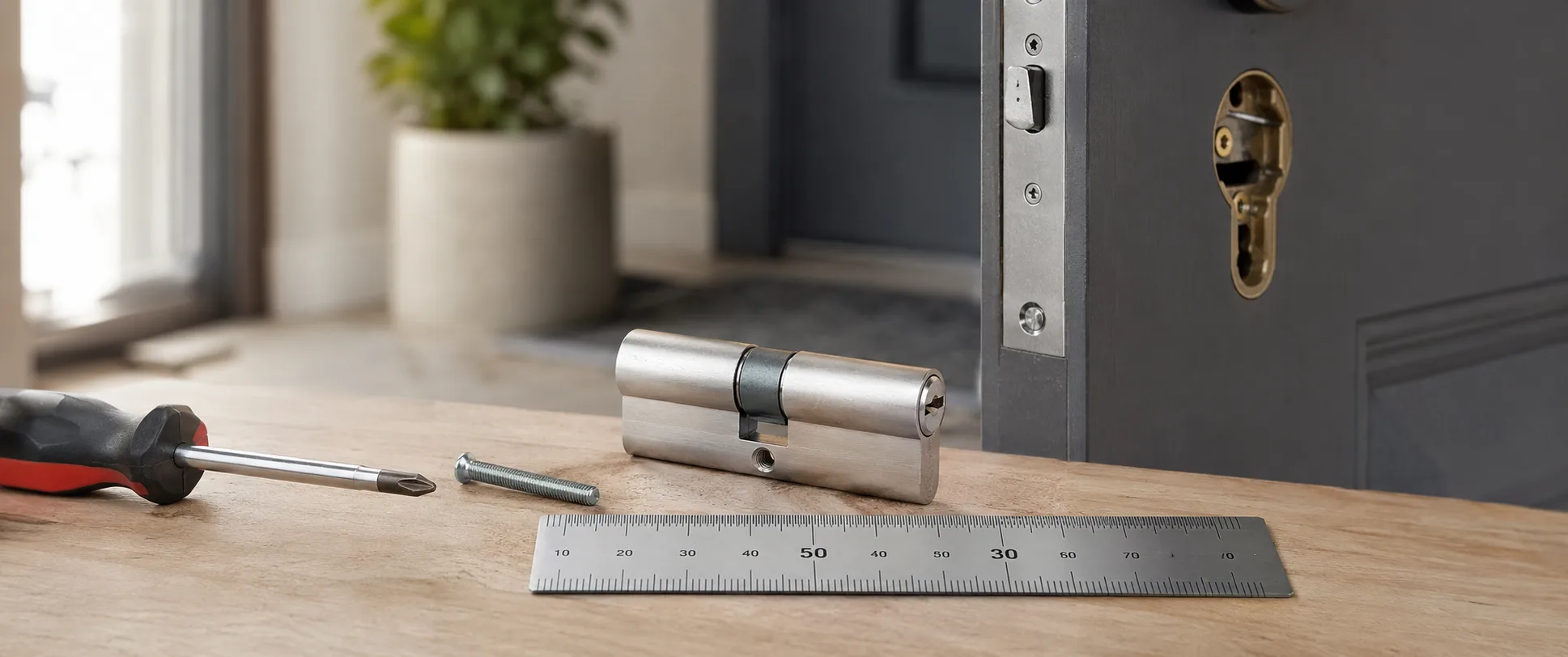
Sometimes the cylinder is already worn inside or ruined by old oil, and no spray will help. If the key still catches after cleaning and PTFE, the mechanics are done. Then a replacement is due, and that is no wizardry: a standard cylinder costs 15 to 40 euros as a part, a good security cylinder with anti-drill protection per DIN 18252 more like 60 to 150 euros, plus the fitting. What that costs with us you can see transparently in our pricing; the swap itself we do through lock replacement.
And if nothing works at night, the key is stuck and you cannot get in, then that is exactly my job. The emergency service is reachable around the clock, and I name the price on the phone before I drive out. Anyone who does not do that, steer clear.
Quick questions, quick answers
Is WD-40 really a total no? Yes. Once briefly might work, but you lay the groundwork for gumming up. Leave it.
My key squeaks, is that bad? Squeaking is usually just dry friction. A short burst of PTFE, done. Squeaking is the lock asking for care.
Door lock or cylinder, is that the same? For care, yes, the cylinder is the heart. Moving parts like the latch and bolt on the lock body can take a tiny bit of acid-free grease, but inside the cylinder it stays dry.
What about the mailbox or the padlock outside? Out there with moisture I use PTFE too. Graphite pulls water in the rain and the powder turns to mush. For a padlock on the cellar or garden gate in Niederrad, PTFE is the safe choice.
Can I clean the lock myself if there is already oil in it? A bit. Spray some brake cleaner into the hole, pull the key through twenty times, blow it out, let it dry, then PTFE on top. If it still catches afterwards, the cylinder is done, no home remedy will help.
Is graphite or PTFE better? Both are fine. Graphite is cheaper and lasts longer in a dry indoor door. PTFE is cleaner, faster and better outdoors in the wet. I would not lose sleep over the choice. The mistake is only ever the oil, not which of the two dry products you pick.
How do I know my cylinder just needs lubrication and not a swap? Simple test. If the key turns harder than it did a year ago but still works, that is dryness, lubricate it. If it grinds, jams halfway or only turns in one position, that is wear or damage, and spray will only mask it for a week before you are locked out.
Bottom line: the right can costs a few euros, the wrong one costs you the cylinder and an emergency call at two in the morning. Graphite or PTFE, never oil or WD-40. That simple, and so often done wrong.